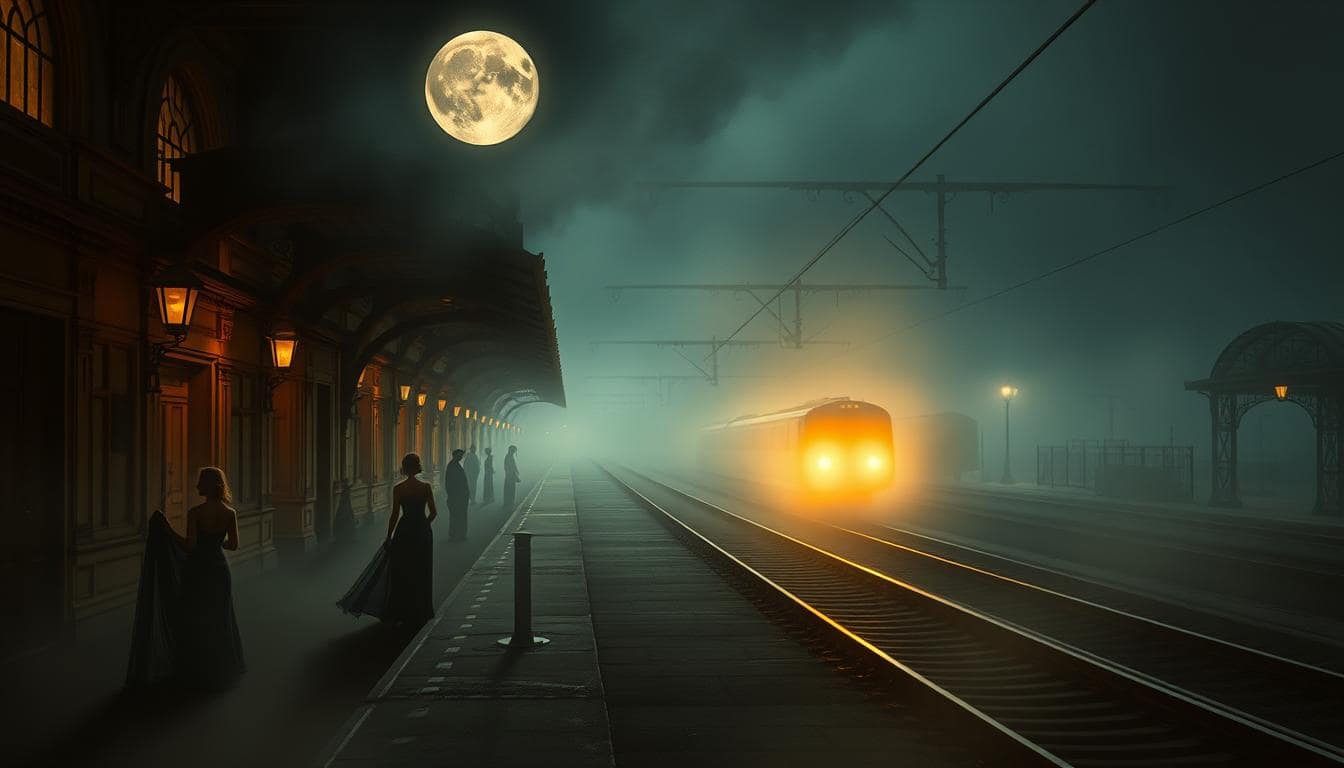
Imagine a moonlit station where nude women board phantom trains. Skeletons check pocket watches. Welcome to the dreamscapes of Belgium’s most rebellious surrealist. He painted like Freud’s subconscious playing chess with Magritte.
Christie’s 2025 Surrealist Evening Sale is more than an auction. It’s a séance for the movement’s quiet disruptor. Delvaux’s works from 1936-1956 will be on display.
Delvaux was a ghost at a manifesto party, close to André Breton but not bound by his rules. His paintings are haunting, making Dalí’s clocks seem like wristwatch ads. The question is: Can you define surrealism while ignoring its high priests?
His canvases whisper secrets Breton’s crew shouted. The railway tracks are more than childhood nostalgia. They’re Freudian psychodramas in steel. The somnambulant women are surrealist revolutionaries in plain sight.
While others chased shock value, Delvaux built a symbolic lexicon. It decodes our midnight anxieties. Christie’s is spotlighting these enigmatic works, leaving us to ponder: Did surrealism need an outsider to truly map the unconscious?
Early Classical Roots
The Académie des Beaux-Arts might seem odd for a Surrealist like Delvaux. Yet, his architectural skills opened doors in the art world. While others drew perfect columns, Delvaux infused his Brussels scenes with unease. Shadows stretched, trams moved through empty spaces, and buildings seemed skeletal.
His 1920s works are like M.C. Escher prints for the soul. At first, they look like normal city views. But, upon closer inspection, windows turn into empty eyes, and streets become chessboards of fear. His training was a strategic disguise, allowing him to sneak past art world barriers.
Dalí was bold and open in his rule-breaking. Delvaux, on the other hand, was subtle. He showed how strange the world already is. Their styles reflect the difference between Belgian surrealist’s evolution and André Breton’s Parisian show.
Delvaux’s rebellious phase came after mastering classical art. His architectural skills turned into a surrealist language. The key to innovation? Using established rules to your advantage.
Symbolist to Surrealist Transitions
What does an art historical heist look like? For Paul Delvaux, it was taking Symbolism’s dark mystery in the 1930s to fund Surrealism’s wild rebellion. It was like a moonlit heist, where moonlit nymphs turned into enigmatic figures in bowler hats. Classical ruins became train stations with naked philosophers lurking.
The 1934 Minotaure exhibition was a turning point for him. Surrealist poets like André Breton and Paul Éluard shared their dream-filled manifestos. Giorgio de Chirico’s metaphysical art hinted at empty spaces and faceless clocks. Delvaux didn’t just copy; he remixed these ideas.
His women were both mysterious sphinxes and everyday commuters. They wore silence but screamed satire through their empty eyes.
Enter Edward James, a British patron who supported Salvador Dalí and Magritte. James didn’t just buy Delvaux’s art; he built Monkton House in Sussex. Christie’s said it was more than a home—it was a collaboration.
- Magritte’s Influence: Bowler hats as Trojan horses mocking middle-class conformity
- De Chirico’s Ghost: Infinite corridors where time collapses into haunted geometry
- Surrealist Poets: Words became brushstrokes, framing Delvaux’s canvases as visual sonnets
Delvaux’s shift wasn’t a complete change—it was a Belgian surrealist trick. He kept Symbolism’s sadness but added train tracks to its velvet curtains. Magritte is known for apples and pipes, but Delvaux’s work thrives in mysterious places. These are stations where trains never come, temples where skeletons talk philosophy, and women who are both inspirations and spies.
Delvaux’s Thematic Concerns
What does it mean when a painter’s women seem to sleepwalk through their own canvases? Paul Delvaux’s surrealist muses, 70% of his figures, float through train stations and moonlit forests like ghosts. Their frozen poses suggest arrested development, caught between classical ideals and modern unease.

Delvaux’s Wax Venus was inspired by the Spitzner Museum’s oddities. These figures glow with eerie perfection, their marble skin contrasting sharply with the clothed men. In The Awakening of the Forest, nude women recline like ivy, while suited gentlemen stalk through the foliage. It’s a mix of Eyes Wide Shut and The Lion, the Witch and the Wardrobe.
But are these women trapped by the male gaze, or are they critiquing it? Compare Delvaux’s nudes to Leonora Carrington’s alchemical heroines or Dorothea Tanning’s feral brides:
| Artist | Female Representation | Setting | Symbolism |
|---|---|---|---|
| Paul Delvaux | Statuesque, silent | Abandoned stations | Moonlight as voyeur |
| Leonora Carrington | Alchemists, shape-shifters | Mystical kitchens | Cauldrons as power |
| Dorothea Tanning | Feral brides, rebels | Surrealist bedrooms | Doors as portals |
Delvaux’s dreamscapes are more than just nightmares—they’re tests for gender politics. Those vacant stares could be a critique of societal expectations or a sign of the male imagination’s laziness. The train tracks in his paintings might not lead anywhere, or they might be heading straight to today’s culture wars.
Does eerie beauty have a critical message? The Wax Venus has been waiting silently for 80 years, waiting for us to ask.
Main Techniques & Subjects
If Surrealism had a stage director, Delvaux’s brush would be its most meticulous choreographer. His method acting approach to painting treated architectural sketches like Broadway set designs and nude models as actors awaiting direction. Think De Chirico meets Hitchcock—every colonnade and railway track meticulously plotted to mess with your perception.
Let’s dissect La Rue de Tramway like art-school surgeons. Those converging tracks aren’t just perspective lines—they’re psychological vanishing points dragging viewers into existential limbo. The genius? Making industrial infrastructure feel more intimate than a lover’s whisper through forced perspective techniques borrowed from Renaissance frescoes.
His toolkit revealed:
| Technique | Visual Effect | Psychological Gut-Punch |
|---|---|---|
| Linear Perspective | Depth stretching to infinity | Cosmic loneliness |
| Cinematic Lighting (see Nuit de Noël) | Moonlit chiaroscuro | Dreams made tangible |
| Skeleton Studies | Bones in business suits | Modernity’s memento mori |
Art students—take notes. Delvaux’s train motifs aren’t just nostalgic props. They’re existential timetables asking: “Next stop—desire or despair?” The man turned railway tracks into Freudian slipways, where steam engines chug through collective unconsciousness.
And those skeletons lounging in parlors? A cheeky danse macabre for the atomic age. While Dalí melted clocks, Delvaux gave mortality a front-row seat to modernity’s parade—bone structures posed like fashion models at a noir photoshoot.
Relationship with Contemporaries
Was Paul Delvaux the art world’s ultimate “it’s complicated” relationship? Breton called him “the most poetic painter alive,” but Magritte saw his nudes as “sleepwalking mannequins at a train station clearance sale.” Delvaux’s career was a surreal dance—admired by the movement’s founders, yet never fully welcomed to their circle.
Edward James, a patron of both Dalí and Delvaux, treated them like rival siblings. He funded Dalí’s lobster telephones and bought Delvaux’s moonlit railway visions. Shared collectors created accidental alliances, but stylistic differences were deep. Dalí used shock (melting clocks, ant-covered faces), while Delvaux traded in quiet unease—his women stared through viewers like haunted subway passengers.
The Surrealist group history reveals fascinating tensions:
- Breton praised Delvaux’s “architectural dreams” but vetoed his official membership
- Magritte’s snarky critiques masked professional jealousy (Delvaux outsold him in the 1940s)
- Shared motifs with Remedios Varo’s clockwork women, yet none of her occult flair
Even Yves Tanguy’s barren landscapes feel like Delvaux’s train stations after an apocalypse. But here’s the kicker: while Dalí’s biography reads like a PR stunt factory, Delvaux lived his surreal visions. He painted in a studio filled with model trains and anatomical skeletons.
| Artist | Surrealist Cred | Patron Play | Legacy Quirk |
|---|---|---|---|
| Delvaux | Breton-approved outsider | Edward James’ railway obsession | Real-life studio as installation art |
| Dalí | Expelled showman | James’ lobster phase | Mustache as performance art |
| Magritte | Core member | Minimal wealthy patrons | Corporate logo inspiration |
So was Delvaux the Surrealists’ favorite unofficial member? Or just their “he’s not like other girls” artist crush? The answer lies in his 1944 masterpiece “The Great Sirens”—a painting so perfectly unsettling, even Breton’s manifestos couldn’t contain it. Sometimes, the best way to belong is to refuse the clubhouse entirely.
Signature Works
Delvaux didn’t just paint dreams – he built railways to them. Take La Ville Endormie, where moonlight turns into liquid mercury around crumbling temples. This 1938 masterpiece is more than surrealism; it’s a blueprint for dreamscapes.
It features ghost stations where classical nudes wait for trains that never come. Art professors use this work to show how architecture can be a form of psychological theater.

| Work | Machinery | Mood | Hidden Track |
|---|---|---|---|
| Les belles de nuit | Steel factories | Industrial anxiety | Clockwork ovaries |
| Nuit de Noël | Vintage locomotives | Nostalgic yearning | Ticket booth to childhood |
Delvaux’s 1950s skeleton Christs crucified beside Belgian rail yards are a big deal. Critics were shocked by these bone-yard epiphanies, missing their genius as postwar protest art. Those rattling ribcages weren’t blasphemy – they were existentialist timetables asking “Next station: annihilation or redemption?”
Three reasons these works are a hit in classrooms:
- The Hitchcock factor: Every composition feels storyboarded by the Master of Suspense
- Temporal whiplash: Roman ruins sharing track space with steam engines
- Feminine gaze reversal: His nudes aren’t objects – they’re engineers of the uncanny
Delvaux’s true brilliance? Making trains the ultimate surrealist device – iron horses charging through our collective unconscious. Who needs Freudian couches when you have third-class compartments filled with archetypes?
Later Life and Honors
How does a surrealist rebel become a national treasure? Delvaux’s later years show how to challenge the system. By the 1970s, he was Belgium’s beloved artist, known for his unique style. He even got to design Brussels metro murals.
Imagine seeing his moonlit figures on station walls as you rush to your destination. It’s surrealism in the subway. Delvaux found this ironic.
“They want my nightmares in mosaic?” he joked about the metro project. Yet, his 1969 designs became surreal gems in the city. The establishment that once shunned him now celebrated his work.
| Year | Milestone | Cultural Paradox |
|---|---|---|
| 1981 | Warhol’s portrait series | Pop art meets Belgian surrealist |
| 1986 | Royal Academy honor | Former outsider becomes academician |
| 1994 | National foundation | Lifetime rebel gets state-funded archive |
Andy Warhol’s 1981 portrait of Delvaux shows his duality. Delvaux’s face is set against a Warholian background. It’s a mix of the avant-garde and the elder statesman.
By his death at 96, Delvaux had outlived surrealism. He received many honors, a testament to his enduring legacy. Yet, he continued to paint his haunting scenes. The stations were public, but his nightmares remained private.
Influence & Critique
What do J.G. Ballard’s dystopian highways and David Lynch’s velvet-curtained nightmares owe to a Belgian painter? Paul Delvaux was obsessed with moonlit train stations. His dreamscapes predicted 20th-century unease and ghostwrote the visual language of existential dread.
The feminist critique of Delvaux’s Women in surrealism is complex. His nude figures seem like frozen sirens. But compare them to Claude Cahun’s gender-bending self-portraits or Eileen Agar’s playful collages. Suddenly, Delvaux’s muse is seen as an oracle, reflecting our discomfort with the male gaze.
Modern creators keep drawing from Delvaux’s work. Takemitsu’s 1975 symphonic tribute Marginalia brings Delvaux’s visual silence to life with trembling strings. Instagram’s #SurrealArt hashtag is full of train-obsessed digital artists who never knew his name. Even TikTok’s 15-second clips pause for his tableaus, feeling radical in our fast-paced world.
Delvaux’s greatest legacy might be what he refuses to explain. In a time of quick explanations, his paintings remain mysterious. Those railway tracks leading nowhere? They’re not just surreal – they’re the original algorithm, chugging eternally through our collective subconscious.
Conclusion
Paul Delvaux’s Delvaux trains continue to haunt our minds, even 30 years after his passing. The 2025 Christie’s sale of La Gare Forestière shows his work’s lasting impact, with an estimated value of £2 million. His unique blend of the eerie and the erotic remains unmatched by today’s AI.
Delvaux’s work stands out because it’s hard to understand. His ghostly trains and glowing figures are more relevant today than ever. They capture the tension between desire and fear in a way that feels both timeless and urgent.
Three museums hold the keys to Delvaux’s world: Brussels’ Musée Delvaux, Paris’ Pompidou, and New York’s MoMA. Standing before L’Aube or Sleeping Venus, you’ll feel a sense of familiarity. This feeling is why his art continues to captivate us. His work invites us to explore the unknown.