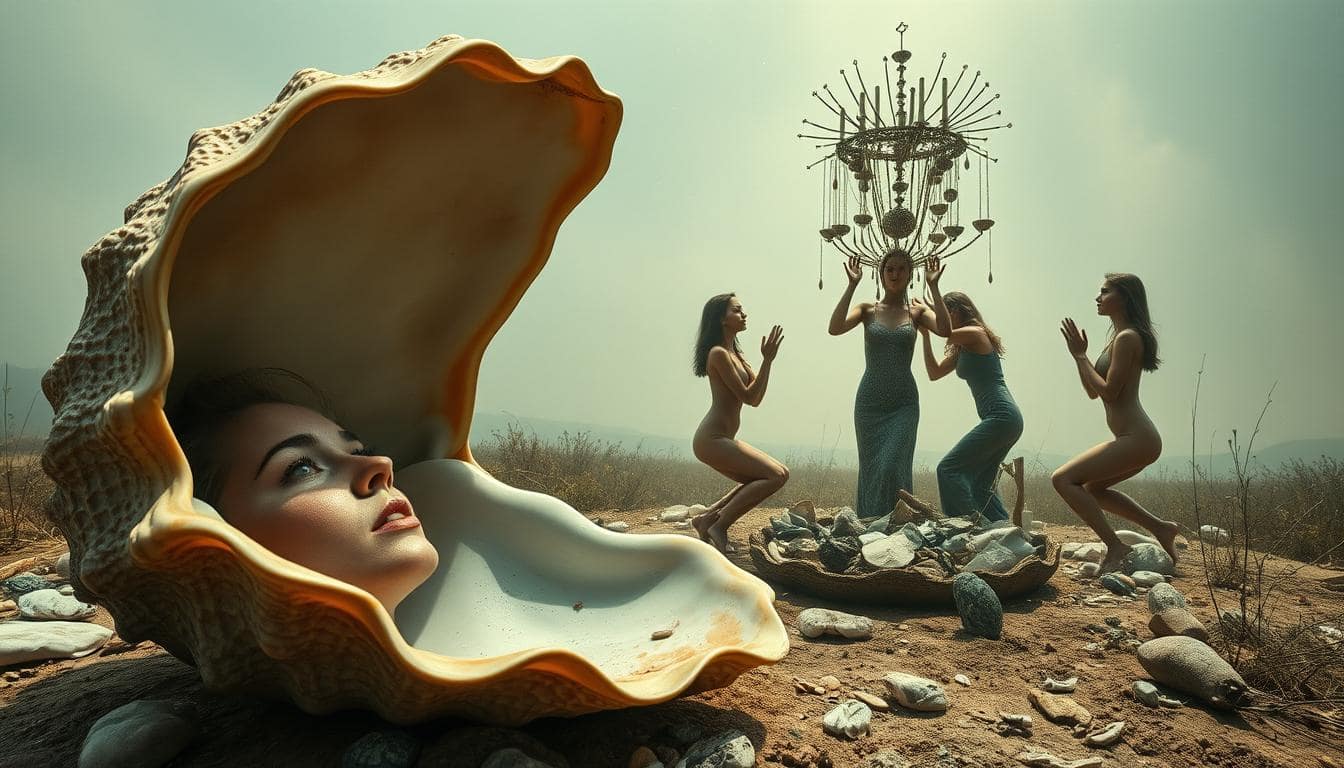
In 1936 Britain, a hat made of lobster claws and mussel shells caused a stir. Eileen Agar’s “bouillabaisse headpiece” at the International Surrealist Exhibition was seen as shocking. The society, known for its tame surrealism, was shocked by a woman using marine detritus as a statement.
Agar’s Angel of Anarchy was a sculptural dream wrapped in velvet and seashells. It showed what the headlines missed. While men mythologized muses, Agar turned beach finds into feminist messages. Her work, decades before Damien Hirst, brought rebellion to England’s art scene.
Why do we remember André Breton’s circle more than Britain’s surrealists? Agar’s work asked tough questions. Her shell-encrusted pieces were not just found objects. They were landmines that challenged gender norms with absurdity.
Today, Agar is seen as surrealism’s mermaid. She’s half in movement history, half resisting labels. As we look at her marine relics, we wonder – did British art ever catch up to her radical ideas?
Childhood and Creative Roots
Eileen Agar’s artistic journey began with a mix of coastal chaos and family heritage. Born to an Argentinian heiress and a Scottish industrialist, she grew up between Buenos Aires and English seasides. This upbringing gave her a unique “tidal aesthetic”, blending South American vibrancy with British eccentricity.
As a six-year-old, Agar collected cockle shells, unaware they’d become her surrealist symbols. These shells would later hold deep meaning in her art.
Beach walks were more than just fun for Agar. They taught her to see the world differently. While others saw driftwood, Agar saw the influence of Marcel Duchamp’s ready-mades.
Her 1927 self-portrait, with its angular brushstrokes, mirrors the edges of shattered seashells. This work shows a subversive side, challenging traditional art forms.
Freudians might see her shell obsession as a sign of daddy issues. But Agar’s art was often about making a bold statement. Like gluing a starfish to a canvas and making critics deal with it.
Agar’s creative process was like automatism, but with a beachy twist. Beachcombing was her way of finding accidental poetry in nature’s debris. A cracked ammonite fossil was more than a rock; it was a collaboration with the Jurassic period.
This approach electrified her work with British surrealists. It turned everyday objects into profound statements.
What made Agar stand out among surrealist poets and writers? She treated mythology like a collage. Her assemblages, with shells draped over classical amphoras, were not just juxtapositions. They were time travel with a sense of humor.
Her works say: “The Minotaur probably collected seashells too, you know.” This shows her ability to blend the old with the new in a playful way.
British Surrealist Group Membership
The 1936 International Surrealist Exhibition was more than just an art show. It was Agar’s introduction to a world of chaos. Roland Penrose and Herbert Read practically drafted her into the British surrealists after a studio visit. She joked: “Joining them felt like being handed a script written by someone who’d never met me.”
Agar became Britain’s most celebrated female surrealist while openly mocking Breton’s dogma. This was a cultural shock:
- Parisian surrealists: Obsessed with Freudian analysis and automatic writing
- British contingent: Preferred tea-stained collages and seashell metaphors
Her affair with Paul Éluard, a poet and communist, was a turning point. Through conversations and debates, Agar learned from Parisian theory. Yet, she kept her distinctly British surrealism. This mix led to works like “The Angel of Anarchy”, a rebellious piece against Breton’s strict rules.
André Breton’s biography shows a strict side that clashed with Agar’s playful style. While his manifestos called for “the absolute non-conformism of thought,” Agar used photography with rocks and feathers. Their disagreement reached a peak at the 1936 exhibition, where Agar’s works outshone French artists. Breton even called England “the most surrealist country” begrudgingly.
Agar later said: “We fought the Parisians with wit instead of manifestos. Our weapons? A perfectly placed lobster telephone or an ill-timed sneeze during their lectures.” The British surrealists’ biggest trick? Showing you could challenge the patriarchy without being too serious.
Agar’s Art: Paint, Collage, and Photography
Eileen Agar didn’t just make art—she created tactile symphonies. Starfish danced with Roman pottery shards in her studio. Unlike male surrealists like Max Ernst, who explored Freudian nightmares, Agar mixed “bric-a-brac alchemy” in her work.
Her 1939 Marine Object was more than a piece of art. It was a challenge to artistic norms. It showed that art could be more than just pretty pictures.
Why choose Ernst’s gritty textures or Miró’s dreamy biomorphs? Agar glued a starfish to a classical urn. Her collages were a 3D rebellion.
- Tactile over theoretical: She focused on texture—like sand, shells, and fabric—over deep meanings
- Feminist subversion: She turned everyday objects into symbols of power (her Ceremonial Hat for Eating Bouillabaisse mocked old rituals)
- Photographic wit: Her camera turned beach trash into magical worlds
Dalí melted clocks, but Agar’s Quadriga collage mixed horse figurines with seashell chariots. It was a playful challenge to the big, bold surrealist works. Her photography was like a coastal scavenger hunt, blending Georgia O’Keeffe’s style with Marcel Duchamp’s wit.
This wasn’t just art-making. It was tactile philosophy. Agar showed that a woman’s hands could change the art world. Her work made us think about our place in the universe in new ways.
Feminist and Mythic Influences
Eileen Agar flipped the surrealist script, using seashells as weapons and mythology as a form of rebellion. Unlike André Breton, who policed surrealism, Agar and her fellow women surrealists created their own space. Her 1936 Angel of Anarchy was a powerful critique of patriarchal norms.
Comparing Agar to Leonora Carrington is like comparing lightning to thunder. Both artists reshaped reality, but in different ways:
| Eileen Agar | Leonora Carrington | Remedios Varo | |
|---|---|---|---|
| Mythic Language | Mediterranean goddess energy | Celtic witchcraft | Alchemical puzzles |
| Feminist Strategy | Collaborative assemblages | Solitary symbolism | Esoteric coding |
| Patriarchal Response | “Let’s exhibit her…but not take her seriously” | “She’s hysterical (in both senses)” | “Charming decorative madness” |
Breton’s 1929 Second Manifesto called women “lyrical objects.” Agar turned the tables, making men objects in her 1940 photographs. Her shell collections were clever critiques of biological essentialism.
Agar’s feminism was revolutionary because of how she distributed power. Unlike Carrington’s gothic biography, Agar focused on building networks and mentoring artists. She made collectivity seem more appealing than individual genius.
Today, when male curators praise Agar’s “playfulness,” they’re missing the point. Her beachcombing assemblages were not whimsical but powerful messages. Each glued-down seashell carried a message: “The tide always returns. And so do we.”
Collaboration with the International Group
Eileen Agar didn’t just network; she created a surrealist circus. Picasso photobombed her beach days, and Dali showed up fashionably extra. Her circle included Paul Nash and Dylan Thomas, known for their avant-garde chaos.
But it was her work with the International Group that really changed things. They made surrealism more playful and subversive.
In 1937, Agar met Picasso in Saint-Tropez. Despite his dislike of cameras, she captured him laughing on the beach. This showed her unique way of working with others.
Her collaborations with Yves Tanguy and Paul Delvaux were unexpected. Tanguy’s landscapes were alien, and Delvaux’s scenes were eerily quiet. Agar brought humor with her collage work, like mermaids with Dali’s clocks.
| Artist | Style | Agar’s Influence |
|---|---|---|
| Yves Tanguy | Otherworldly geology | Added organic textures |
| Paul Delvaux | Haunting urban silence | Introduced seashell motifs |
| Julien Levy | Gallery curation | Pushed photographic boundaries |
In 1938, Julien Levy Gallery in New York showed Agar’s work. This made her a key figure in surrealism. Her photomontages, like seashell bras and lobster phones, were seen as “party tricks” at first.
But soon, people saw her work as a new way to view surrealism. It was a cultural shift, blending styles in a unique way.
Agar’s collaborations were more than just mixing styles. They were a way to challenge the status quo. Why fight the rules when you can just dance around them?
Major Exhibitions and Honors
In a world obsessed with Dalí’s clocks and Magritte’s pipes, Agar’s art dared to ask tougher questions. Her 1936 London debut was met with critics calling her Fish Hat a “novelty act.” It felt like surrealism’s version of being stuck in the circus freak tent. At the same time, male peers’ works were displayed in the main gallery like sacred relics. But history loves a plot twist.

Then, in 1988, the Whitechapel Gallery gave Agar a retrospective. Her seashell assemblages and photo-collages were treated like sacred relics. Curators framed her work as a radical counterpoint to surrealism’s boy’s club. (Fun fact: Dalí’s Persistence of Memory gets more merch deals, but Agar’s Bride of the Sea actually made viewers rethink reality.)
Here’s the delicious irony—while the Salvador Dalí biography crowd fixates on melting watches, Agar’s work asked: “What if art isn’t about answers?” Her 1936 show shared walls with Magritte’s Ceci n’est pas une pipe, yet only Agar’s pieces truly embodied that subversive question. Galleries called it “quirky” then; we call it visionary now.
The honors rolled in late but landed hard: Arts Council awards, a Tate acquisition, even a surrealist stamp collection feature. For women in surreal art, Agar’s journey from punchline to pantheon remains the ultimate mic drop. Next time someone name-drops the René Magritte biography at a cocktail party? Casually mention Agar’s 1940s photographic experiments. Watch their monocle pop.
Influence in Museums/Education
Why do art classes make Agar’s marine assemblages seem simple? Museums show her work as just a small part of their collections. Her seashell collages are seen as a gateway drug for teaching about found object art. They’re great for explaining “how to make trash look expensive” to students who might not be fully awake.
- Subversion 101: Students learn to see her shell compositions as a way to question beauty standards.
- Political Archaeology: Classes discuss if her beachcombing was an early form of environmental activism.
- Surrealist Lab: Studio courses try to recreate her unique blend of wit and menace.
MoMA shows her as “Britain’s answer to Duchamp” in their postwar exhibitions. But, when her work is next to Hirst’s sharks, it’s clear what museums really value. Hirst gets the best spots, while Agar’s work is seen as just a decoration.
This shows how museums can be hypocritical. It’s why I love teaching “Agar vs. The Art Market.” Students learn how Surrealism and politics are separated in museum displays. Her bold coastal explorations are seen as “charming seaside curiosities.”
But here’s the amazing part: by the end of the course, every student defends Agar’s work. They see how the most groundbreaking art can be hidden in plain sight, looking harmless.
Conclusion
When Eileen Agar passed away in 1991, people saw her as Britain’s quirky surrealist aunt. But today, we see her in a new light. She was a visionary who found prophecies in seashells and fishing nets.
Her 1936 photo, Bride of the Sea, showed her vision of oceanic art. It asked if the ocean could help us. This was a bold idea for its time.
Now, Agar is seen as a key figure among women in surreal art. She used everyday crafts to make a statement. Her work with shells and driftwood was a form of craftivism, turning trash into powerful messages.
While men like Freud focused on dreams, Agar created Angel of Anarchy. It was a bold statement against the male-dominated art world. Her work was a call for change, wrapped in fabric.
The Surrealist legacy lives on, thanks to Agar. Artists like Tracey Emin and Bharti Kher carry on her work. Tate Britain’s 2023 show showed Agar’s beachcombing was more than just a hobby.
It was a form of radical fieldwork. Each shell she found was a challenge to traditional art. It asked why only urinals get to be seen as art.
Next time you find a seashell, remember Agar’s spirit. That spiral in your hand is a piece of her revolution. You’ve become part of her ongoing fight for change.