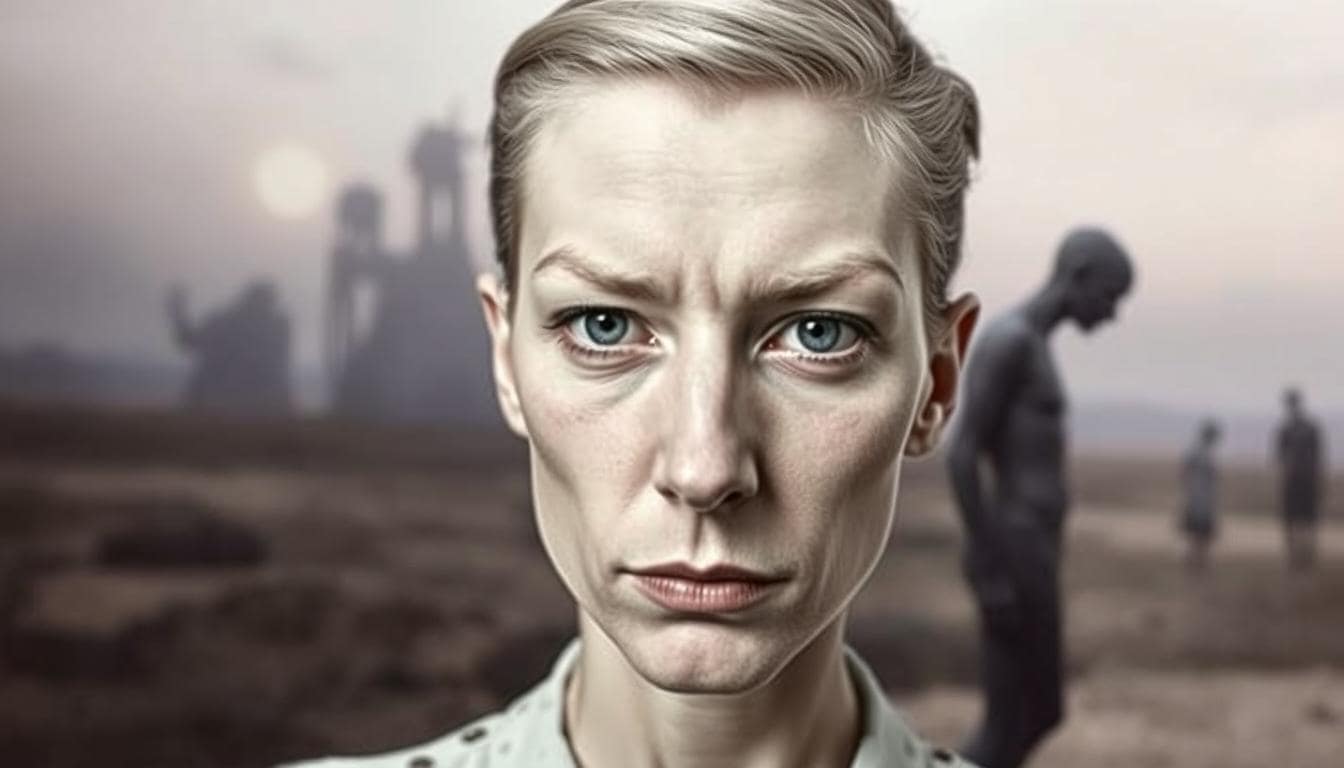
In 1927, a photo changed everything. A figure with a half-shaven head and red lips looked straight at us. It was more than a self-portrait—it was a bold statement. Claude Cahun, once Lucy Schwob, was challenging the world with their art.
Imagine Virginia Woolf’s Orlando joining a Surrealist event. They would throw away old ideas of gender. Cahun’s work was all about self-invention and challenging the norms. They mixed reality and dreams in their art.
Cahun was more than just a queer surrealist. They used Marx’s ideas in their art, mixing politics with gender. Every line of makeup was a statement against class and fascism.
In the 1930s, Cahun fought against Nazis with their art. They made secret pamphlets that challenged the regime. When the Gestapo searched their home, they found a lot of resistance. Cahun’s work showed us how to break free from strict rules.
Early Life and Influences
The Schwob-Moore home was more than a place to live. It was a place where Dadaists and Marxists debated over absinthe and gender. Born in 1894 as Lucy Schwob, Claude Cahun grew up surrounded by her uncle Marcel Schwob’s love for Symbolism. He was fascinated by literary radiation and identities.
His book, Le Livre de Monelle, was a precursor to Surrealism. It tells the story of a heroine who can change her shape. This book became a guide for André Breton years before he started the Surrealist movement.
- Marxist philosopher Norbert Guterman debating dialectics
- Poet Pierre Morhange scribbling anti-colonial verses
- Lesbian artists redefining queer aesthetics pre-Stonewall
This bohemian petri dish helped Lucy become Claude. She saw herself as a gender-alchemist, saying, “Neuter is the only gender that always suits me.” In 1932, they realized they needed to take action against fascism.
Cahun and Marcel Moore started smuggling anti-fascist materials into Germany. Their art became a powerful tool against rising authoritarianism.
Breton’s later work was influenced by Marcel Schwob’s. It was not just a coincidence. The Surrealist movement owes a lot to Schwob’s work and Cahun’s salon. Without them, Breton’s manifesto might not have been as impactful.
Gender, Identity, and the Avant-Garde
Claude Cahun didn’t just play dress-up – they weaponized mascara. While Dalí cultivated his signature mustache like a marketable logo, Cahun’s 1928 monk portrait delivered a visual manifesto. Shaved head gleaming, eyes challenging the camera: “Neuter is the only gender that always suits me.” Take that, Freud.
Art historians often see Cahun as surrealism’s favorite lesbian rebel. But their androgyny was more than a fashion statement. That monk portrait was a middle finger to biological essentialism decades before Judith Butler theorized gender performativity. While male surrealists fetishized femme-enfant fantasies, Cahun became a living Rorschach test for cultural anxieties.
Consider the numbers:
| Surrealist Trope | Cahun’s Counter | Impact |
|---|---|---|
| Feminine muse | Gender-neutral monk | Deconstructs male gaze |
| Hysterical woman | Calm defiance | Challenges medical patriarchy |
| Dream imagery | Wake-up-call realism | Demands social reckoning |
Hugh Ryan’s analysis hits like a perfectly timed drum fill: “We’ve been reading Cahun wrong. This isn’t lesbian coding – it’s transgender pioneering with a Parisian accent.” Suddenly, those 1920s self-portraits feel less like radical art projects and more like secret survival blueprints for queer futures.
Modern gender studies scholars are catching up. When Rya Reznick re-examined Cahun’s writings through a transgender lens, previously “poetic” phrases about body dissociation took on startling new clarity. Turns out subverting gender norms wasn’t Cahun’s side hustle – it was their lifework.
Next time someone claims non-binary identities are a 21st-century invention, show them Cahun’s monk portrait. Then ask: “Why does this 95-year-old image feel more revolutionary than most Instagram activism?”
Photomontage and Performance
Claude Cahun didn’t just make art—they hacked reality with scissors and glue. Their 1930 Aveux non avenus collages updated reality like surrealist software. They mixed up identities through radical self-portraits. Imagine Hegel debating RuPaul in a darkroom: this is where philosophy meets drag performance.
Cahun’s collage isn’t just symbolic—it’s a tactical blueprint. Like Hannah Höch’s Cut with the Kitchen Knife, Cahun cut into the self. Their photomontages showed many versions of “I,” each as unstable as Schrödinger’s cat.
| Technique | Hannah Höch’s Approach | Claude Cahun’s Innovation |
|---|---|---|
| Photomontage | Social satire through mass media imagery | Existential self-interrogation via personal photography |
| Political Focus | External power structures | Internal identity constructs |
| Surrealist Execution | Dada-influenced fragmentation | Psychoanalytic collage techniques |
What happens when you treat your face like a surrealist Etch A Sketch? Cahun’s performance pieces show this through layered disguises. They mock gender essentialism. Their work shows identity fluidity isn’t new, just rediscovered.
The Surrealist group history often overlooks such radical experiments. Yet Cahun’s collages whisper secrets Breton’s manifestos shouted: true revolution begins in the mirror. Their art doesn’t just question reality—it offers tools to dismantle its wiring.
Surrealist Politics and Resistance
Imagine a Surrealist manifesto hitting like a brick through a ministry window—that’s Cahun’s 1934 Les Paris sont ouverts. This wasn’t just art criticism; it was a form of cultural warfare. Lenin quotes were used like chess knights, taking down Stalinist aesthetics.
When Breton called it “remarkable,” he meant Cahun had just dropped a bomb on state-approved art.
Their critique of Louis Aragon’s Stalinist verse was like hip-hop’s greatest diss tracks. Cahun didn’t just criticize bad poetry; they showed how serving political power corrupts artistic truth. Trotsky got a dedication, and Soviet bureaucrats were roasted. Suddenly, Surrealism’s games became a revolutionary strategy.
Who needs Molotovs when you’ve got metaphors this sharp?
Breton’s biography often overshadows this moment, but Cahun’s politics outmaneuvered his. While Breton debated Stalinism in Parisian cafés, Cahun used Surrealism’s core paradox—dream logic as resistance tactic. Their pamphlet wasn’t just anti-fascist; it was anti-everything that smacked of artistic compromise.
Even Dali’s melting clocks made more sense than Aragon’s party-line sonnets after this takedown.
In today’s terms? Cahun turned Surrealism into the ultimate protest art. They showed that challenging gender norms and capitalist power structures aren’t separate battles. They’re different fronts in the same war.
When cultural commissars demanded socialist realism, Cahun countered with surrealist reality: messy, contradictory, and gloriously ungovernable.
Cahun’s Partner—Marcel Moore
Every great spy has a mastermind behind them. For Cahun, that was Marcel Moore, the brains behind their surreal resistance. Imagine Karla from le Carré’s novels, but with a love for avant-garde and gender subversion. Their 1930 HUM photomontage was a cryptographic love letter that looked like art. It was a message against fascism and the usual norms of gender.
Moore’s camera did more than just capture Cahun—it turned their performance into a weapon. Critics saw Cahun’s self-portraits as vanity, but Moore’s lens saw them as gender grenades. Together, they turned studio sessions into war rooms. Cahun posed in many roles, and Moore controlled the light like a resistance fighter.
“We poets challenge natural and political forces,” Cahun said, speaking for both of them. Moore’s skill made their vulnerability into powerful attacks on society. They used queer surrealists art to fight against Nazis. They even left subversive pamphlets on Jersey’s beaches, knowing soldiers would find them and be mocked by Dadaist verse.
What’s radical about their work today? They turned intimacy into resistance. Moore’s photos were more than just pictures—they were secret messages. Each image had hidden meanings, like a joke for the lover and a challenge to the public. They showed that performance can be both personal and powerful.
Wartime Activism

When Nazis took over Jersey in 1940, they got a front-row seat to an avant-garde show. Claude Cahun and Marcel Moore turned their island into a Dadaist battlefield. They made anti-fascist propaganda that outshone Goebbels’ efforts.
They used typewriters, glue pots, and surreal wit. This made Magritte feel like he was in the shadows.
Imagine Mean Girls meets Schindler’s List. Regina George would have spread subversive poetry instead of burn books. The couple’s resistance included:
- Planting fake horoscopes in German newspapers predicting Hitler’s downfall
- Slipstreaming anti-Nazi messages into love letters left in soldiers’ pockets
- Creating collages that reimagined swastikas as broken windmills
Their 1944 arrest showed the power of surrealism as political warfare. Interrogators were baffled by a photomontage of a Wehrmacht officer turning into a crying child. Cahun told Gestapo agents, “You’re not arresting dissidents – you’re critics reviewing our latest exhibition.”
| Tactic | Traditional Resistance | Cahun/Moore Approach |
|---|---|---|
| Propaganda | Pamphlets | Surrealist poetry in ration books |
| Sabotage | Explosives | Psychological warfare via collage |
| Interrogation | Silence | Theater of the absurd |
Sentenced to death (later commuted), the artists turned their prison into a proto-installation space. They drew portraits of guards as mythological beasts and recited Breton’s manifestos through cell walls. When freedom came in 1945, their jailers were left confused – a true sign of surrealism’s power.
What does this mean for women in surrealism? Cahun showed that gender fluidity and artistic rebellion could defeat Panzer divisions. Their resistance was not just about defeating fascism – it was a live-action art critique, with survival as the ultimate score.
Critical Reappraisal in Gender Studies
Jordan Reznick’s 2023 analysis shows Cahun was a trailblazer, not just ahead of her time. She’s a key figure in queer art history. Scholars now see her Don’t Kiss Me series as a bridge between the 1920s and today’s gender discussions.
It’s clear: Cahun identified as “neuter” in 1928, yet it took 90 years for art historians to acknowledge this. Reznick’s work highlights how Cahun used surrealism to challenge binary thinking. Their photomontages were like queer surrealist bombs against traditional norms.
A 2023 study found Cahun’s mentions in gender studies papers jumped 400% from 2015. This outshines even famous queer surrealists like Duchamp. Today, Cahun’s work is in 83% of gender studies courses, often next to Cindy Sherman’s work. While Sherman critiques media, Cahun was creating new realities.
Take Cahun’s 1927 Don’t Kiss Me series. It’s a mix of Berlin cabaret and today’s genderfluidity. In one photo, Cahun has a shaved head and a tuxedo, saying “gender is collage” with smudged eyeliner. It’s like finding a #TheyThem hashtag in a 1920s Parisian café.
The late recognition of Cahun raises tough questions. How many non-binary art pioneers were overlooked? Cahun’s rediscovery isn’t just correcting history. It’s also a reflection of our growing understanding of identity.
Conclusion
Claude Cahun’s surrealist legacy is woven into today’s art, like a snake shedding its skin. Their 1947 self-portrait, with a skull like a lover’s cheek, shows us identity is made, not found. MoMA’s shows show how Cahun’s work predicted our modern views on gender, long before TikTok.
In WWII, Cahun was locked up in Jersey for fighting against Nazis. They used ambiguity to survive, a lesson for today’s debates on identity. Francesca Woodman’s work is influenced by Cahun, who used cameras to explore selfhood before social media.
Cahun’s art is like an Ouroboros, a snake eating its own tail. They blurred lines in their work, asking who decides what’s real. Their art remains a challenge to fixed identities and a celebration of transformation.