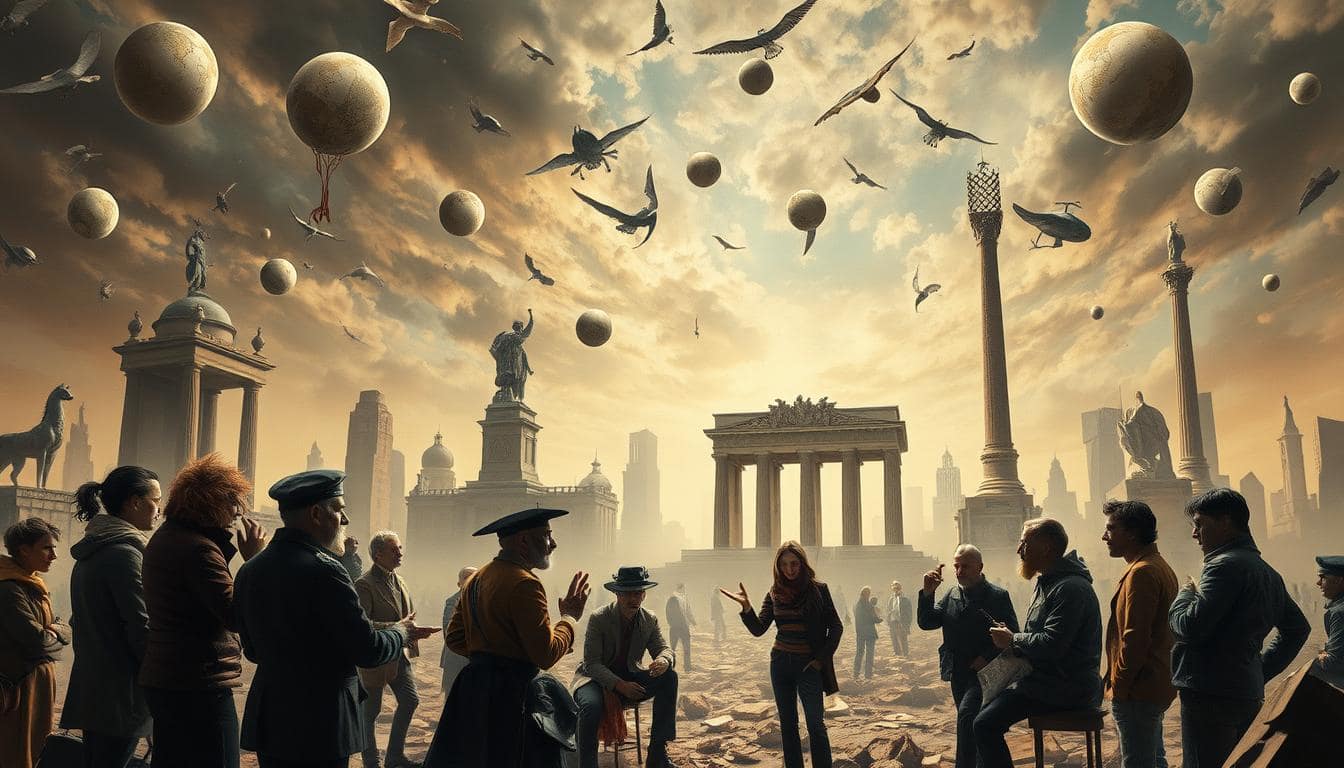
Imagine André Breton scribbling away in 1920s Paris. His cigarette ash fell on pages mixing Freud with communism. He didn’t just write about art; he created cultural grenades. His 1924 manifesto was a call to arms against reason.
What if you used dreams to fight against colonial and fascist powers? You’d get the most daring art group in history.
The surrealist movement was born from World War I’s ruins. Salvador Dalí’s melting clocks were more than weird art. They showed how shaky capitalism’s hold on reality was.
Breton’s group didn’t just create art. They staged “cultural sabotage” through writing and protests. They mixed Marx with Magritte, turning meetings into war rooms.
This wasn’t just about art. They stood against colonialism, like supporting Algeria’s freedom. But could art really change governments? Breton thought so, betting his life on it. His manifesto was a call to dream dangerously, turning galleries into battlefields for the soul.
Marxism, Anarchism, and Surrealist Ideology
When Marx’s ideas met Freud’s, surrealists mixed them into a unique blend. André Breton, once a French Communist, used his paranoiac-critical method to view politics through a distorted lens. Trotsky joined him, showing the year 1938 was full of surprises.
The manifesto “For an Independent Revolutionary Art” by Breton and Trotsky is complex. It shows the surrealists wanted to break reality, while Marxists aimed to change it. This mix led to strange moments, like Buñuel making L’Age d’Or with lottery money, critiquing the rich.
Surrealist writers, like Paul Éluard, believed everyone should write poetry. Breton even held séances to connect with Communist spirits. Their work combined deep political theory with the mysterious, like Das Kapital rewritten by Dalí under mescaline.
Three main points show how surrealists mixed art and revolution:
- Collective action vs. individual madness (see: Artaud’s asylum writings)
- Materialist analysis vs. occult symbolism (Breton’s obsession with tarot)
- Proletarian revolution vs. bourgeois art markets (Dalí’s later Gucci ads)
Their biggest legacy is showing art and revolution can coexist. Their failed plans inspired later movements, like Situationism. Buñuel showed, sometimes luck is needed to fund change.
Political Splits and Social Impact
Surrealism’s internal politics made reality seem dull by comparison. The 1936 London International Surrealist Exhibition was more than an art show. It was a psychoactive grenade aimed at the middle class. Visitors saw Salvador Dalí in a diving suit and Meret Oppenheim’s Object, a fur-covered teacup that challenged traditional roles. But beneath the surface, the movement was breaking apart like a Dadaist piñata.
André Breton, the self-proclaimed leader of surrealism, had the power to excommunicate. He kicked out Georges Bataille and Antonin Artaud for questioning his vision. This was ironic, given surrealism’s emphasis on “absolute nonconformism”. The movement had stricter rules than a Swiss school.
Women surrealists found ways to rebel within this chaos. Leonora Carrington escaped Nazi-occupied France and challenged surrealism’s male dominance. She wove Mexican folk magic into her work. Dalí, on the other hand, showed how even anti-fascists could compromise by designing lobsters for Wall Street.
| Figure | Political Stance | Contribution | Expulsion Status |
|---|---|---|---|
| André Breton | Marxist purist | Manifesto gatekeeping | Chief Expeller |
| Meret Oppenheim | Feminist anarchist | Subversive domestic objects | Survived purge |
| Salvador Dalí | Capitalist collaborator | Surrealist-branded commerce | Self-exiled |
These splits led to surrealism’s greatest paradox: Could political activism thrive in a movement that rejected unity? The answer was hidden in plain sight. Oppenheim’s furry teacup was more than just Freudian. It was a defiant statement against patriarchal norms, served with a hint of Earl Grey.
By 1938, Breton’s blacklist was longer than a Hollywood registry from the McCarthy era. Yet, this ideological struggle inadvertently strengthened surrealism’s legacy. Every expulsion made room for new voices, including women artists who used domestic imagery to critique fascism. Sometimes, the most powerful act is not unity, but the messy, glorious dissent.
WWII, Colonialism, and Resistance
Imagine fascists taking over Paris and artists using dream logic to fight back. This was a time when surrealist political activism turned art galleries into secret theaters. As Nazi forces marched through Montparnasse, surrealists found new ways to protest. They hid rebellion in small poems, avoiding the need for big signs.
Max Ernst’s Europe After the Rain from 1942 looks like a game set in a post-apocalyptic world. The strange textures were made from his prison uniform. Ernst turned his time in prison into a powerful visual statement, showing the horrors of dictatorship.
Claude Cahun, known for their bold gender expression, sneaked anti-Nazi poems into soldiers’ pockets. This showed that propaganda could be both deadly and beautiful.
Magritte’s Ceci n’est pas une pipe was a clever jab at fascist thinking. By saying “This is not a pipe,” he challenged the idea of absolute truth. This idea was so powerful that anti-colonial essays from 1932 mentioned it as a key to fighting against oppressive systems.
Paul Delvaux, from Belgium, created dreamlike scenes of moonlit train stations filled with nude figures. These paintings were more than just eerie visions. They were hidden critiques of colonialism, showing the displacement of people from places like Congo to Casablanca.
The CIA later used surrealism’s visual style for their own purposes during the Cold War. They funded abstract art to counter Soviet realism. This shows the double-edged nature of surrealist political activism. It can be used for resistance or as a tool for control.
Major Political Works & Manifestos
What do lobsters, eyeballs, and Marxist theory have in common? They all became key tools in surrealism’s fight for art and revolution. Let’s explore the movement’s most explosive creations. These works made dictators uncomfortable and made philosophers question reality.

Salvador Dalí’s lobster telephone (1936) was more than a joke. It was a way to challenge the status quo. Born in 1904, Dalí used absurdity to attack the norms of society. His lobster-handset mix asked: “Why should revolutionaries use boring red phones when they could dial up chaos with sea creatures?”
Three works changed the face of political art:
| Work | Year | Provocation | Impact |
|---|---|---|---|
| Breton’s Second Manifesto | 1929 | Declared capitalism “a senile crab-louse” | Outsold Marx in Parisian bookstores |
| Declaration on Right to Insolence | 1927 | Demanded “creative disobedience” as civic duty | Inspired 1960s protest movements |
| Buñuel’s Un Chien Andalou | 1929 | Eyeball slicing as anti-fascist metaphor | Made censors vomit in 12 countries |
| Heartfield’s Photomontages | 1930s | Hitler with spine made of coins | Nazi regime issued death warrant |
| Dalí’s Lobster Telephone | 1936 | Absurdist critique of communication | Stills baffles FBI art theft files |
Breton’s 1929 manifesto was a game-changer. It didn’t just criticize society; it rewrote the rules of engagement. By calling for the exaltation of freedom, he turned gallery openings into hubs for cultural change. The manifesto sold faster than baguettes, showing that political theory could be more appealing than a beret-wearing Simone de Beauvoir.
John Heartfield’s photomontages pushed the limits of visual dissent. His 1935 piece Adolf the Superman showed Hitler swallowing gold coins, a bold critique the Gestapo couldn’t tear down fast enough. Yves Tanguy’s landscapes, with their eerie emptiness, foreshadowed nuclear fears a decade before Hiroshima.
These works were more than just comments on revolution; they were the revolution. Each image was a Trojan horse, sneaking radical ideas past those who controlled what was acceptable. Dalí once said during his 1936 MoMA show: “The only difference between me and a terrorist is I detonate minds instead of buildings.”
Surrealism in Protest Art
Why did authoritarian regimes fear eyebrow pencils and fake mustaches? Remedios Varo, a Spanish-Mexican painter, knew the answer. She used alchemy to fight against fascism. While exiled from Franco’s Spain, she created surrealist political activism through dreamlike machines.
Varo’s life was like a Dali painting and Che Guevara’s diary mixed together. She fled fascism in 1937 and found herself in Mexico City’s vibrant art scene. Her “The Juggler” was a visual attack on power, making Magritte’s floating apples seem mild.
In the 1960s, New York became a battleground for art and protest. Frederick Kiesler’s Design Correlation theory turned galleries into protest spaces. His 1942 “Art of This Century” gallery was a blueprint for surrealist protests against the Vietnam War.
The fusion of surrealist political activism and Césaire’s Négritude movement was magical. Imagine Aimé Césaire’s poetry and Wifredo Lam’s creatures coming together. This mix inspired 1970s Chicano artists to create powerful works.
- Guerrilla Girls’ gorilla masks: Duchamp’s gender-bending meets ACT UP’s rage
- Frida Kahlo’s unibrow: A biological manifesto against beauty fascism
- Magritte’s clouds: Floating over Paris in 1968, sprayed on gas masks
Today’s meme activists owe a debt to these surrealist pioneers. That viral photo of Trump’s face turning into a cheeto? It’s pure Ernstian collage. Banksy’s shredded “Girl With Balloon”? A direct nod to Varo’s art of chaos.
So, when you see a protest sign with melting clocks or lobster-phones, remember. You’re seeing surrealist political activism at its finest. The irrational is the ultimate tool against unreasonable power.
Legacy in 21st Century Movements

Surrealism didn’t end with Dalí’s melting clocks. It just evolved, embracing new technologies. Today, its political DNA is seen in deepfake Trump memes and Occupy Wall Street’s zombie parades. Dorothea Tanning’s twisted Victorian interiors now seem prophetic, echoing our AI-generated landscapes.
Janelle Monáe’s Dirty Computer era brought surrealism to queer liberation through Afrofuturism. TikTok’s #SurrealistChallenge uses FaceSwap filters to recreate Magritte’s floating apples. Media theorist Stephen Duncombe says today’s activists use absurdity like Breton’s crew did automatic writing.
- Occupy’s 2011 “Corporate Zombie March” through Manhattan’s financial district
- Deepfake parody accounts satirizing political figures
- AI-generated images of Marx riding neon snails through Wall Street
Tanning’s life shows why her legacy lives on. A self-taught painter, she turned suburban boredom into erotic scenes. Today, Instagram artists like @SurrealAI carry on her work. Her quote about leading the eye into hidden spaces could be TikTok’s motto.
But, does the rise of surreal content daily threaten the authentic surrealist legacy? The answer is in today’s protest art. From Palestinian VR experiences to Black Lives Matter murals, art challenges the status quo.
Breton’s dérive concept gets a modern twist in AR scavenger hunts. These hunts expose capitalist absurdities in our cities. Surrealism’s power to make the familiar strange now works at smartphone speed. The establishment is left wondering whether to laugh or panic.
Conclusion
Surrealism and politics are like a Magritte pipe – they look different but are real. Today, surrealism’s followers don’t just hang out in Paris. They create murals of George Floyd and make memes about climate change.
Shepard Fairey’s Obama Hope poster is a great example of surrealism in action. It took an old image and made it new again, just like the Situationists did. This shows how surrealism can change our view of the world.
Our digital world makes Dalí’s ideas seem even more relevant today. QAnon’s use of surreal imagery at the Capitol shows how far this can go. But so does Banksy’s art and Greta Thunberg’s performances.
These artists use surrealism to make a point. They show truth in a way that’s hard to ignore. By using absurdity, they challenge our usual ways of thinking.
Activist art today uses surrealism to fight for change. Black Lives Matter and climate activists use surreal images to make a point. They show us that truth can be strange and unexpected.
The Doomsday Clock is getting closer to midnight, and surrealism offers a warning or a guide. Will we just go along with the world, or will we change it? The answer lies in how we use surrealism to challenge the status quo.