
By Sarah Torres, Surrealists Staff Writer
If Surrealism is the dream, Endre Rozsda is the moment you wake up—when the fragments of the nightmare are still spinning in your eyes, rearranging themselves into a new, dizzying reality. A Hungarian painter who bridged the gap between the classic Surrealism of the 1930s and the Lyrical Abstraction of the post-war era, Rozsda did not just paint objects; he painted the “magma” of time itself.
The Architect of Dreams (1913–1999)
Born in Mohács, Hungary, in 1913, Rozsda began his artistic life under the influence of Hungarian Post-Impressionism, but a move to Paris in 1938 shattered his conventional approach. It was there, in the cauldron of the Montparnasse avant-garde, that he met Pablo Picasso, Max Ernst, and Françoise Gilot (who would become his lifelong friend and pupil).
But it was the outbreak of World War II that forged his true style. Forced to return to Budapest in 1943, Rozsda found himself painting in the shadow of fascism and, later, Stalinist oppression. While the world around him demanded “Socialist Realism,” Rozsda retreated into the “European School”—a clandestine group of artists determined to keep the avant-garde flame alive behind the Iron Curtain.

Surrealism as a Hiding Place
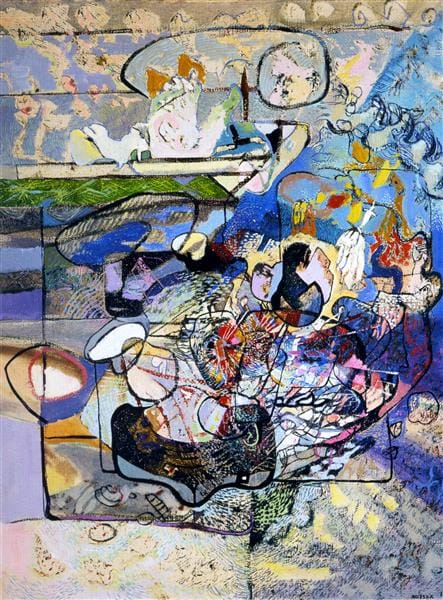
Rozsda’s work from this period is claustrophobic, dense, and stunningly beautiful. He developed a technique that André Breton would later champion. Instead of the open, empty landscapes of Dalí, Rozsda filled every inch of the canvas with swirling, microscopic details—shattered glass, feathers, lace, and hidden faces.
Breton, the Pope of Surrealism, wrote a glowing introduction for Rozsda’s 1957 exhibition in Paris, famously stating:
“Here is the supreme example of what had to be kept hidden if one wanted to survive… Here the forces of death and love are pitted against each other; everywhere under the magma of blackened leaves and broken wings irresistible forces are seeking a way of escape.”
The Style: A Kaleidoscope of Memory
Rozsda’s mature style is often described as “Surrealist Impressionism.” He did not paint a watch melting; he painted the ticking. His method involved rotating the canvas constantly, building up layers of non-figurative patterns until a “subject” emerged from the chaos—a face, a castle, or a beast. He called this process “weaving time.”
He believed that memory was not a linear film but a pile of crushed images. To look at a Rozsda painting (like Sacred and Profane Love) is to look through a kaleidoscope: the longer you stare, the more the abstract shapes resolve into eyes, mouths, and architectural ruins, only to dissolve again.
The Legacy
After fleeing Hungary following the failed 1956 Revolution, Rozsda settled permanently in Paris, eventually obtaining French citizenship. He became a fixture of the later Surrealist group, exhibiting alongside the likes of Toyen and Meret Oppenheim.
He died in Paris in 1999, leaving behind a body of work that serves as the missing link between the psychological depth of Surrealism and the textural freedom of Abstract Expressionism.
Key Works:
- Sacred and Profane Love (1947) – Musée des Beaux-Arts de Dijon
- Terror (1947) – Private Collection
- The Tower of Babel (1958-1961) – Centre Pompidou, Paris