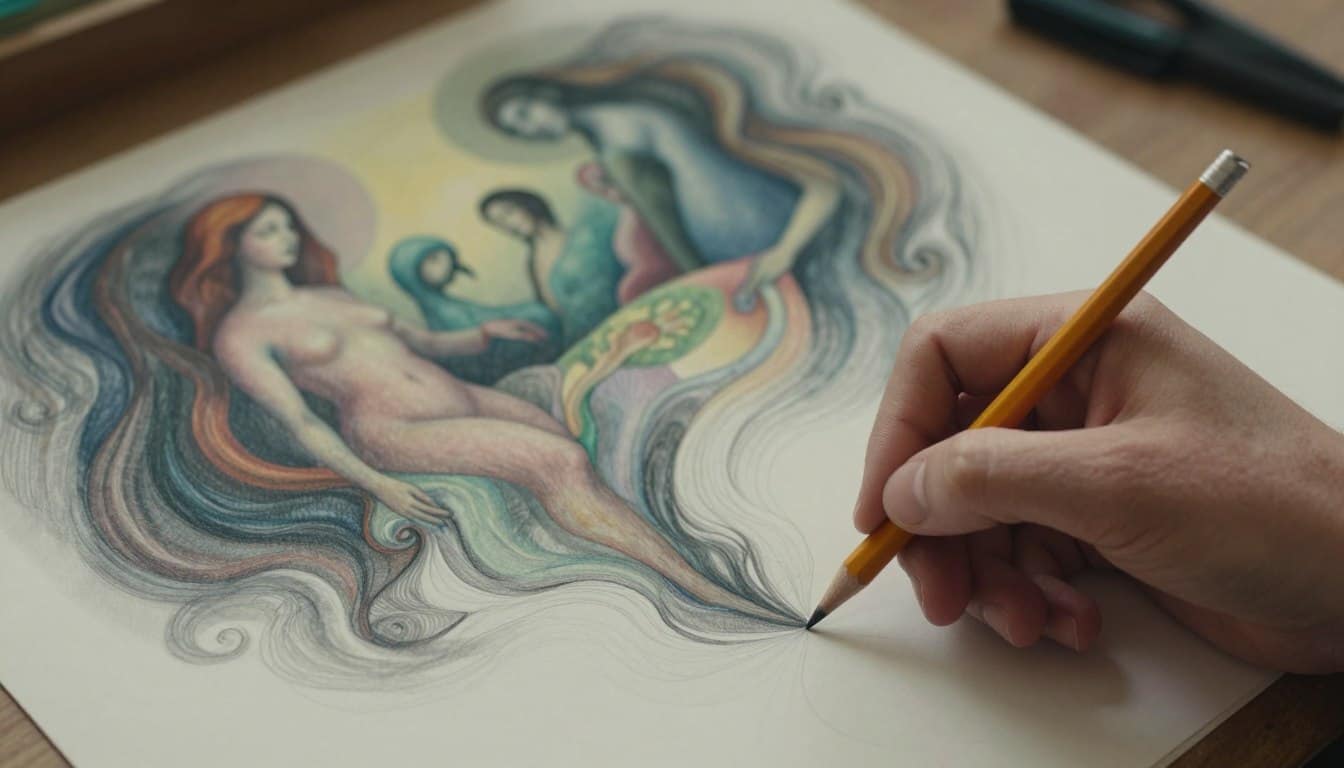
In 2007, artist Philippe Parreno created The Writer, a mechanical automaton that endlessly types text. This modern work connects directly to an age-old human fascination: can a machine, or a method, reveal thoughts we don’t consciously control?
The Surrealists, led by André Breton, provided a powerful answer. In his 1924 manifesto, he defined the movement’s core technique as “pure psychic automatism… thought dictated in the absence of all control exerted by reason.” This idea of exploring automatism in art was more than a style; it was a philosophical pursuit to bypass logic and access the raw creativity of the unconscious mind.
This article journeys through that pursuit. We’ll see how Automatic Drawing (Surrealist Automatism) evolved from a radical experiment into a vital tool for understanding thought itself. From its roots in scientific recording devices to its use in classrooms today, we explore how letting go of conscious control can lead to profound artistic and personal discovery.
Origins and theory of psychic automatism
Automatic drawing didn’t start in art studios. It has roots in 19th-century science. Scientists used tools to record the body’s hidden functions on paper.
This was called the graphic method. Tools like Étienne-Jules Marey’s myograph tracked muscle movements. At Paris’s Salpêtrière Hospital, machines recorded the curves of hysterical episodes. These tools showed that truth could be recorded directly, without human interpretation.
The Surrealists, led by poet André Breton, adopted this idea. In his 1924 Manifesto of Surrealism, he defined Surrealism as “pure psychic automatism.” It aimed to express the real functioning of thought, free from reason.
The theory was groundbreaking. It aimed to bypass rational control and aesthetic intention. The artist’s hand moved without conscious direction. The unconscious mind guided the marks.
Breton linked this process to science. He said surrealists became “modest recording instruments.” Like a myograph, they translated mental impulses into lines on paper.
This experimental approach was formalized in the Bureau of Surrealist Research. Founded in 1924, it studied the unconscious mind. Members saw art as research, not traditional creation.
The key aims of psychic automatism are:
- Suppress the conscious “editor”: Silence logical, aesthetic, and moral judgments.
- Embrace speed and spontaneity: Work quickly to outpace deliberate thought.
- Value process over product: The act of unleashing the unconscious is the primary goal.
- Accept the “marvelous”: Welcome unexpected imagery and bizarre connections.
This theory changed the artist’s role. It made them a passive, receptive medium. The next step was to apply this idea through specific techniques and pioneering artists.
Key artists and seminal works
Artists like André Masson and Hans Arp have made automatic techniques their own. They turned the idea of psychic automatism into a tool for finding new art. This group showed how to use it in many ways.
André Masson was a key figure. His work from the 1920s and 30s showed the raw power of automatic gesture drawing. He drew quickly, letting his hand move freely, creating complex lines without thinking.
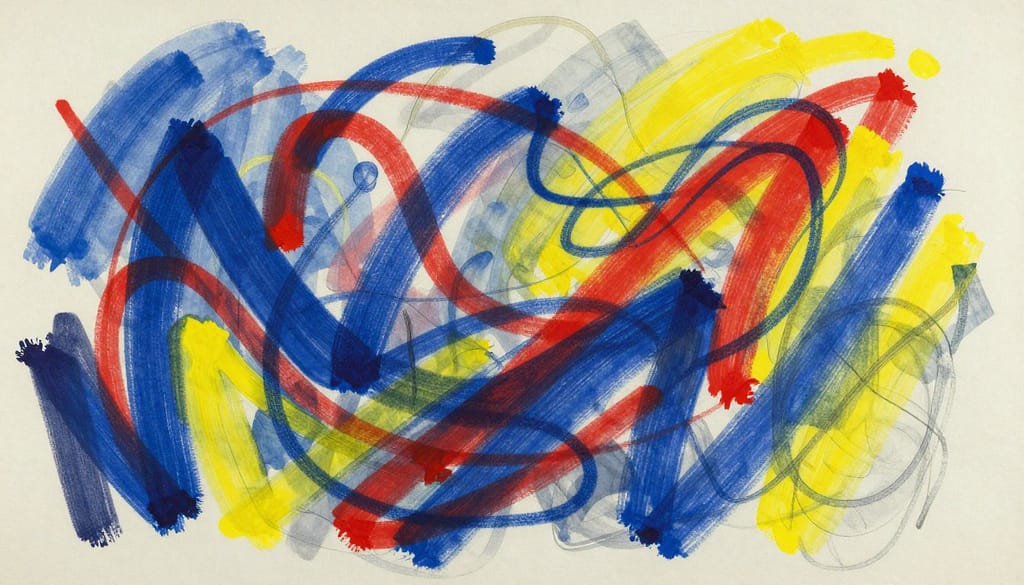
Masson also used sand and glue in his art. This added texture and chance, making his work vivid and often violent. It seemed to come straight from his subconscious.
The Magnetic Fields (1919) by André Breton and Philippe Soupault was a big deal for literature. It showed how automatic writing could inspire visual artists too.
Hans Arp used chance in his collages, dropping paper and fixing it where it fell. Marcel Duchamp and Francis Picabia even used precise drawing ironically.
Salvador Dalí talked about the surrealist experiment a lot. He saw it as a way to capture the irrational.
Today, artists like Brent Harris keep using automatic drawing. He taps into his subconscious to create complex paintings.
Key artists and their contributions include:
- André Masson: Pioneered fast, gestural drawing with mixed media like sand.
- Hans Arp: Applied chance procedures to collage and composition.
- Brent Harris: A modern practitioner using automatism to generate figurative forms.
- Breton & Soupault: Codified the method through landmark automatic writing.
Each artist brought their own twist to automatism. Together, they created a rich legacy that inspires artists to explore their subconscious.
Materials and Studio Setup (Papers, Inks, Dry Media)
Imagine a studio where every material invites you to draw freely. Psychic automatism and gesture drawing rely on this. Your tools should help you draw quickly and without worrying about making mistakes.
Choosing the right supplies is key to starting. You need materials that are affordable, forgiving, and easy to use quickly.
Paper is your first choice. Avoid expensive sheets that make you hesitant. Choose large, cheap pads that can handle erasure and heavy ink.
- Newsprint: A classic for gesture drawing. It’s cheap, has a pleasant tooth, and is perfect for quick studies.
- Kraft Paper or Butcher Paper: Provides a sturdy, neutral surface for both dry and wet media.
- Mixed-Media Paper: A step up for projects involving ink washes or collage. Its weight prevents buckling.
Having plenty of paper encourages you to make more marks. This way, you worry less about “wasting” a sheet.
Inks and Fluid Media: Embracing the Unpredictable
Fluid media make you work fast and commit to your marks. Once a mark is made, it’s permanent. This is perfect for automatism.
- India Ink: Offers deep, permanent blacks. Use it with brushes, dip pens, or even sticks for varied line quality.
- Watercolor: Great for adding washes of color or mood. Its transparent nature allows for layered, accidental effects.
- Acrylic Ink: Vibrant and water-resistant when dry, useful for building complex, layered images.
Keep a jar of water and rags nearby. Embrace drips, spills, and bleeds as part of the process.
Dry Media: The Soul of Gesture Drawing
Dry media are essential for capturing movement and energy quickly. They are tactile and immediately responsive.
- Vine or Willow Charcoal: Soft, erasable, and perfect for broad, sweeping gestures. It creates a range of tones from faint gray to deep black.
- Compressed Charcoal: Delivers darker, more intense marks. Excellent for bold, decisive lines.
- Graphite Sticks: Provide a silvery line and are less messy than charcoal. Great for detailed, yet spontaneous, contour work.
- Oil Pastels or Crayons: Add color and can be used for techniques like frottage (rubbing over textured surfaces).
Found Materials and Experimental Tools
Automatism isn’t limited to traditional art supplies. Use everyday items to introduce chance and texture.
- Collage Elements: Old magazines, newspapers, or book pages can be torn and glued to create unexpected backgrounds.
- Frottage Tools: Place paper over wood, fabric, or coins and rub with a crayon to generate automatic textures.
- Decalcomania: Press aluminium foil or plastic wrap into wet paint or ink, then peel away to reveal random, organic patterns.
These methods break habitual patterns and can kickstart a stalled drawing.
Crafting the Ideal Studio Environment
Your physical space is as important as your materials. The setup should minimize friction and maximize focus.
First, ensure a clear, clean work surface. A large table or even a wall pinned with paper works. Have all your core materials—papers, inks, charcoal—organized and within arm’s reach. This prevents the distraction of searching for a tool mid-flow.
Lighting is key. Good, bright light reduces eye strain and lets you see your marks clearly. Consider a lamp if natural light is insufficient.
Lastly, create the right atmosphere. This might mean playing instrumental music to drown out distracting thoughts or setting a timer to create productive urgency. The aim is to create a sanctuary where your hand is free to move without internal critique.
Remember, the best setup is the one that gets you drawing immediately. Start simple, then expand your toolkit as you explore what fuels your most spontaneous gesture drawing.
Step‑by‑step methods: free gesture, blind contour, non‑dominant hand, time limits
Let’s dive into the hands-on ways that make automatic art magic. Theory is important, but the real magic happens when you start drawing. These four methods help you skip your thinking mind and connect with your subconscious.
Each method is like a special key that unlocks different ways to create. We’ll explore free gesture, blind contour, using your non-dominant hand, and working under tight time limits.
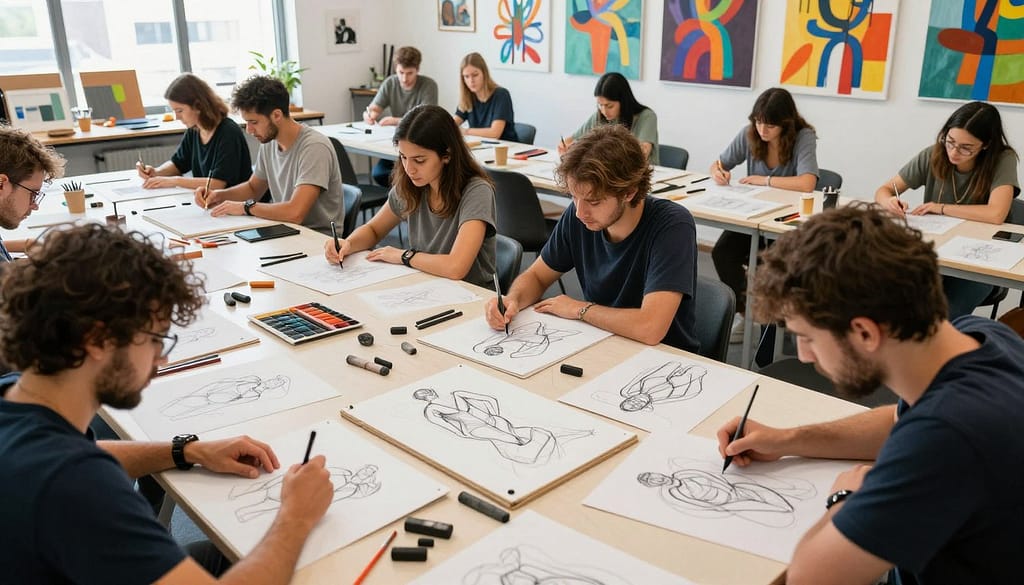
This is the purest form of gesture drawing for automatism. Stand at an easel or work on a large sheet of paper on the floor. Hold a charcoal stick or a marker loosely. Now, make marks using your entire arm, not just your wrist.
Focus on the physical sensation of movement. Let your arm swing, swirl, and jab. Don’t try to draw an object. Instead, as artist Paul Klee suggested, “take a line for a walk.” The result is a record of energy and motion, a direct transfer of impulse to page.
Blind Contour Drawing: Seeing Without Looking
This classic exercise is perfectly adapted for automatic exploration. Choose a simple object in front of you, like a plant or a cup. Now, fix your gaze on its outline. As your eye slowly traces the object’s edge, let your drawing hand follow simultaneously without looking at the paper.
Keep your pen on the sheet in one continuous line. This method forces you to rely on touch and spatial feeling, not visual judgment. It creates wonderfully distorted, honest lines that your logical brain would never produce.
Non-Dominant Hand Drawing: Engaging New Pathways
If you are right-handed, pick up your pencil with your left hand, and vice-versa. This simple switch is profoundly disruptive. Your dominant hand is skilled and controlled by familiar neural routes.
Your other hand is unskilled, clumsy, and connected to different parts of your brain. This clumsiness is an asset. It prevents you from making “good” drawings and instead leads to raw, childlike, and unexpectedly expressive marks. It’s a direct line to a less censored creative state.
Imposing Strict Time Limits: The Power of the Clock
Overthinking is the enemy of spontaneity. Following André Breton’s instruction to “write quickly… so quickly that you retain nothing,” set a firm timer. Give yourself 30 seconds, one minute, or two minutes maximum for a drawing.
The pressure of the clock forces immediate action. You have no time to plan, critique, or edit. You must react and let the marks flow. This method often yields the most surprising and energetic results, as hesitation is simply not an option.
Practice these methods in sequence or combine them. Try a one-minute blind contour drawing with your non-dominant hand. The goal is not a masterpiece but the process itself—the act of unlocking a more intuitive, authentic mode of making art.
Variations: constraints, musical prompts, chance operations
Surrealist automatism loves surprises. It uses musical prompts, chance operations, and team work to achieve this. These methods help break free from your usual thinking, leading to new discoveries.
The Exquisite Corpse game is a top example of team surrealist art. It’s played with a group, combining many minds into one piece. The rules are simple but effective.
- One person starts a drawing on a sheet of paper, then folds it to hide most of their work, leaving only a few connecting lines visible.
- The next person continues the drawing based only on those visible lines, folds the paper to hide their contribution, and passes it on.
- This continues until the sheet is complete, then it’s unfolded to reveal a bizarre, composite creature or scene—the “exquisite corpse.”
A literary version of the game uses sentences instead of drawings. It uses randomly chosen words as a creative prompt. This lets you explore new connections, like between “umbrella” and “kaleidoscope.”
Sound is another powerful tool. Using music as prompts can guide your art. The rhythm and mood of the music can influence your drawings, making them a physical expression of sound.
For those who want to remove all intention, chance operations are key. These methods welcome accidents as co-creators.
- Dropped Paper: Inspired by Hans Arp, tear or cut shapes, drop them onto a surface, and fix them where they land. The composition is governed by gravity, not taste.
- Frottage: Place paper over a textured surface (wood grain, stone, fabric) and rub with a pencil or crayon. The revealed pattern becomes a starting point for imagery.
- Froissage: Crumple a sheet of paper, smooth it out partially, and then draw based on the network of creases. The lines of the crease dictate the drawing’s architecture.
Each method, from the Exquisite Corpse game to the physics of falling paper, aims to surprise. They help you create art that is truly new and unexpected.
Analyzing results: form, symbolism, semiotics
After finishing your automatic drawing, you have a special document. It’s a direct look at your subconscious mind. This is where psychic automatism turns from a creative outlet into a deep tool for self-discovery.
Look at your drawing with kindness, not criticism. It’s like a record of unseen forces. Your job is to observe, not to judge. This is similar to how a group works together in an Exquisite Corpse, finding a surprising story in their drawings.
Use three main lenses to analyze your drawing: form, personal symbolism, and semiotics. Ask yourself questions to help you explore.
- Form: What shapes or gestures keep showing up? Are there areas with lots of lines or open spaces? Do you see shapes that look like people or are they just abstract marks?
- Symbolism: Is there something in your drawing that feels special, even if you don’t know why? Could a certain shape mean something important to you, like an emotion or a person?
- Semiotics: How does a simple mark become a sign with meaning? A jagged line might show tension, and a circle could mean something whole. What language is your unconscious speaking?
This thinking process is key to learning from automatic drawing. It’s not just about the technique. You learn to see your own patterns and symbols. The goal is to discover, not to make something perfect.
By regularly looking at your drawings with curiosity and without judgment, you get closer to psychic automatism. You start to see your drawings as maps of your inner world. They offer insights that your conscious mind might miss. This makes the practice a deep conversation with your subconscious.
Classroom lesson plan with objectives, timing, assessment rubric
For teachers wanting to spark creativity in students, a lesson on automatic drawing is a great tool. It turns surreal ideas into hands-on, timed activities. This focuses on the journey of creating, not just the end result.
The aim is to create a space where students can explore freely. They learn to ignore their doubts. This method values finding new things over mastering skills.
Learning Objectives
By the end of this session, students will be able to:
- Create art without thinking too much about it.
- Try out two different ways of drawing within set times.
- Talk about how chance and accidents play a part in their art during a group discussion.
Suggested Session Timeline (75 Minutes)
A 60-90 minute block is best. Here’s a 75-minute plan:
- Introduction & Demo (15 mins): Explain the idea of psychic automatism. Show a quick drawing with the non-dominant hand. This sets a non-judgmental mood.
- Focused Creation Time (40 mins): Students go through different, timed stations. This is the main part of the lesson.
- Group Critique & Reflection (20 mins): Students share their work in a group discussion. They focus on the surprises and the role of chance in their art.
Core Timed Activities
In the 40-minute creation time, set up stations. One good activity is “Write this word repeatedly for 10 minutes.” This simple task makes writing turn into drawing as the word loses its meaning.
Another activity is “Play the exquisite corpse game.” Students pass papers around, building a figure without seeing the whole. This classic surrealist game is great for groups.
Include “Press and peel” decalcomania instructions. Have students apply wet paint between two papers, press, and peel them apart. The patterns that come out become a starting point for automatic drawing.
For older or more advanced students, introduce a narrative case study. Use detailed character sketches from surrealist literature. Ask students to create automatic responses to the psychological states described.
This connects philosophy with practice. It makes the conversation about the unconscious mind in art deeper.
Sample Assessment Rubric
Assessment should look at effort, engagement, and reflection. Here’s a simple rubric for this teaching method.
| Criteria | Emerging | Developing | Proficient | Exemplary |
|---|---|---|---|---|
| Process & Engagement | Struggled to start; got distracted during timed activities. | Participated but stuck to what they knew. | Really got into it; let surprises happen. | Was fully into it; tried new things with curiosity. |
| Creative Risk-Taking | Work was very controlled, showing little change from usual. | Tried new things but went back to safe choices. | Embraced the rules (e.g., non-dominant hand); let accidents happen. | Looked for surprises; work showed clear signs of letting go. |
| Reflective Analysis | Couldn’t describe their process or find unconscious parts. | Described their work but didn’t share much insight. | Talked about surprises and chance in their work. | Shared deep thoughts, connecting personal experiences to surrealist ideas. |
This lesson plan gives a full framework. The timed activities give structure. The rubric makes sure evaluations are fair and based on growth.
This approach empowers teachers. It turns theory into a powerful classroom experience. The heart of this teaching is creating a safe space for intuition to shine.
Common pitfalls and how to facilitate safely
Exploring the unconscious through art is powerful. But, without the right guidance, some common issues can pop up. The freedom of psychic automatism can sometimes lead to frustration. Good facilitation can turn these obstacles into breakthroughs.
Challenges can be practical or psychological. Knowing them helps prevent them.
- Self-Consciousness: Beginners often freeze, worried about their art’s quality.
- Empty Gestures: Movements can become repetitive if the mind is engaged too much.
- Group Dynamic Issues: Competition or discord can ruin the creative space in group exercises.
- Emotional Intensity: Exploring the unconscious can bring up unexpected feelings or memories.
- Misinterpretation: People might see the art as just scribbles or not meaningful.
The facilitator’s job is to make a safe space for risk. Set the right tone before starting. Frame the session as a journey of discovery, not just making art.
Start with physical and mental warm-ups. Simple exercises can help loosen up. For groups, set clear rules, like no comments during creation.
When strong emotions or personal images come up, handle them with care. Remind everyone that the studio is for art, not therapy. Acknowledge the feeling and gently steer the focus back to the art.
To avoid mechanical or chaotic art, use time limits and musical prompts. A short meditation can also help keep the creative flow going.
Safe facilitation for psychic automatism is about giving permission and being present. You allow people to explore freely and make “bad” art. Your calm presence helps everyone journey inward safely.
Reading list and museum/online collections
Your journey into automatic drawing doesn’t stop here. A special reading list can deepen your understanding. Start with key texts like André Breton’s manifestos. Also, check out Le Monde des automates from 1928.
For today’s views, look into Kurt H. Wolff’s ideas on “surrender and catch”.
Seeing original works is key. Big museums like The Museum of Modern Art (MoMA) in New York and Tate Modern in London have amazing Surrealist collections. They have important pieces by André Masson and Joan Miró.
Online archives are also a treasure trove. Look up digital collections from these museums to see high-quality images. Look closely at André Masson’s automatic drawings. See how they compare to your own gesture drawing.
Also, explore artists like Brent Harris and Hans Arp. Their work shows the balance between chance and control. Use these resources to keep learning and practicing gesture drawing.