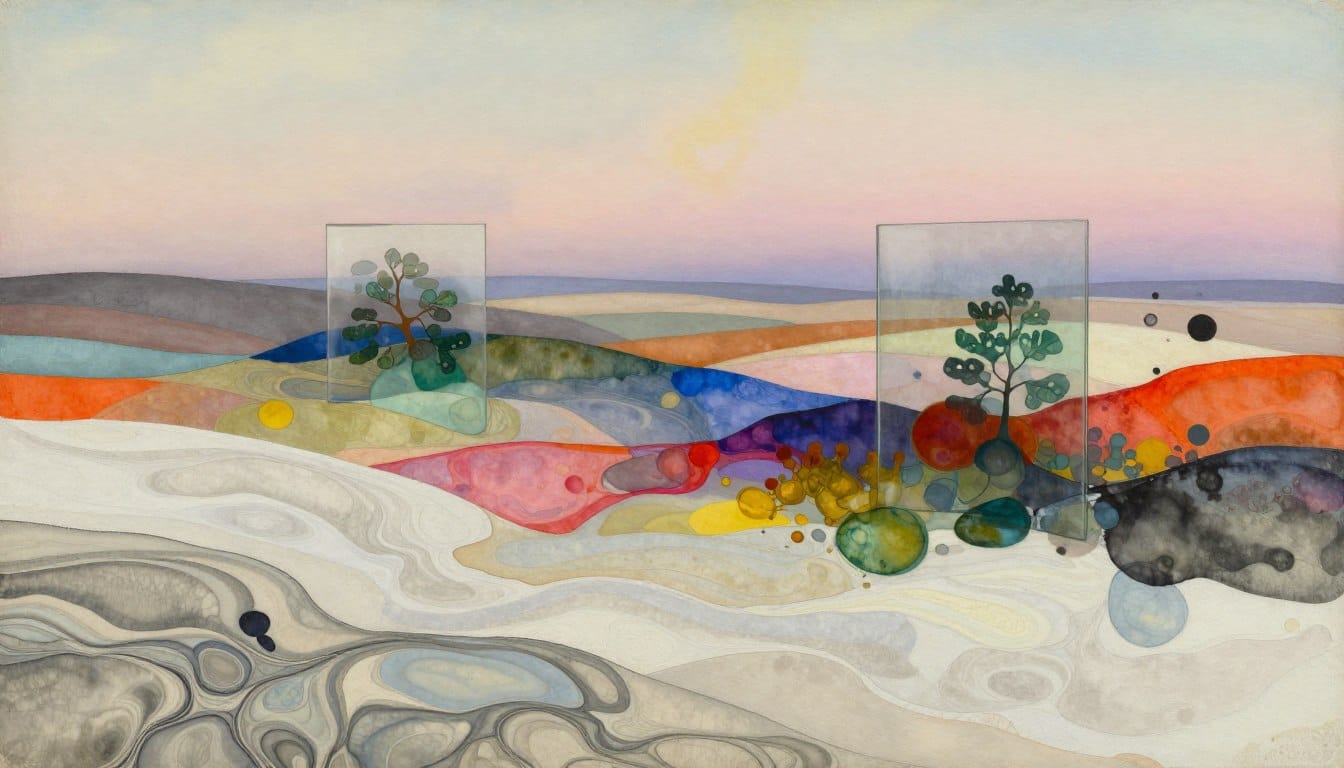
What if a spilled drop of ink or a crack in glass wasn’t a mistake, but the start of your next masterpiece? For centuries, artists have used basic materials to harness chance. They turn random marks into profound art.
This practice has a deep history. Renaissance master Leonardo da Vinci advised artists to find inspiration in wall stains. He saw clouds, landscapes, and battles in the random patterns.
The Surrealists of the 20th century gave this a name: “Psycho-morphology.” This concept uses automatic processes and “objective hazard”—a fancy term for planned chance—to reveal the hidden contents of the mind.
Artist Oscar Domínguez was a key pioneer in this movement. The core idea is simple. Create a stain by chance. Gaze at it for suggestions. Then, develop those hints artistically.
This taps into a common human experience called pareidolia. That’s our brain’s tendency to see familiar shapes, like faces, in random patterns. Artist Ithell Colquhoun famously traced cracks in a wall to create an entire mural.
A simple flaw becomes a portal to the unconscious mind. It transforms from an accident into a revered creative tool. This philosophy sets the stage for powerful techniques any artist can use.
Materials: inks, gouache, acrylics, papers, glass
Artists like Oscar Domínguez found that gouache, ink, and paper were key to a ‘mantic stain’. Choosing materials is more than just a purchase. It’s picking a variable in a chance-based experiment.
Each pigment and surface reacts differently when pressed, lifted, and peeled. This guide will show you how to pick the right materials for your art.
Pigments and Mediums: Controlling the Flow
Gouache is the go-to for traditional decalcomania. Its matte, water-soluble finish is great for transfers. Artists often spread black gouache on paper and water it down in some spots.
This water play creates pockets of different thickness. When pressed, it makes complex, lace-like patterns. Gouache’s re-wettability lets you tweak areas if needed.
Fluid Inks and watercolors bring intense, transparent color. They flow freely, making delicate, web-like stains. For waterproof inks or paints, you can’t use water. Instead, you adjust how much you apply.
Heavy-Body Acrylics are thicker and dry fast into a plastic film. They’re perfect for bold, textural transfers. You get sharper edges and more defined shapes than with gouache.
Surfaces and Substrates: The Printing Plate
The surface you apply pigment to is your printing plate. It determines the texture and detail of your image.
Non-porous surfaces like glass or plexiglass are ideal. Pigments slide and pool freely, creating smooth, fluid patterns. Glass offers the cleanest lift and most precise control.
Paper or board as a base absorbs moisture. This creates a softer, more diffused effect. Heavier watercolor paper or illustration board can handle wet media without warping.
You can even use water’s surface for marbling effects. Then, capture the floating pigments onto paper.
| Material Type | Key Properties | Best For / Use Case |
|---|---|---|
| Gouache | Water-soluble, matte, re-wettable | Classic decalcomania and gouache transfer; soft, organic patterns |
| Fluid Inks | Highly pigmented, transparent, fluid | Creating vibrant, delicate veils and web-like stains |
| Acrylics | Fast-drying, plastic polymer, thick | Bold, textural transfers with sharp, defined edges |
| Paper (Watercolor) | Absorbent, textured, stable when wet | Receiving transfers; also as a pigment base for softer effects |
| Glass | Non-porous, smooth, impermeable | As a printing plate for high-contrast, fluid patterns with clean lifts |
Begin with simple tools. A tube of black gouache, a sheet of glass, and some sturdy paper are enough. This setup lets you explore press-and-lift techniques. Then, you can add color and try other materials from the table.
Remember, the goal is to set up conditions for chance to operate. Your material choices create the boundaries of that creative experiment.
Core procedures: press‑and‑lift, veiling, glazing, image finding
The heart of decalcomania lies in four key steps. Artists move from chaos to refined images through these processes. These steps are press-and-lift, veiling, glazing, and image finding. Together, they form a complete gouache transfer workflow.
This journey mixes chance with control. It starts with random stains. Then, layers of meaning are built. And, hidden forms are discovered. Mastering these methods unlocks the full creative power of the medium.
Press-and-lift
The press-and-lift method is the heart of decalcomania. It creates a chaotic texture that all other work builds upon. This process is also known as the classic gouache transfer.
Here is a simple step-by-step guide:
- Spread a layer of gouache paint onto a sheet of paper or glass.
- Lightly dilute the paint with water to increase its fluidity.
- Carefully place a second sheet of paper on top of the wet paint.
- Apply even pressure across the entire surface with your hands or a roller.
- Peel the two sheets apart to reveal the unique, mirrored patterns.
Each separation creates a unique texture. No two pulls are ever the same. A modern version involves dragging a primed canvas across a forest floor. This captures organic debris and pigments in a similar “lift” action.
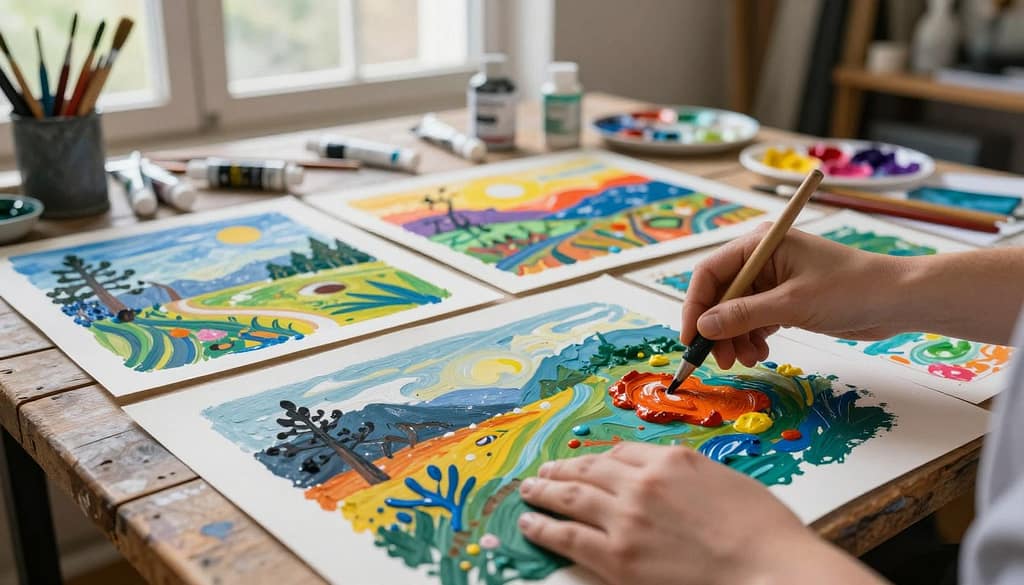
After the initial pull, you often have a wild, abstract base. Veiling is the first step to tame and guide it. This technique involves applying thin, transparent overlays of paint or ink.
Think of veiling as adding a sheer curtain over a window. It softens harsh edges and unifies disparate elements. You can use diluted inks or very thin acrylic glazes for this effect. The goal is to subtly alter the mood and cohesion of the piece without obscuring the interesting textures below.
Glazing
Glazing takes veiling a step further. It adds depth, richness, and specific color adjustments. A glaze is a transparent layer of colored medium applied over a dry layer.
This procedure allows you to warm up or cool down areas of the composition. You can push elements into the background or pull them forward. For example, a thin blue glaze can make a section feel more distant and atmospheric. Multiple glazes build a luminous, complex color field.
Image finding
The most magical and personal procedure is image finding. This is not a physical action but a receptive state of mind. It involves gazing intently at the abstract stains to see what themes emerge.
This process taps into pareidolia—the human tendency to see familiar shapes in random patterns. Be patient. Allow your imagination to wander over the textures. A swirling mark might become a storm cloud. A blotch of color could transform into a distant mountain. The key is to let the image reveal itself to you, not to force a predetermined idea onto the surface.
| Core Procedure | Primary Purpose | Key Action | Typual Outcome |
|---|---|---|---|
| Press-and-Lift | Create foundational texture | Transfer paint between two surfaces | Unique, chaotic base pattern |
| Veiling | Unify and soften the base | Apply transparent overlays | A more cohesive, atmospheric field |
| Glazing | Adjust color and depth | Layer transparent colored films | Rich, luminous, and dimensional space |
| Image Finding | Discover narrative and form | Patient, intentional observation | Emergent imagery and personal meaning |
Mastering these four core procedures gives you a complete toolkit. You start with the exciting accident of the gouache transfer. Then, you use veiling and glazing to bring order and depth. And, you engage in image finding to uncover the story within the stains. This cycle turns simple materials into expressive art.
Variations: monotype, marbling, sgraffito, solvent effects
The world of automatist art goes beyond decalcomania. It includes many techniques that play with chance. Oscar Domínguez showed that giving up control can lead to amazing images. He used methods like fumage, frottage, parsemage, and vaporisation to explore the unknown.
Monotype
Monotype makes a unique print. An artist paints on a smooth plate, then presses it onto paper. This method captures painterly gestures in a single impression. It’s a mix of painting and printmaking, embracing the surprise of the transfer.
Marbling
Marbling, or écrémage, works with water and paint. Oil paint or ink floats on water, then a sheet of paper captures the patterns. It creates stunning, organic designs. Artists use this method to accept chance patterns as their art.
Sgraffito
Sgraffito combines chance with deliberate marks. After a wet ground, like decalcomania, the artist scratches into it. This reveals layers beneath. It’s a mix of accident and intention, letting the artist define shapes within abstracts.
Solvent Effects
Solvents like alcohol can change wet paint. They create blooms, bleeds, and textures. This effect adds complex, unpredictable textures to a work. It’s a way to explore new, ethereal forms.
These variations show the wide range of automatist art. From Oscar Domínguez’s work to today’s experiments, they prove chance is a powerful tool for discovery.
From accident to imagery: pareidolia and editing
Pareidolia, our brain’s pattern-finding instinct, turns random marks into art. It’s why we see faces in clouds or animals in rocks. In fumage and other stain-based techniques, this natural ability is your greatest ally.
Start by relaxing and looking at the stain, not just seeing it. Let your mind explore the shapes and smudges. What do you see? A twisted tree, a distant mountain, or a curious creature? This moment is the heart of stain imagery.

Artists like Cecilia Vicuña say it’s like transferring a mental picture to the canvas. The random marks provide the base. Your mind then completes the picture it sees in the chaos.
Next, you make choices to guide the viewer’s eye. In traditional fumage, artists use ink or paint to highlight chosen forms. They also paint over parts that don’t fit to simplify the image.
This editing phase turns a vague blot into a strong statement. The table below shows the key steps in this journey.
| Stage | Artist’s Action | Cognitive Process | Outcome |
|---|---|---|---|
| Observation | Gaze at the dried stain without preconception. | Pareidolia activates; the brain seeks familiar patterns. | Initial imagery suggestions emerge (e.g., a landscape, a figure). |
| Selection | Identify the most compelling forms discovered. | Conscious evaluation of the accidental marks. | A clear visual concept is chosen for development. |
| Emphasis | Use line, value, or color to strengthen the chosen shapes. | Intentional focus and clarification of the vague form. | The accidental mark becomes a defined focal point. |
| Reduction | Paint over or scrape away distracting areas. | Editing for clarity and compositional balance. | A coherent, simplified image with clear intent. |
Learning to use pareidolia is a skill you can develop. Start by looking at everyday things that look like other objects. This trains your eye to see possibilities in the ambiguous. In the studio, let your imagination run wild. A smudge could be a stormy sky or a flock of birds.
The final artwork is a mix of chance and choice. The stain offers endless possibilities. Your decisions bring one compelling vision to life. This process celebrates the unexpected, turning a happy accident into a meaningful piece of stain imagery.
Classroom experiments and risk management
Turning an art studio into a lab for discovery starts with a new view of success. Automatism stands against today’s focus on perfect, repeatable work. It values being present over planning every detail.
This method lets students have a direct dialogue with materials and the moment. The goal is not just the end product but the journey itself. How do we make this free, yet unpredictable, learning experience work for students?
Experts say these methods are easy to start. Success comes from simple steps and a new way of thinking. We suggest a series of classroom experiments to build skills and confidence.
- Foundation: The Simple Blot. Begin with basic ink or watercolor drops on paper. Fold, press, and reveal. This introduces the core “press-and-lift” procedure with immediate, surprising results.
- Exploration: Veiling and Glazing. Once students get the hang of it, they add layers. They practice veiling with tissue paper or glazing with translucent acrylics, observing how images emerge through accumulation.
- Integration: Multi-Process Pieces. Challenge students to mix techniques—marbling a background, then using sgraffito to draw into a dried monotype. This fosters complex image finding.
Managing risk is key in automatist art education. Risk isn’t about avoiding mess or “mistakes.” It’s about creating a space where failure is not an option.
Every drip, bleed, or unexpected mark is a chance to discover something new. This mindset lets students see the unknown as an adventure. It turns fear into excitement.
Key principles for managing creative risk include:
- Process Over Product: Focus on the journey, not just the final look. Grade how students engage, experiment, and think.
- The “Yes, And…” Rule: Encourage students to see every mark as a new start. A big blot isn’t a mistake; it’s a feature to build on.
- Time for Dialogue: Make time for students to step back and talk about what they see. This practice of pareidolia—seeing images in abstract forms—is a key skill.
- Clear Physical Boundaries: Use trays for messy work, have areas for drying, and set up clean-up rules. Keeping the space organized helps the mind flow freely.
The table below shows how traditional and automatist teaching differ:
| Aspect | Traditional Art Classroom | Automatist-Inspired Classroom |
|---|---|---|
| Primary Goal | Technical replication of a subject or style | Cultivating presence and responsive mark-making |
| Role of “Accident” | Something to be corrected or minimized | The primary source of imagery and discovery |
| Assessment Focus | Skill accuracy and final product composition | Process engagement, reflective observation, and creative adaptation |
| Student Mindset | Fear of making a “wrong” mark | Curiosity about every mark’s possibilities |
This approach does more than teach art skills. It builds resilience. Students learn to work with chance, adapt, and find meaning in the unexpected.
They see art as a dialogue with the seasons of their creativity. By redefining risk, you let them explore with confidence and joy.
Clean‑up, ventilation, and archival health
Creating art is exciting, but keeping your studio safe is just as important. It’s key to keep your space clean and your art preserved. This way, your art practice can thrive for years to come.
There are three main areas to focus on: ventilation for your health, clean-up for your space, and archival health for your art’s future.
Ventilation is non-negotiable. Many art techniques use sprays and solvents that release harmful fumes. It’s vital to avoid breathing them in.
- Always work in a well-ventilated area. Open windows and use fans to create cross-ventilation.
- For heavy solvent use (like alcohol or turpentine effects), consider a dedicated spray booth or a respirator with appropriate filters.
- Even “low-odor” mediums and fixatives release volatile organic compounds (VOCs). Good airflow is essential.
While mess is part of the art-making process, it’s important to manage it. A clean space is safer and ready for the next project.
- Wipe down surfaces immediately after using inks or paints to prevent permanent stains.
- Dispose of solvent-soaked rags in a sealed metal container to prevent fire risk.
- Clean your tools thoroughly. Dried acrylic or gouache can ruin good brushes.
- Have dedicated, labeled containers for different waste streams (e.g., water-based wash, solvent waste).
Lastly, think about the longevity of your art. This is archival health.
Some art materials fade or degrade over time. For example, fumage drawings need a fixative to last. This step makes your artwork permanent.
Choosing the right materials from the start is critical. Use acid-free papers and non-toxic inks to ensure your art stays healthy. This way, your art and environment remain safe.
| Medium/Technique | Key Archival Consideration | Safety & Clean-up Note |
|---|---|---|
| Fumage (Soot) | Extremely fugitive; requires immediate, heavy-duty fixative. | Work outdoors or with powerful ventilation due to smoke. |
| Alcohol/Solvent Effects | Can degrade some paper fibers or plastic substrates over time. | High ventilation needed. Use nitrile gloves, dispose of rags properly. |
| Natural Botanical Inks | Lightfastness varies; test before using for final work. | Generally low toxicity, but always clean up properly. |
| Acrylic Glazing & Veiling | Very stable and archival when using professional-grade paints. | Clean water-based tools quickly; dried acrylic is permanent. |
By following these steps—good airflow, clean-up, and careful material choice—you create a responsible studio. This lets you explore freely, knowing your art is safe and will last.
Analyzing historical and contemporary examples
Looking at specific artworks, we see how stain imagery evolved. It went from Surrealist experiments to today’s ecological practices. Artists’ work makes theory real, showing us the power of automatist art.
Historical Surrealists saw accidental marks as a way to tap into the unconscious. Ithell Colquhoun’s “Giantesses Undressing to Bathe” started with wall cracks. She saw these stains as mythological figures, turning a flaw into a story.
Max Ernst used decalcomania to create dreamlike landscapes. He pressed paint between surfaces and lifted it, revealing forms he then refined. This press-and-lift method became a key part of his art.
Cecilia Vicuña mixed automatism with personal and political themes. Her “Calcomanías” series uses stains to explore memory and displacement. In “Angel de la menstruación,” she links material flow to bodily and spiritual cycles. Vicuña shows how stains can carry deep symbolic meaning.
Leonora Carrington taught students to find images in random spills and textures. This method, bypassing conscious control, unlocked unique visions. Her approach shows the value of embracing accident in art.
Today, artists are taking these ideas further. Dr. Kelsey Ashe’s “River Portal” uses botanical inks in a forest. This project is an ecological collaboration, where nature helps create the art. The stains and flows of natural pigments document a place and moment. It shows how automatist methods address modern themes of nature and connection.
Key insights from these examples include:
- Interpretation is Key: The artist’s vision turns a stain into meaningful imagery.
- Technique Serves Concept: Methods like decalcomania help explore big ideas.
- Context Matters: The same technique can have different results in different settings.
- Evolution is Continuous: From psychology to ecology, the core practice evolves with new concerns.
By studying these examples, you can better discuss and critique automatist art. You learn to see the deliberate choices behind the apparent accident. This shows that stain imagery is a flexible and lasting artistic language.
Assessment rubrics and reflective writing prompts
How do we judge art where the journey is as key as the end result? This section offers the tools. Traditional art grading focuses on skill and a set goal. But monotype printing, embracing chance, needs a new way to evaluate.
Good evaluation in monotype values exploration and the ability to see chance as opportunity. It looks at how artists handle the unknown, not just the end product.
A good rubric for monotype focuses on the journey, not just the destination. It rewards the courage to try new things and the insight to see beauty in unexpected places. The skill of pareidolia—seeing shapes in abstracts—is key to assess.
The following rubric is a guide for both instructors and artists. It highlights what’s most important in monotype.
| Assessment Criteria | Developing | Proficient | Exemplary |
|---|---|---|---|
| Material Exploration | Uses materials in a basic, predictable way. Shows limited experimentation. | Actively tests material limits. Shows clear understanding of ink, paper, and tool interactions. | Demonstrates innovative or highly sensitive material use. Outcomes show deep, intentional material dialogue. |
| Pareidolia & Image Finding | Struggles to develop accidental marks into coherent imagery. Relies on pre-set ideas. | Successfully identifies and develops images from chance marks. Editing choices support the found image. | Skillfully leverages pareidolia to discover complex, evocative imagery. The process feels intuitive and insightful. |
| Reflective Depth | Provides minimal description of process or intent. | Articulates clear steps and decisions. Connects process to final outcome. | Offers deep analysis of intuitive choices, challenges, and breakthroughs. Writing adds meaning to the work. |
Reflective writing, inspired by Cecilia Vicuña, becomes part of the art. Vicuña showed texts with her paintings, creating a dialogue. These texts answered questions and wove stories into the visuals.
Use similar prompts to understand pareidolia and your creative process better. Try these questions after finishing a print series:
- Describe one moment where an accident surprised you. How did you respond, and why?
- What did the materials “tell” you during the press-and-lift or veiling steps?
- Trace the journey of one specific shape or blotch. How did it change from a random mark to a deliberate part of your image?
- How did pareidolia guide your editing decisions? What did you start to see, and what did you choose to enhance?
- If you were to write a short text to display beside this work, what would it say about the process that isn’t immediately visible?
This mix of a clear rubric and thoughtful prompts changes assessment from judgment to dialogue. It helps artists share their intuitive path. It turns evaluation into a tool for growth, deepening the understanding of pareidolia and one’s unique creative voice.
Resource list and image banks
Starting your journey with gouache transfer is easier with many resources. Key texts give you the basics. Ithell Colquhoun’s essay, “The Mantic Stain,” dives into automatist methods. Her archive at Tate has over 5,000 items, showing one artist’s journey.
Looking at art online is a big help. The MoMA and Tate websites have great images of Surrealist and automatist art. You can see works by Max Ernst, Joan Miró, and others.
Today’s artists keep the tradition alive. Cecilia Vicuña draws from Surrealist poetry and indigenous art. Her work shows how objective chance in Surrealism is used today.
Getting the right materials is key. Golden Artist Colors and Legion Paper offer what you need. With these, you can turn random marks into art.