
The world of Surrealist visual art is split into two main approaches. Knowing the Biomorphic vs. Veristic Surrealism difference is key to understanding the movement fully.
This comparison is more than just labels. It opens up the creative minds of famous artists. It also shows us practical techniques that artists use today.
Abstract surrealism explores the subconscious with fluid, organic shapes. Think of Joan Miró’s playful, amoeba-like forms or Yves Tanguy’s mysterious, floating landscapes.
The other path focuses on hyper-realistic, yet impossible, dream scenes. Artists like René Magritte and Salvador Dalí painted with great detail. They made the fantastical seem real.
This stylistic analysis is important for artists, educators, and fans. It helps us see how art has evolved. It also guides technical choices in line, color, and composition.
Let’s start our journey into these two captivating worlds within art.
Definitions and timeline
To understand Surrealism’s impact, we need to know its two main styles. Biomorphism is about fluid, organic shapes, while verism is about sharp, dreamlike clarity. Both styles started with André Breton’s 1924 Surrealist Manifesto. Knowing this split is key for studying modern art.
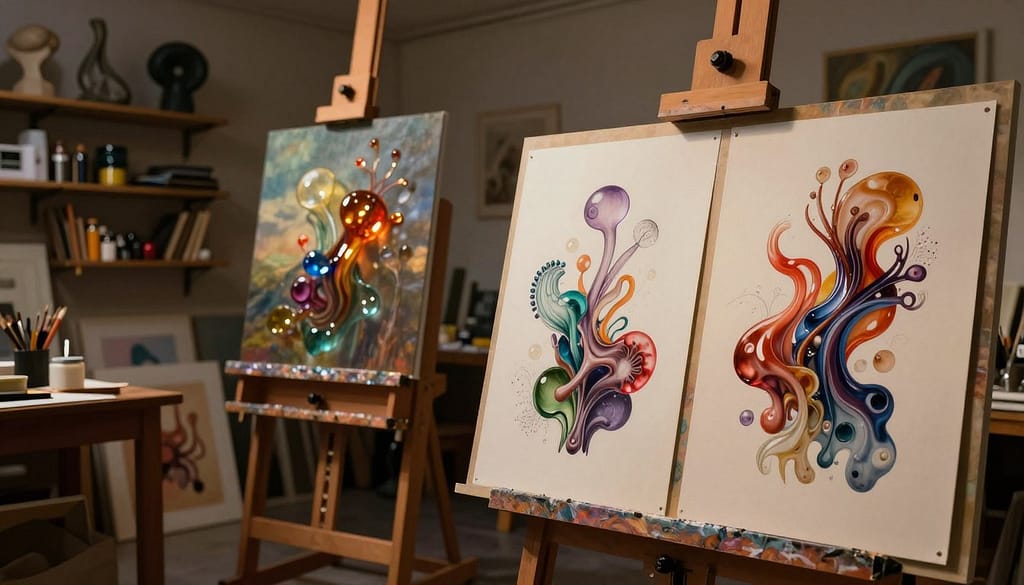
Biomorphic Surrealism focuses on the automatic and organic. It uses automatism, where the hand moves freely to tap into the unconscious. This results in paintings with abstract shapes and forms that look alive. It’s all about free association.
Veristic Surrealism is a paradox. It uses precise, realistic drawing for impossible scenes. Artists create “hand-painted dream photographs” with sharp detail. This style shocks the mind awake with irrational juxtaposition.
The timeline below shows how these styles developed from the movement’s start to its peak.
| Period | Key Development | Biomorphic Focus | Veristic Focus | Representative Artists |
|---|---|---|---|---|
| 1924-1929 | Publication of Breton’s Manifesto; rise of automatism. | Exploration of pure psychic automatism in drawing and painting. | Early experiments in dream narrative and collage. | André Masson, Max Ernst |
| 1930-1939 | Solidification of the two distinct visual languages. | Mature biomorphic abstraction, as seen in Joan Miró’s Constellations. | Perfected illusionistic technique; iconic works by Dalí and Magritte. | Joan Miró, Yves Tanguy, Salvador Dalí, René Magritte |
| 1940-1945 | War years; dispersal of artists; photography’s increased role. | Continued flow of organic forms, often reflecting anxiety. | Photography becomes a major veristic tool (e.g., Lee Miller’s war photography). | Lee Miller, Man Ray (collaboration) |
| Post-1945 to Present | Legacy and influence on Abstract Expressionism and contemporary art. | Abstract Surrealism informs gestural abstraction and digital art. | Precise surreal imagery thrives in photorealistic painting and media art. | Gerry Bergstein, contemporary digital artists |
Joan Miró’s career is a great example of biomorphic evolution. His work moved from figurative to cosmic in the early 1940s. This shows his deep commitment to automatism and creating new symbols. His art shows how abstract surrealism aims to create a new world from imagination.
Lee Miller’s work is a key chapter in veristic Surrealism. She started as a model for Man Ray but became a skilled artist and photographer. Her work from 1929-1945, done with Ray, uses photography to create shocking compositions. This period shows how veristic techniques extended into photography, capturing the “dream photograph” with precision.
Today, artists like Gerry Bergstein use Surrealist methods. They show that the drive to bypass rational thought is powerful. The history of biomorphic and veristic surrealism gives artists the tools to keep exploring.
Formal traits: line, palette, space, edge handling
Line, palette, spatial depth, and edge handling are key elements in Surrealist painting. They help us tell apart biomorphic dreamscapes from veristic illusions. A detailed stylistic analysis of these traits is essential for grasping the two main branches of Surrealist art.
By comparing these traits, we see clear differences that help artists and students learn.
Line is a key trait in biomorphic Surrealism. It’s fluid and organic, often resembling cells or molten rock. On the other hand, veristic Surrealism uses precise lines to outline objects with architectural detail.
The palette also shows a stark contrast. Biomorphic artists use a limited color range to evoke feelings. They often choose earth tones and unexpected colors. Veristic artists, by contrast, aim for realistic colors to mimic the real world, even with strange subjects.
Space is another area where the two styles differ. Biomorphic works, like Yves Tanguy‘s, have shallow, dreamlike spaces. Veristic art, on the other hand, uses deep perspective to create believable spaces.
Lastly, edges are soft in biomorphic art and sharp in veristic. This difference highlights the fluidity in biomorphic art and the reality in veristic.
| Formal Trait | Biomorphic Surrealism | Veristic Surrealism |
|---|---|---|
| Line | Fluid, amoebic, organic | Hard, precise, descriptive |
| Palette | Intuitive, mood-based, often limited | Hyper-realistic, academic rendering |
| Space | Shallow, ambiguous, horizon-less | Deep, illusionistic perspective |
| Edge Handling | Soft, blended, permeable | Crisp, defined, sharp |
David Bergstein’s work shows the power of mastering both styles. He combines different painting techniques to create intense effects.
Bergstein’s skill in drawing and painting is impressive. He can blend biomorphic and veristic styles seamlessly. This ability creates a unique, thought-provoking effect in his art.
Studying line, palette, space, and edges is key for understanding Surrealist art. It helps move from vague ideas to a clear understanding of style.
Biomorphic studio approaches: automatist shapes, staining, airbrush
Artists like Joan Miró didn’t just imagine strange forms; they developed repeatable studio approaches to materialize them. This section serves as a practical guide to the core techniques of biomorphic abstract surrealism. The goal is always the same: to bypass the conscious, planning mind and let the subconscious guide the hand.
Automatist drawing is the foundational practice. You start by making a random mark on the paper or canvas. It could be a quick line, a dot, or a spilled drop of ink. Then, you look at that mark and let your mind free-associate. Does it resemble a creature’s eye, a strange planet, or a twisting root? You then draw from that association, allowing one organic shape to suggest the next. This “rorschaching” process, as artist Bergstein describes it, is about visually exploring your brain in response to the marks you make.
Staining takes the principle of chance into the realm of color. Thin paints or inks are poured, dripped, or sponged onto an absorbent surface. The liquid medium bleeds and spreads in unpredictable ways, creating fluid, atmospheric fields. These stained areas become the luminous backgrounds or amorphous bodies within a composition. Artists can then draw back into these wet stains using tools—a technique known as sgraffito—to reveal layers beneath or define emerging forms.
Airbrushing introduces a tool for achieving ethereal, nebulous effects. By spraying diluted paint, artists can create soft gradations of color, misty veils, and forms that seem to dissolve at the edges. This technique is perfect for suggesting depth, atmosphere, or cellular, microscopic worlds. It eliminates the hand-drawn line entirely, favoring a purely atmospheric and dreamlike quality.
The experimental spirit of these methods was championed in workshops like Atelier 17. Under S.W. Hayter, printmakers embraced automatism and chance operations. They proved these were not random acts, but disciplined studio strategies for innovation.
| Technique | Primary Tool/Material | Core Action | Visual Outcome |
|---|---|---|---|
| Automatist Drawing | Pencil, pen, brush | Free-associative mark-making | Linear, organic, calligraphic shapes |
| Staining | Fluid acrylic, ink, watercolor | Pouring, dripping, blotting | Fluid, uncontrolled color fields and textures |
| Airbrushing | Airbrush tool, diluted paint | Spraying misted pigment | Soft gradations, nebulous forms, atmospheric depth |
Together, these approaches form a versatile toolkit. An artist might begin with a stained ground, use automatist drawing to find forms within it, and then employ an airbrush to unify the composition with a hazy glow. Mastering these methods allows for a true exploration of abstract surrealism, where the studio itself becomes a lab for the subconscious.
Veristic studio approaches: precise drawing, perspective, glazing
Veristic surrealism teaches us to master reality before breaking its rules. This is different from biomorphic surrealism, which is more spontaneous. Veristic art is like a photograph, aiming for hyper-realism in impossible ideas.
Artists need a strong foundation in traditional drawing. Marylyn Bergstein, for example, studied under Jan Cox. She learned the importance of “real academic drawing” for complex visions.
Precise drawing is essential. Every line is intentional, with contours that are crisp and clean. This clarity makes the illogical parts of the art even more striking.
Next, artists use linear perspective to create believable space. But then, they add elements that defy logic. For example, a cloud might be in a room, or a train might come out of a fireplace.
The last step is glazing. This technique involves applying thin, transparent layers of paint. It adds depth and luminosity, creating a glossy sheen or soft glow.
René Magritte is a master of this method. His works, like “The Son of Man” and “The Treachery of Images,” show these techniques. His art is so realistic, it tricks the eye.
| Technique | Primary Tool/Method | Visual Effect | Example in Magritte’s Work |
|---|---|---|---|
| Precise Drawing | Hard pencil (H series), fine liner brushes, detailed underpainting | Creates crisp, clean edges and defined, believable forms. | The sharply outlined apple in front of the man’s face in “The Son of Man.” |
| Linear Perspective | Vanishing points, horizon line, measured orthogonals | Constructs deep, rational space that is then subverted. | The perfectly rendered room and window in “The Human Condition,” where the painting on the easel merges with the view outside. |
| Glazing | Transparent oil layers (e.g., alizarin crimson, phthalo blue) over a monochrome grisaille. | Produces luminous, deep color and a hyper-realistic, textured surface. | The vibrant, glossy sky and realistic clouds in “The Empire of Light.” |
| Composite Illusion | Photographic reference combined with imaginative juxtaposition | Makes impossible combinations appear seamlessly real. | The giant rock floating over the sea in “The Castle of the Pyrenees.” |
Understanding veristic techniques is key to analyzing surrealist art. It shows how skill meets mystery. For artists, it teaches that a strong foundation makes the impossible seem real.
Side‑by‑side lesson plans and outcomes
We draw from our teaching experience at the School of the Museum of Fine Arts, Boston. We present two art projects that show the main differences between Tanguy’s and Magritte’s surrealism. These plans help teachers teach biomorphic and veristic techniques directly to students.
The table below compares the two projects. It highlights their different goals and methods.
| Lesson Component | Biomorphic Surrealism Project (Inspired by Yves Tanguy) | Veristic Surrealism Project (Inspired by René Magritte) |
|---|---|---|
| Core Objective | To create an abstract, dreamscape composition using spontaneous, automatic techniques that bypass conscious control. | To construct a realistic yet impossible scene using precise drawing and painting methods that challenge perception. |
| Key Artist Inspiration | Yves Tanguy | René Magritte |
| Primary Techniques | Automatic drawing, staining, airbrush blending | Precise contour drawing, linear perspective, acrylic glazing |
| Suggested Materials | Large paper, ink, brushes, watercolor or thin acrylics, spray bottle (for airbrush effect), charcoal | Drawing paper, pencils, rulers, acrylic paints, soft brushes, palette for glazing, reference photo of an ordinary object |
Biomorphic Surrealism Lesson: The Automatic Landscape
Project Steps:
- Initiate with Automatism: Have students close their eyes and make continuous, non-representational marks on paper for 2-3 minutes. This is the “automatic drawing” base.
- Develop Shapes: Ask students to look at their scribbles and identify biomorphic (life-like) shapes. Outline these forms with charcoal or ink.
- Apply Staining Technique: Dilute watercolor or acrylic paint heavily. Apply it liberally within and around the drawn shapes, allowing colors to bleed and merge spontaneously on the damp paper.
- Create Depth with Airbrush Effect: Use a spray bottle with very diluted paint to mist a soft, hazy background. This mimics Tanguy’s vast, atmospheric spaces.
- Refine and Title: Let the work dry. Students can add minimal details but should preserve the initial sense of chance. Have them give the piece a dreamlike title.
Potential Student Outcomes: Finished pieces will feature amorphous, organic forms floating in ambiguous space. Color will be fluid and atmospheric. The work should feel discovered, not planned, capturing the essence of a subconscious landscape inspired by Tanguy.
Veristic Surrealism Lesson: The Impossible Object
Project Steps:
- Select and Draw Precisely: Students choose a common object (e.g., an apple, a shoe, a clock). They create a highly accurate, detailed contour drawing of it on paper.
- Design an Impossible Context: Using perspective rules, students draw a realistic environment (a room, a landscape). They then place their precisely drawn object in an illogical spot within it—floating, giant, or made of unexpected material.
- Underpaint with Local Color: Paint the entire scene with flat, accurate colors as a base layer, just as one would in a realistic painting.
- Apply Glazing for Realism: Mix transparent glazes (acrylic paint with glazing medium). Apply these thin layers over the base colors to build up shadows, volume, and a unified, luminous quality, much like Magritte’s polished surfaces.
- Finalize and Reflect: Ensure the impossible element is rendered with the same precise realism as its surroundings. Students should write a short statement on the paradox they created.
Potential Student Outcomes: Artworks will display technical skill in drawing and painting. The final image presents a clear, jarring contradiction—a hyper-realistic object in a logically impossible situation. This captures the conceptual rigor of Magritte’s vision.
These lesson plans offer a structured yet flexible framework. They empower teachers to demystify two complex artistic styles through direct making. Students gain not just art historical knowledge, but also practical skills in both spontaneous expression and meticulous craftsmanship.
Critique rubrics for each style
A great critique doesn’t ask if you ‘like’ a piece, but how well it meets its artistic goals. This change is key for stylistic analysis. It shifts from personal taste to judging based on the work’s aims.
This method fits with the “politics of art aesthetics,” where value is judged in context. We offer special rubrics for abstract surrealism. These tools turn vague feedback into clear, helpful analysis.
The Biomorphic Surrealism rubric looks at the dreamlike and subconscious. It checks how the artist brings the unseen to life. The criteria are clear.
First, check the success of automatism. Look for signs of unthought-out mark-making. Does the form seem discovered, not forced?
Next, look at the innovation of organic forms. Are the shapes strange yet believable? They should feel like they could grow or breathe.
Color harmony and evocative power are also key. Colors should feel natural and add to the mood. The work’s ability to evoke emotion and imagination is what matters most.
The Veristic Surrealism rubric, on the other hand, focuses on precision and solving intellectual puzzles. It requires skill to make the impossible seem real.
First, check the technical proficiency in rendering. Look at the draftsmanship and paint application. Is the technique flawless enough to make the unreal seem real?
Then, analyze the cleverness and clarity of the conceptual juxtaposition. Is the mix of elements surprising and logically jarring? Does it create a new, resonant meaning?
Lastly, evaluate the mastery of illusionistic space and the painting’s finish. The depth should be convincing, and the surface should be perfectly resolved. Every detail supports the central paradox.
For a clear comparison, use the table below. It outlines the main criteria for each style, making evaluation easier.
| Evaluation Category | Biomorphic Surrealism Rubric Focus | Veristic Surrealism Rubric Focus |
|---|---|---|
| Primary Aim | To evoke the subconscious and organic world | To depict the irrational with precise, realistic technique |
| Key Formal Criteria |
|
|
| Success Metric | Overall evocative, emotional, or poetic power | Strength of the intellectual paradox and finish quality |
Using the right rubric changes the way we talk about art. It lets professionals and students analyze work in its proper context. This shift from “I don’t get it” to “How well does this piece execute its vision?” is at the heart of stylistic analysis in abstract surrealism.
Cross‑influences and boundary cases
The line between biomorphic and veristic surrealism is not strict. Many artists have crossed this line. Their works blur the boundaries, making us question our need for clear categories.
Gerry Bergstein is a great example. He mixes different styles on one canvas. He uses expressionism, Abstract Expressionism, veristic Surrealism, and trompe-l’oeil. Bergstein aims to confuse and challenge our views.
These works can take two forms. A biomorphic artist might add precise elements. Or, a veristic painter might use abstract shapes. This mix shows the movement’s flexibility.
Joan Miró also explored these areas. He’s known for his organic shapes but later used symbols. This mix of spontaneity and control creates tension.
René Magritte also mixed styles. He made objects simple and placed them in mysterious scenes. This shows how he blended biomorphic and veristic styles.
Key traits of these works include:
- Intentional dissonance: Mixing textures that shouldn’t go together.
- Hybrid narratives: Scenes that are both clear and abstract.
- Expanded technique: Using airbrushes for softness and glazing for detail.
It’s important to understand these overlaps. They show Surrealism was a conversation, not a doctrine. Artists shared and mixed ideas freely. This spirit of exploration is connected to pioneering Surrealist techniques in photography. It reminds us to test creative boundaries.
Museum case studies and image analysis worksheets
This section turns passive art viewing into an active discovery. We use museum examples for stylistic analysis. You can test your eye on real artworks. By working with specific case studies and guided worksheets, you learn through structured exercises.
Let’s look at Max Ernst, a master of abstract surrealism. His painting, The Elephant Celebes (1921), is a puzzle. It has a rounded, machine-like creature in the center. Yet, the landscape is rendered with sharp perspective, making it feel real.

Lee Miller’s photography is another great example. Her stylistic analysis shows a veristic approach to surreal reality. Her war photos are graphic and true to the horrors of WWII. Her portraits of Joseph Cornell’s assemblages focus on the arrangement of found objects, telling dreamlike stories.
Miller also used solarisation, creating a silvery edge around forms. This technique adds chance to a controlled medium, showing her skill and intent.
Atelier 17’s prints are another area for study. Artists used engraving and etching to create textured, abstract impressions. Analyzing these prints involves looking at line quality, ink density, and the balance between planned and accidental marks.
To guide your analysis, use the worksheet below. It helps you break down any artwork systematically. Try it with the examples discussed or during your next museum visit.
Image Analysis Worksheet
| Prompt | What to Look For | Biomorphism Leaning | Verism Leaning |
|---|---|---|---|
| 1. Dominant Formal Traits | Line (flowing/geometric), Color Palette (muted/vibrant), Space (deep/flat), Edges (soft/hard) | Flowing lines, organic colors, ambiguous space, soft edges. | Geometric lines, realistic colors, perspective space, hard edges. |
| 2. Hypothesized Technique | Was it dripped, stained, airbrushed? Or drawn, glazed, photographed precisely? | Automatism, staining, frottage, decalcomania. | Precise drawing, linear perspective, glazing, sharp focus. |
| 3. Overall Classification | Does the work feel more like a dream organism or a precise, unreal scene? | Emphasizes organic, subconscious, chance-driven forms. | Emphasizes realistic rendering of illogical or fantastical subject matter. |
This worksheet turns a quick glance into a meaningful investigation. For example, applying it to a Lee Miller solarised portrait, you might see the hard face edges (veristic) and the soft glow (biomorphic). This leads to a nuanced classification.
The goal is active learning. By asking specific questions, you move from simply liking or disliking a piece to understanding how it communicates. This skill is invaluable for students, educators, and anyone seeking a deeper connection with abstract surrealism and beyond.
Assessment and portfolio integration
Adding surrealist styles to your portfolio needs careful planning and a clear story. This stage links what you learn in class to your ongoing creative work. We’ll look at how to assess your work well and build a strong portfolio.
Art teacher Mary Bergstein says structured plans help artists who like clear goals. This is key for judging your work. A single rubric doesn’t fit all, as biomorphic and veristic surrealism have different goals.
Here are some tips for stylistic analysis:
- For Biomorphic Work: Look at how well automatist processes and color fields work together. Also, how well they evoke a sense of mystery.
- For Veristic Work: Check the technical skill, how well it creates a sense of space, and the mix of different ideas.
This method respects each style’s purpose. It also gives students useful feedback to improve.
When making your portfolio, you have a big choice. Do you focus on one style deeply? Or mix both styles to show your range?
Choosing one style shows you’re a master and have a unique voice. Yves Tanguy is a great example. He stuck to biomorphic art his whole life, creating a unique world. This focus can impress galleries and collectors.
On the other hand, showing both styles can show you’re adaptable and open to new ideas. It tells a story of exploration and blending. This can attract programs or residencies looking for artists who can do many things.
Think about these questions when deciding your portfolio:
- Does my best idea need one visual style?
- Is there a technical or thematic problem that contrasts styles can solve?
- What do the people I want to impress (galleries, schools, grants) value most?
Bergstein’s thoughts on changing curricula show that structure can free creativity. Use this in your portfolio. Whether you focus on one style or mix them, a clear story makes your work stand out.
Your stylistic analysis should guide your portfolio choices. Which pieces best show your unique view in the surrealist world? Your choice makes a strong statement.
Reading/viewing list
Learning Surrealist techniques means studying key texts and artworks. This list offers essential resources for a deeper dive.
Start with broad surveys to grasp abstract surrealism. Books like *Surrealism: The Road to the Absolute* give a historical view. They outline the movement’s main ideas.
Artist monographs offer in-depth looks. A detailed study on Magritte uncovers his symbolic language. It links his precise methods to abstract surrealism concepts.
The Lee Miller trilogy is a must-read. *Surrealist Lee Miller*, *The Home of the Surrealists*, and *A Life with Food, Friends & Recipes* explore her photography and surrealist connections.
*The Women of Atelier 17* focuses on modernist printmaking. It shows how surrealist artists used these techniques. This book is a key technical resource.
Documentaries bring the era to life. Films on Dali or Magritte offer visual insights. They show studio practices and artistic philosophies in action.
Use these resources to enhance your knowledge. They help with lesson planning and personal artistic growth. Keep exploring with these authoritative guides.