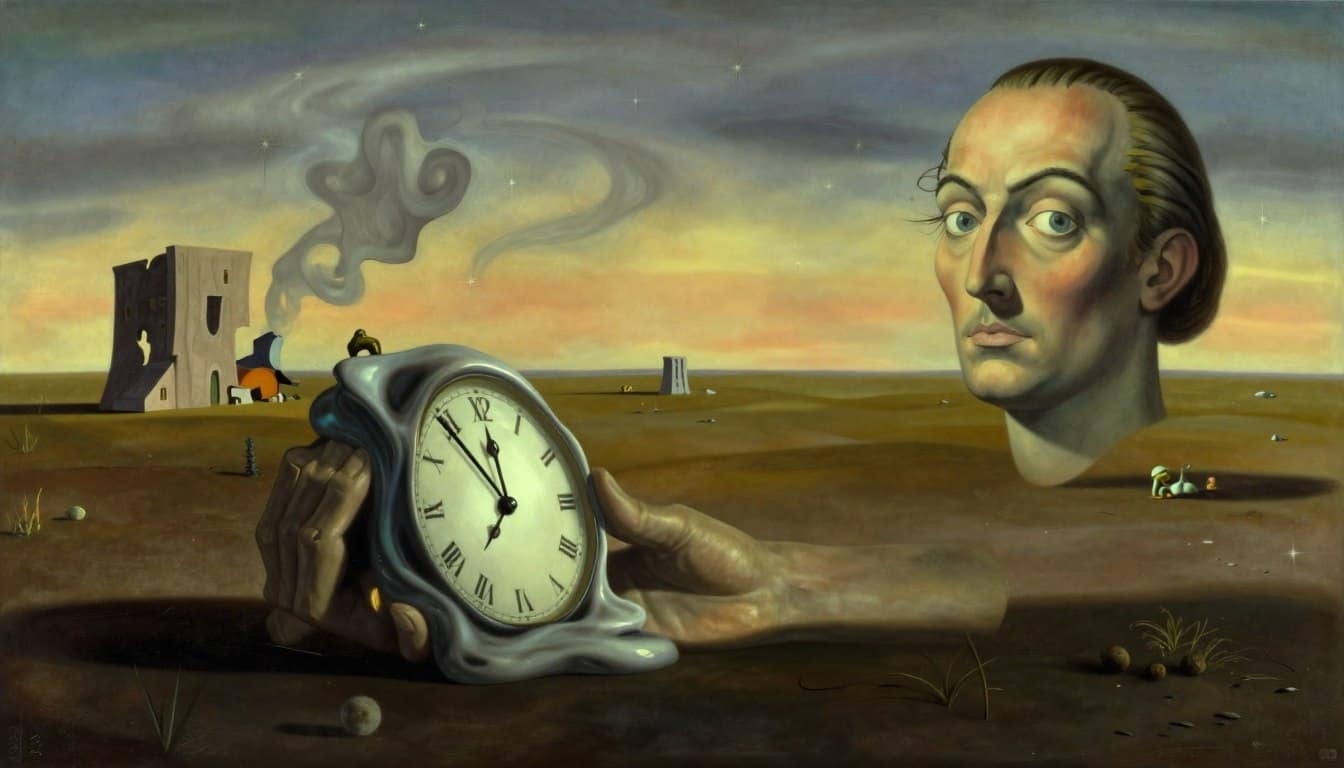
Have you ever seen a face in a cloud or a hidden picture in a pattern? This fun trick of seeing things differently opens up a powerful creative world.
Artist Salvador Dalí turned this experience into his groundbreaking Paranoiac-Critical Method. It was more than just an art style. He created a system to use self-induced paranoia and critical thinking.
His aim was to create those amazing double images and ambiguous forms. Dalí himself loved the mystery. In a 1970 interview, he told Dick Cavett, “Today I don’t understand nothing of my works […], so it’s legitimate that other people don’t understand.”
This article will make his method clear. We’ll go beyond art history to find a useful toolkit. You’ll learn how to change how you see things, just like Dalí did. These insights are great for anyone who needs to think outside the box and solve problems creatively.
Theoretical background and optics
To understand Salvador Dalí’s visual tricks, we need to know his deep theories. His paintings were not just random. They were a careful study of how our minds see things.
He used a method called the Paranoiac-Critical Method. Dalí called it a “spontaneous method of irrational knowledge.” It has two main parts.
First, Dalí got into a paranoid or dreamlike state. He let his subconscious make strange connections between things. He loved the suspended state before sleep, when the mind is open to weird ideas.
Then, he used a scientific approach to make these ideas real. He made them precise and detailed. This mix is what makes his illusions so striking and unsettling.
Dalí was also interested in how we see things. He didn’t just paint strange scenes. He created experiences that make our brains see different realities.
He saw modern tech, like TV, as a way to explore this. He studied TV’s “derealising power” and “hypnotic effect.” He thought TV could change how we see things, making us see things in a new way.
This thinking led to his famous illusions. His double images and changing forms are not just for show. They come from his method. Dalí learned to see the world differently and made us see it his way.
Dalí’s Framework for Perceptual Illusion
| Concept | Mechanism | Artistic Outcome |
|---|---|---|
| Paranoiac-Critical Method | Cultivate delirious association, then apply rational critique. | Systematic generation of irrational, yet precisely rendered, imagery. |
| Optical Manipulation | Exploit binocular vision, perspective, and ambiguous contours. | Double images and forms that shift based on viewer focus. |
| Hypnagogic State | Focus on the mind’s imagery in the threshold of sleep. | Dreamlike, fluid scenes that feel both familiar and alien. |
| Technological Derealisation | Use of media (like TV) as a model for fractured reality. | Hyper-real surfaces with a pervasive, uncanny sense of unreality. |
This theory is key to understanding Salvador Dalí’s genius. His paintings are puzzles for our minds. They make us question how we see the world. By using theories of perception and the subconscious, he brought the unseen to life. His work invites us to question reality itself.
This exploration of symbolism in Surrealist art shows how artists like Dalí encoded meaning in their art. Next, we’ll look at how these theories led to unforgettable icons and ambiguous forms.
Iconography of double images and ambiguous forms
Salvador Dalí watched TV upside down through a moiré screen. This wasn’t just odd. It was a way to create ambiguous forms that define his art. He learned to see reality in new, dreamlike ways.
His art shows a deep exploration of complexity. The double images in his work are not just tricks. They are part of a special visual language, filled with symbols and clever visual jokes.
Dalí wanted to make us think more about what we see. When figures look like a vase or a face, our brain works hard. We see different things at the same time. This is the heart of his method, making us find strange connections in everyday things.
Let’s look at some of his most famous symbols. These examples show how he packed many stories into one picture.
| Primary Image | Hidden/Second Image | Symbolic Meaning/Effect |
|---|---|---|
| A rugged coastal landscape with rocks | The profile of a human face | Blurs the line between nature and humanity, the eternal and the mortal. |
| A group of figures arranged in a scene | The outline of a larger object, like a skull or vase | Comments on mortality (vanitas) or the individual’s role within a larger societal structure. |
| Architectural elements and drawers | Anatomical parts of the human body | Represents Freudian concepts of the mind as a locked space filled with hidden desires and memories. |
| Distorted, melting clocks | Organic forms like cheese or faces | Visualizes the subjective, fluid nature of time as opposed to its rigid, mechanical measurement. |
Take the landscape that looks like a face. It’s not just a trick. It shows Dalí’s idea of a “Liquid and Gaseous Television”. The solid landscape turns into the soft, changing features of a person. One reality superposes onto another, making a picture full of meaning. For more on this, check out this scholarly analysis.
Creating these images needed great skill. The mix of forms must feel natural, not forced. The blending of images was done through careful layering. The glazing technique was key to making these double images look so real.
Understanding Dalí’s visual code is the first step. Then, we need to learn how he did it. The technical skill, from the first layers of a painting, is what brings his complex images to life.
Technical painting: drawing transfer, underpainting, glazing, trompe‑l’œil
Creating a double image needs both skill and creativity, as Salvador Dalí knew well. He used classic oil painting techniques to bring his strange ideas to life. This made his surreal visions look incredibly real.
Dalí’s work was praised for its “perfect representations” and “completely unreal realism.” Let’s look at the main steps that made his illusions famous.
Drawing Transfer: The Blueprint of Illusion
Dalí and his team started with detailed drawings. They used a grid to ensure accuracy. These drawings were then transferred to the canvas.
They used charcoal or a pounce wheel to transfer the drawings. The pounce wheel made a dotted outline on the canvas. This careful step set the scene for the double image.
Underpainting: Establishing Light and Form
The next step was the underpainting, or “dead layer.” This layer was usually in shades of gray or brown. It outlined the light and shadow.
This stage was key for Dalí. It helped him solve form and depth before adding color. A good underpainting made the final image feel real and three-dimensional.
Now, the magic begins. Glazing involves applying thin, transparent layers of oil paint. Each layer changes the color without covering it.
Dalí used glazing to add depth and a glowing light. It also blended the edges of two images in a double image. This created the dreamy effect that defined his work.
In his “atomic period,” Dalí used glazing to make objects seem to float or dissolve. This was achieved through careful layering.
Trompe-l’œil: The Ultimate Goal
All these techniques aimed to create trompe-l’œil, or “deceive the eye.” It’s not just trickery. It’s about making the painting so real that it challenges our perception.
Dalí’s work was called “unreal realism.” It was so realistic yet impossible. The double image was the ultimate trompe-l’œil challenge. It required balancing two realistic scenes in one.
The surprise of discovering something new in the painting comes from this technical skill. From the first drawing to the final glaze, each step leads to that mesmerizing moment of confusion.
Studio exercise: design and render a double‑image composition
Ready to try the paranoiac-critical method? This exercise will guide you in creating your own ambiguous painting. We move from theory to practice, turning knowledge into a skill you can use.
You will create a composition where one form blends into another. This is inspired by the work of Salvador Dalí. Follow these steps to unlock your creative vision.
- Select a Thematic Concept
Start with a simple, familiar pair of ideas. Think of natural changes: a cloud turning into a face, a tree root becoming a hand. Pick concepts that are visually connected. This connection is the heart of your double image.
Your idea should spark different interpretations. Don’t pick something too complex at first. A clear idea makes the next steps easier.
- Employ Paranoiac-Critical Prompts
Now, use Salvador Dalí‘s advice as your guide. He talked about using your “interior television” by turning it upside down or looking inward. Try this.
Look at your initial sketch. Let your mind wander and add a second image to the first. Try flipping your drawing over. This simple action can reveal new forms and connections you hadn’t seen before.
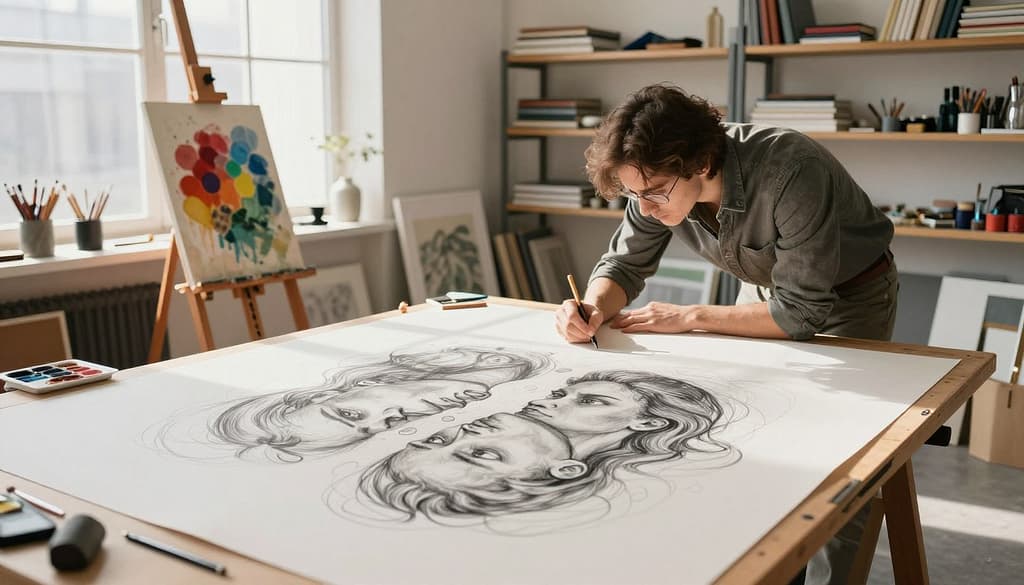
Make a series of quick, rough sketches. Don’t worry about making them perfect. Focus on finding the shared lines where your two ideas can blend together.
Start with a simple example, like tracing a vase. Can the same line also show two facing profiles? This is a great way to begin. Your goal is to create one drawing that clearly shows two different things.
- Refine the Drawing with Value Structure
Once you have a promising sketch, refine it with light and shadow. Create a grayscale study. This step is key for believable illusions.
Decide on your light source. The shadows should model both forms logically. A strong value structure makes the illusion believable to the viewer’s eye.
- Plan the Painting Approach
Look back at the technical methods from before. Plan your layers. Will you use a detailed drawing transfer? An underpainting to set values?
Think about using glazing to subtly change colors and enhance the ambiguity. The trompe‑l’œil techniques you learned are now your tools for creating this visual puzzle.
This exercise makes the abstract concept of optical illusions personal and practical. By following Salvador Dalí‘s prompts, you train your mind to see creatively. The result is more than a painting. It’s a skill in visual problem-solving.
Remember, the first try is an experiment. Enjoy the process of looking inward and letting your “interior television” show you something new.
Critique methods: perception, ambiguity, and interpretation
The true power of a paranoiac-critical composition is not just in its creation. It’s in the analysis that follows. Creating a double image is just the start. To truly understand its meaning, we must switch from artist to critic.
This shift requires a structured approach. We focus on three key areas: perception, ambiguity, and interpretation. This method turns you from a passive viewer to an active analyst.
Let’s break down this critique methodology:
- Perception: What do you see first? What do you discover only after prolonged looking?
- Ambiguity: How stable or unstable is the double image? Does your vision “snap” between forms?
- Interpretation: What symbolic or personal meanings emerge from the combined imagery?
Perception is about the immediate visual experience. In veristic surrealism, the hyper-realistic detail is key. It makes the wildest illusions believable.
This “stupefaction of the spectator,” as theorist Marshall McLuhan noted, is intentional. The detailed technique makes the impossible seem real. Your first glance should see one scene. The second image should feel like a hidden secret.
Next, look at the Ambiguity. A good double image has a fine balance. Is the hidden form clear, or does it hint at more? The best works often resist a fixed interpretation.
This uncertainty is what makes the piece dynamic. Ask if your eye settles or keeps moving. High ambiguity can make the artwork feel alive and engaging.
The last layer is Interpretation. Here, personal and cultural context matter. What does combining these two forms suggest? A face hidden in a landscape might suggest a spiritual presence in nature.
Symbols often connect to the unconscious mind, holding meanings even the artist may not have fully grasped. Your task is to offer a reading. There’s no one “right” answer, but compelling arguments based on the visual evidence.
Apply this three-part method to your own work. First, note the visual journey. Then, assess the ambiguity’s impact. Lastly, propose an interpretation. This structured critique turns your work into a profound piece of veristic surrealism ready for discussion. It completes the creative cycle, empowering you to analyze not just your illusions, but the great works of the genre.
Ethical teaching notes on psychological themes
Salvador Dalí’s use of strange images was more than just art. It was a way to explore the mind, which teachers today must approach with care. Teaching veristic surrealism and its unique techniques means guiding students through deep, subconscious ideas. This requires a careful and ethical approach from the start.
Dalí called this method the “paranoiac-critical” state. It’s a way to engage with irrational thoughts and feelings. Artists learn to see things in a way that’s both unsettling and transformative. This method taps into our deepest, unconscious thoughts.
Teachers have a big job: to make a safe space for this exploration. They aim to spark creativity without causing harm. This means setting clear rules and talking openly before starting any activity.
- Establishing Psychological Safety: Make the studio a place where students feel safe. Let them know they’re in control and can stop anytime.
- Framing as a Technique: Explain that the exercise is a controlled artistic simulation. It’s not about real paranoia or diving into personal trauma.
- Acknowledging the Content: Be clear that the subconscious can create potentially disturbing images. See it as part of the creative journey, not a personal reflection.
- Prioritizing Critical Analysis: This is key. After exploring the irrational, students need to analyze and decide on their art.
This last point is very important. The “critical” part of the method is what balances it. It turns raw thoughts into intentional art. Teachers should focus on both creating and analyzing these images equally.
Dalí knew how media could affect our minds, warning of its power to make us passive. Teachers should be aware of this too. By guiding students through veristic surrealism responsibly, they can unlock deep creativity. This is done in a professional, mindful, and aware way.
Comparative analysis with other illusionists
Dalí’s work on perception wasn’t alone. Artists like Andy Warhol and Nam June Paik also explored media’s impact on reality. But their approaches and meanings were quite different from Dalí’s.
Warhol focused on the surface and repetition. Paik, on the other hand, broke down the TV’s electronic essence. Dalí, though, saw the TV as a portal to the subconscious, embracing its power for irrational storytelling.
This makes Dalí unique compared to artists who rejected TV. Fabio Mauri, Chris Burden, and Richard Serra criticized TV’s passive nature and ideological sway. Their work was a clear, conceptual rejection. Dalí, by contrast, absorbed and transformed TV.
Looking at art history, we find many visual tricksters. But Dalí’s work stands out because of his unique approach.
- Giuseppe Arcimboldo (1526-1593): Known for composite portraits. His art is a puzzle, blending fruits or books into faces. It’s often allegorical, not psychological.
- M.C. Escher (1898-1972): Famous for impossible drawings. His work explores infinite loops and conflicting views with precision. It’s a mind-bending logic, not a dreamlike state.
- Salvador Dalí (1904-1989): Creator of veristic surrealism. His double images come from deep, irrational thoughts. His technique is hyper-realistic, making the impossible seem real.
This comparison highlights Dalí’s unique value. He combined an old master’s technique with a modern, Freudian exploration of the psyche. This blend is what makes his work special.
His art is not just a visual puzzle. It’s a psychological artifact. For more on this, check out the Paranoiac-Critical Method. This method sets him apart from other optical artists. It turns his veristic surrealism into a tool for revelation, not just deception.
In the world of illusionists, Dalí is the great psychologist. His glazing gives shape to our formless fears and desires. This is his lasting, unique contribution.
Materials List and Safety (Solvents, Ventilation)
Before you start painting, make sure your studio is ready. You need the right tools and safety measures for a successful oil painting. This section will guide you on the essential materials for glazing and detail work. We also talk about important safety practices.
Having the right tools is key to your control and the painting’s quality. Below is a list of the main materials you’ll need.
| Category | Essential Items | Purpose & Notes |
|---|---|---|
| Supports | Primed linen or cotton canvas, solid wood panel | Provides a stable, non-absorbent surface for multiple transparent layers. |
| Brushes | Fine rounds (sable/synthetic), filberts, liners | Small rounds for detail; soft filberts for smooth glazing application. |
| Paints & Mediums | Professional grade oils, linseed oil, resin-based glazing medium | Mediums increase transparency and slow drying for blending. |
| Solvents | Odorless mineral spirits (OMS), glass jars | OMS thins paint and cleans brushes with fewer fumes. |
Invest in a few high-quality fine round brushes. They are essential for sharp edges and subtle transitions. For paints, choose a few professional-grade colors over many student-grade ones.
Mediums are key for luminous layers. A glazing medium, often a mix of resin and oil, is perfect. It improves flow and transparency without weakening the paint. Artists like Salvador Dalí used these techniques for depth.
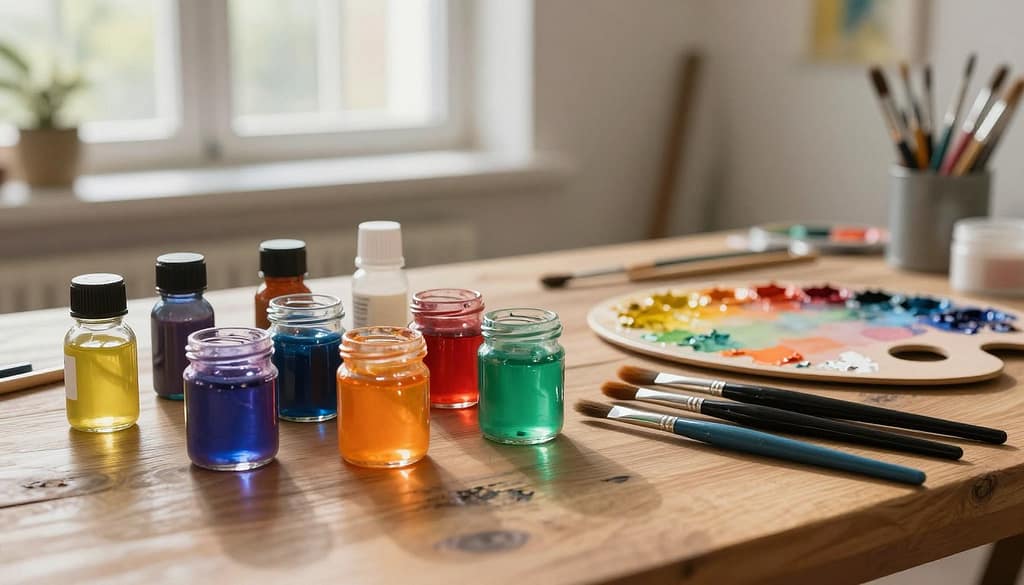
Your studio must prioritize health. Oil painting involves volatile substances. Proper handling is not optional.
Ventilation is Critical. Always work in a room with cross-ventilation—open windows with a fan pushing air out. For a permanent studio, consider installing an exhaust fan. Never work in a closed, unventilated space.
Safe Solvent Practices:
- Use odorless mineral spirits (OMS) over traditional turpentine.
- Store solvents in sealed, labeled glass jars.
- Never pour solvents down the drain. Allow waste to settle in a jar, then dispose of sludge as hazardous waste.
- Keep all containers away from open flames or heat sources.
Personal Protective Equipment (PPE):
- Wear nitrile gloves to prevent skin contact with solvents and pigments.
- Use a VOC-rated respirator if ventilation is less than ideal or during prolonged sessions.
- Protect surfaces with disposable covers for easy cleanup.
Combining premium materials with rigorous safety creates the ideal environment for focused work. This responsible approach protects your health and lets you explore complex techniques with confidence. Your art deserves nothing less.
Conservation notes for layered oils
Creating a masterpiece with layered glazes is just the start. Keeping it bright for years to come is what makes an artist great. This guide focuses on how to care for your work.
Paintings with many layers need special care. They shine brightly because of their depth. But, oil paint’s slow drying can be a problem. Taking good care of them helps them last.
The Critical Role of Drying Time
Don’t rush the drying process. Each glazing layer must dry before adding the next. This follows the “fat over lean” rule.
Lean layers dry quickly because they have more solvent. Fat layers, with more oil, take longer. Putting a fast layer over a slow one traps moisture. This can cause cracks.
For thin glazes, wait 24 to 48 hours in a clean space. Thicker layers or details might need a week or more. Being patient prevents damage.
Varnishing: The Final Protective Shield
Applying a final varnish is essential for protection. It keeps the painting safe from dirt and minor scratches. It also brings out the full beauty of your glazing work.
Wait at least six months to a year before varnishing. This lets the oil fully cure. Use a removable, synthetic resin varnish (like Gamvar) in a thin coat. This makes cleaning safe for future conservators.
The biggest danger to an oil painting is its environment. Changes in humidity and temperature can cause damage. This includes cracks and paint peeling off.
Light, and UV rays in particular, can also harm. They fade colors and yellow varnish over time. Even the works of Salvador Dalí are now shown in low light to slow down damage.
Here’s a quick guide for the best conditions:
| Factor | Ideal for Display | Ideal for Storage |
|---|---|---|
| Light | Low, diffused light; Maximum 200 lux; No direct sunlight | Complete darkness |
| Relative Humidity | 45% – 55% (stable) | 45% – 55% (stable) |
| Temperature | 68°F – 72°F (20°C – 22°C) | 65°F – 68°F (18°C – 20°C) |
| Air Quality | Protected from dust, smoke, and kitchen fumes | Same, with acid-free materials |
Get a hygrometer to check your space. Avoid hanging paintings near heat or outside. For storage, use acid-free boxes and paper.
By following these steps, you become a guardian of your art. For more information, check out the Getty Conservation Institute or the American Institute for Conservation. They offer expert advice.
Bibliography and film/interview resources
This list is a great starting point for diving deeper into the techniques and ideas discussed. Directly engaging with primary sources and expert opinions can greatly enhance your artistic skills.
Salvador Dalí’s writings are incredibly insightful. His book “50 Secrets of Magic Craftsmanship” shares his technical methods. “Diary of a Genius” gives a personal look into his creative process and the creation of his famous double images.
Marshall McLuhan’s “Understanding Media” is also worth exploring. It looks at how media influences our perception. This is important for understanding Dalí’s use of TV and popular culture to show his ambiguous forms.
Expert scholars like Beniamino Levi and Nicolas Descharnes have greatly contributed to understanding Dalí’s work. Their research helps us appreciate his vast and diverse creations.
Filmed interviews showcase Dalí’s talent. His 1970 appearance on the Dick Cavett Show is a great example. His 1961 segment on The Ed Sullivan Show also brought his surreal visions to a wide audience in America.
By exploring these resources, you’ll gain a deeper understanding of surrealist painting and the art of creating ambiguity. They offer a direct connection to Dalí’s creative process and his lasting impact.