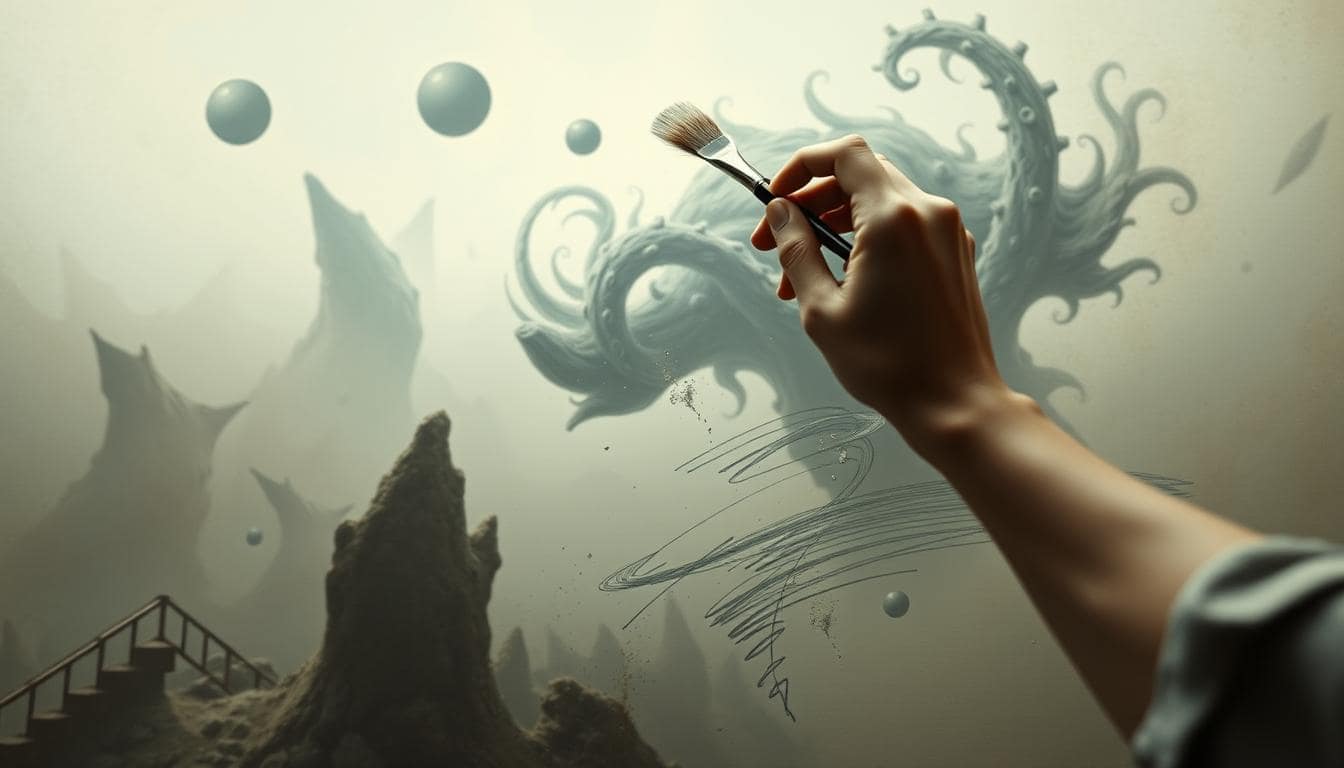
What do TikTok’s viral “unfiltered” videos share with Salvador Dalí’s melting clocks? Both try to skip the brain’s editor. In 1924, André Breton launched his Surrealist Manifesto, challenging rational art. He believed in Subconscious creativity, saying true art comes from the mind’s hidden corners, not careful planning.
This wasn’t just a rebellion in the art world. Breton’s team used Freud’s dream analysis to guide their art. It was like Jackson Pollock meets Rorschach test. They aimed to capture raw human essence before the ego edited it.
Dalí didn’t just paint nightmares. He created them using paranoid-critical methods. He turned ants into superheroes and clocks into limp objects. His goal was to outsmart his own consciousness, like trying to catch smoke with bare hands.
Today’s creators seeking “authentic” content might see Breton’s influence. Whether dripping paint or posting hot takes, the goal is the same: hijack the mental autopilot before doubt edits it. The surrealists just needed fewer hashtags.
Introduction to Automatism in Art
Imagine your paintbrush moving without permission – that’s automatism in a nutshell. This rebellious art technique turns “oops, I did that?” into a philosophy, letting raw impulse override careful planning. Where else do we see this? Your morning coffee doodles. The nonsense you text at 2 AM. The chaos of modern meme culture. Let’s unpack why artists decided to weaponize this human glitch.
Defining Automatism: The Id’s Art Studio
Automatism is art’s version of Freudian slip – unfiltered creativity bypassing the brain’s editors. Surrealists treated it like a backdoor to the unconscious, where illogical scenes weren’t mistakes but revelations. Think of it as creative drunk-dialing: messy, honest, and occasionally genius.
Key characteristics include:
- Spontaneous mark-making (no “undo” button)
- Embracing accidental textures and collisions
- Prioritizing process over polished outcomes
Historical Roots: Dada’s Middle Finger to Logic
Before Surrealism got deep, Dadaism set the stage by crashing a bicycle through art’s stained-glass window. Their 1916 Zurich manifesto? Basically an art-world prank call. Dadaists like Hannah Höch and Marcel Duchamp used juxtaposition in art like grenades – gluing bus tickets to canvases or labeling urinals as masterpieces.
Max Ernst took this further with his collage novels. By slicing up Victorian magazines, he created illogical scenes that feel eerily familiar today – the 1920s equivalent of surreal meme formats. His “Une Semaine de Bonté” could easily be an Instagram feed for existential dread.
| Movement | Vibe | Weapon of Choice | Legacy |
|---|---|---|---|
| Dadaism | Anarchist clown | Scissors & glue | Meme culture ancestor |
| Surrealism | Therapist with paint | Automatic drawing | Algorithms’ nightmare fuel |
Here’s the twist: while Dada just wanted to watch the world burn, Surrealists used the same fire to roast marshmallows of meaning. Both movements loved jarring contrasts, but where Dada screamed “NOTHING MATTERS!”, Surrealism whispered “What if everything does?”
Automatism in Surrealist Practice
Imagine your smartphone’s autocomplete feature taking over your creative thoughts. That’s what surrealists did with automatism. It was more than art; it was psychological parkour where they jumped over their own thoughts.

Masters of Controlled Chaos
André Masson made ink spills into deep, existential maps. He’s like Jackson Pollock’s angrier French cousin. His psychic automatism turned random drips into deep, subconscious images, like Rorschach tests with real meaning.
Joan Miró had a unique style, creating what I call “constellation constipation”. His floating shapes and starbursts looked like cosmic cave paintings. They showed you can make deep art even when your brain is on autopilot.
André Breton was like the Simon Cowell of surrealism. While others made art, he used their techniques to write manifestos. His automatic writing was like conspiracy theories from a fascinating drunk.
DIY Subconscious Mining
Want to try automatic writing? Here’s how to do it, in simple steps:
- Grab pen/brush (wine optional but encouraged)
- Disable your inner editor (imagine dragging it to trash)
- Let hand move like Ouija board planchette
- Decipher results like alien transmission
Think of it like ChatGPT fed dream journals and absinthe. The goal was to embrace the glorious mess of unfiltered thoughts. As Masson showed, sometimes the most profound messages look like your cat walked through ink.
Automatism and the Unconscious Mind
The Surrealists didn’t just take Freud’s ideas; they remixed them like underground hip-hop producers. They used dream theory beats to make avant-garde art. Imagine Freud as the first DJ of the mind, mixing hidden meanings with the obvious.
His 1899 Interpretation of Dreams was their guide. But they didn’t aim to fix mental issues. Instead, they explored the mind’s hidden corners for art.
Psychoanalytic Connections (Freud)
Freud’s ideas on condensation and displacement helped the Surrealists. Artists like Dalí used these concepts to create deep symbolism. For example, melting clocks symbolized more than time; they represented eroticized parent figures.
In 1924, they even started a “Surrealist Bureau of Research.” It was like a team of artists obsessed with understanding dreams.
But Freud didn’t like Surrealism. He thought they simplified dream analysis too much. The Surrealists didn’t care. They saw Freud’s ideas as a way to unlock the subconscious, not just for science.
Automatic drawing was like Freud’s free association. It aimed to capture raw mental thoughts. Miró’s art and Masson’s splatters were examples of this. They turned art into a way to explore the subconscious.
Automatism Today: Contemporary Influences
What happens when automatism vs. intention meets TikTok and AI memes? Surrealism’s love for chance is alive in our swipe culture. Now, objective chance surrealism is more like Tinder’s “Super Like” than Max Ernst’s frottage. Our unconscious mind has evolved to AI.
Jackson Pollock’s art seems old-fashioned next to Instagram’s AR filters. These digital masks change reality and create surreal identities quickly. Every selfie becomes a tribute to automatic drawing, without the ink.
Tinder’s matching system is like Breton’s objective chance surrealism on steroids. The app’s algorithm finds matches with the same random logic as early surrealists. We’re not searching for exquisite corpses in cafés anymore. We’re swiping for human collages at 2 AM.
Today’s creators use chance in new ways. Digital artists use code to mimic automatic processes:
- Generative NFT art that “paints itself” through blockchain parameters
- AI poetry bots channeling unconscious word associations
- Instagram’s “Surprise Me” feature as the new automatic writing prompt
The big question is: Are we in control or are these tools reprogramming us? When a face filter turns you into a cubist masterpiece, who’s the artist? You, the algorithm, or André Breton’s ghost in the metadata?
Teaching Automatism: Pedagogical Strategies
Imagine starting art lessons with sleep loss and too much caffeine. Teaching automatism today mixes Freud’s ideas with a bit of chaos. It’s about finding subconscious creativity without freaking out the students.
Here are three effective methods that blend old-school automatism with modern classroom tricks:
- Coffee-Induced Scribbling 101: Students do 20 quick sketches before their coffee gets cold. A tip: Use your non-dominant hand to avoid saying “I can’t draw.”
- Zoom Corpse Exquis: In breakout rooms, students get a new digital canvas every 90 seconds. It’s like seeing Pollock meet glitch art.
- Dream Journal Roulette: Students swap dream stories and draw them. Freud would either be impressed or want royalties.
Grading the Ungradeable
| Traditional Criteria | Automatism Metrics | Survival Tips |
|---|---|---|
| Technical Precision | Flow State Duration | Stock up on smudge-proof paper |
| Color Theory Mastery | Caffeine Tolerance Levels | Hide the good markers |
| Composition Balance | Unplanned Happy Accidents | Install floor tarps |
When students stop trying to make art and just let go, magic happens. I’ve seen even cybersecurity majors create amazing art once they let go. One student wrote in their final paper, “My anxiety looks great in watercolor.”
Today’s teachers don’t just teach techniques; we create chaos. The best moment is when a student is amazed by their own art. It’s like seeing a surrealist dream come to life, one class at a time.
Critical Perspectives and Debates

Surrealism’s greatest trick is making us wonder if chaos is planned. The movement loves juxtaposition in art, like Magritte’s floating hats and apple-faced men. It asks, can you plan to be spontaneous? Critics have been arguing about this for years.
Dalí’s clocks and Masson’s splattered art are at the heart of the debate. Dalí’s work is like a Vegas magic show, full of smoke and tricks. Masson’s art, on the other hand, is like a jazz improvisation, raw and off-script. Magritte’s work, as Source 2 points out, often has hidden design behind its madness.
| Artist | Method | Critics’ Take | Modern Parallel |
|---|---|---|---|
| Salvador Dalí | Planned paradoxes | “Theatrical automatism” | Political soundbites |
| André Masson | Unfiltered gestures | “Pure psychic expression” | Twitter rants |
| René Magritte | Conceptual juxtaposition | “Philosophical pranks” | AI-generated art |
This debate is relevant today. Source 3’s look at surrealist politics feels too real. When politicians quote Orwell but pass bad laws, it’s like living in a Magritte painting.
The real question is who benefits from the illusion of automatism. Advertisers use juxtaposition in art to sell us things. Dalí would be shocked by their boldness. Today, surrealism lives in memes, where absurdity comments on society.
The answer might be to accept the tension. Like a magician, the power is in questioning reality while showing the strings. Isn’t that the ultimate surrealist act?
Conclusion: Lasting Impact and Future Directions
Surrealism’s idea of automatism now seems like a guide for our dreams of neural links. André Breton’s call for “pure psychic automatism” sounds like Elon Musk’s dreams of brain-computer interfaces. Both aim to unlock creativity by hacking our minds.
The surreality concept lives on, not in Parisian cafés, but in digital dreams. Algorithms create dreamlike scenes as we scroll endlessly. We’ve moved from inkblots to AI prompts, but our goal remains the same: to reach our deepest selves.
Today’s artists use digital tools as fiercely as Max Ernst used scissors. AI art generators are like surrealist symbolism in surrealism, but with code instead of clippings. But does this mean humans are now the ones deciding what’s real?
Freud’s idea of the id’s shadow theater now plays in VR and neural implants. As we move towards tech-enhanced creativity, surrealism’s legacy raises tough questions. Is our unconscious truly unique when machines can mimic it?
Perhaps the true surreality concept is our belief in human creativity over machines. The future of automatism might be a test we’re afraid to take.