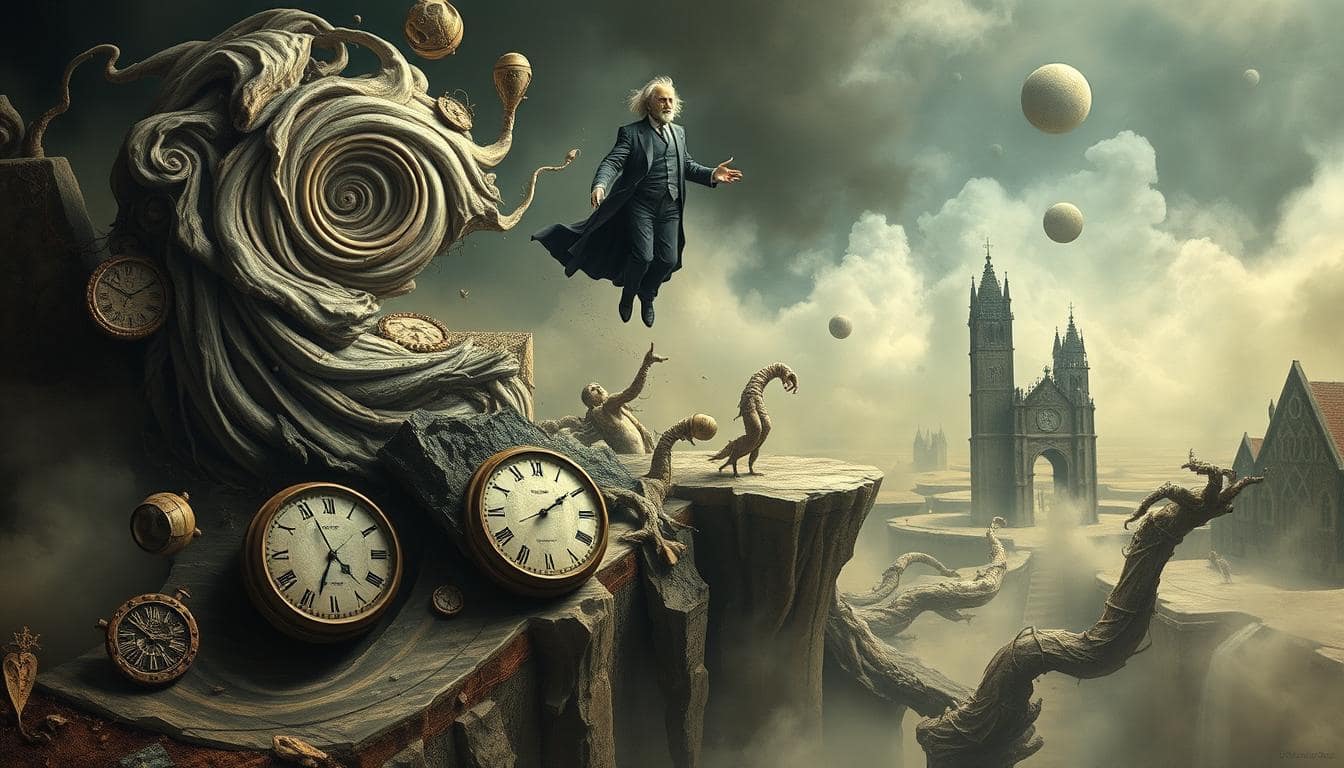
Imagine Salvador Dalí waking up at 3 AM, grabbing a paintbrush like it’s his only hope. He’s painting melting clocks in a desert. It’s not just a dream—it’s a statement in paint.
Sigmund Freud’s The Interpretation of Dreams changed psychology and inspired surrealists. André Breton’s 1924 Surrealist Manifesto was like a call to explore Freud’s ideas. Automatic writing was like drunk-texting your subconscious.
Artists used Freud’s ideas to create strange, dream-like scenes. Dalí’s clocks were more than weird—they showed how time affects us.
Breton’s team didn’t just paint dreams. They turned them upside down, using psychoanalysis to create new art. They mixed Freud’s ideas with their own, making surrealism a bold art movement.
Freud’s Theories of Dreams
Imagine Freud walking into a Surrealist party, cigar ash falling on Dalí’s waxed mustache. He explains how your childhood fears might look like a melting clock. He didn’t just study dreams; he gave artists a peek into the mind’s secret world. His ideas of condensation and displacement helped artists mix the subconscious into their work.
The Couch Meets the Canvas
Freud’s theories were like a puzzle for Surrealists:
- Condensation: In Surrealism, a lobster-telephone could mean many things at once. It’s a mix of fear, technology, and seafood phobias.
- Displacement: Magritte’s apple-faced businessmen were more than odd. They were hiding behind their serious looks.
- Repressed desires: Miró’s shapes were not just random. They showed the struggle between different parts of the mind in bright colors.
Artists used Freud’s dream logic to create magic. Dalí’s Lobster Telephone is a perfect example. It combines a lobster (a symbol of sex) with a phone (a symbol of communication). It’s like Freud asking, “What do women want?” but with a lobster.
| Freudian Concept | Artistic Manifestation | Hidden Meaning |
|---|---|---|
| Condensation | Dalí’s melting clocks | Anxiety about time + rectal fixation |
| Displacement | Magritte’s apple faces | Corporate identity crisis + oral fixation |
| Repressed Desires | Ernst’s bird hybrids | Oedipal complex with feathers |
Surrealists didn’t just show Freud’s ideas; they made his theories famous worldwide. Next time you see a painting that makes you think of therapy, thank Freud’s Interpretation of Dreams. But don’t ask him about your childhood teddy bears.
Surrealists’ Engagement with Dream Analysis
Imagine if your therapist charged admission to your subconscious – that’s what the Surrealists did. They used dreams to create visual art, unlike Freud who analyzed them through inkblots. They saw the mind as a broken piñata, capturing the spill as art.
Automatism: The Original Brain Dump
Before bullet journals and apps, André Masson used psychic automatism to create art. It was like Jackson Pollock meets a hyperactive toddler with ink. His drawings were exorcisms, proving creativity blooms when you stop thinking.
Max Ernst took it further with frottage, rubbing pencil over tree bark. His canvases were like Rorschach tests, revealing postwar anxiety. Surrealism’s techniques turned accidents into art, blending intention and chance.
From Parlor Games to Masterpieces
The Exquisite Corpse game began as drunk doodles at Breton’s. It evolved into objective chance surrealism, with mismatched body parts symbolizing modern identity. By the 1940s, these games became:
- Collages that made satire from magazine clippings
- Paintings where clocks melted like ice cream
- Installations that turned galleries into Freudian funhouses
Today’s AI art owes a lot to these games. The Surrealists didn’t just paint dreams – they created factories for the uncanny, one brushstroke at a time.
Iconic Dream-Based Surrealist Works
Imagine walking into a crime scene where clocks melt like Camembert left in the sun—welcome to Salvador Dalí’s subconscious. Surrealist artists didn’t just paint dreams; they weaponized them. They created illogical scenes surrealism enthusiasts dissect like Freudian cold cases. Let’s dust these canvases for fingerprints and decode their symbolic DNA.
Dalí’s Melting Clocks and Other Uninvited Dream Guests
The Persistence of Memory isn’t just a painting—it’s a temporal crime spree. Those droopy timepieces? Dalí’s cheeky rebellion against rationality, inspired by Einstein’s relativity theories and Freud’s obsession with dream imagery art. But don’t ignore the ants swarming that pocket watch: they’re Freudian symbols of decay, nibbling away at bourgeois notions of order.
Magritte’s The Treachery of Images takes a different approach. That pipe labeled “Ceci n’est pas une pipe”? It’s less about smoking and more about smashing reality’s fourth wall. The painting winks at us: “You think you know what a pipe is? Think again, Descartes.”
| Artist | Work | Dream Technique | Freudian Symbol |
|---|---|---|---|
| Salvador Dalí | The Persistence of Memory | Paranoiac-critical method | Melting clocks (castration anxiety) |
| René Magritte | The Son of Man | Juxtaposition | Floating apple (repressed desires) |
| Frida Kahlo | The Wounded Deer | Autobiographical surrealism | Arrow-pierced stag (chronic pain) |
| Dorothea Tanning | Eine Kleine Nachtmusik | Domestic surrealism | Sunflower claws (sexual awakening) |
Kahlo’s dream diaries make Dalí look tame. Her Roots painting transforms her body into a bleeding plant—a visceral cocktail of Mexican folklore and surgical trauma. Tanning’s furry teacups in Birthday ask: “What if Alice drank LSD-laced tea instead of ‘Drink Me’ potion?”
These artists didn’t just borrow from dreams—they held them hostage. Through Surreality concept masterpieces, they proved our sleeping minds contain more truth than our waking logic. The real mystery? Why gallery security hasn’t installed velvet ropes around our fragile sense of reality.
Psychological Mechanisms in Visual Art
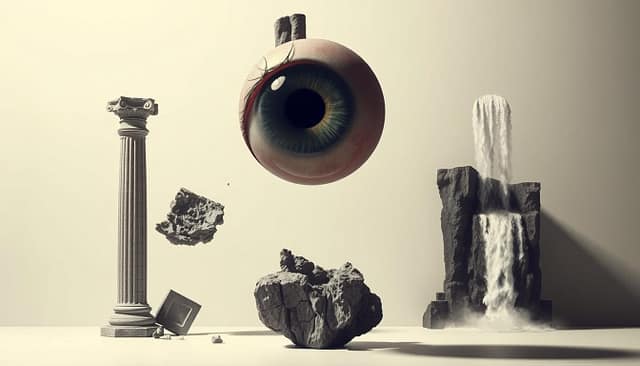
Surrealist artists didn’t just paint dreams; they used Freudian psychology to challenge reality. They turned symbolism into a powerful tool and juxtaposition in art into a way to mix incompatible things.
Juxtaposition: Reality’s Worst Roommates
Think of your subconscious as a small New York apartment. Here, fish tanks and typewriters fight over who left the fridge open. Giorgio de Chirico’s paintings, with bananas growing from statues, show Freudian displacement in a visual form. It’s like finding your childhood teddy bear tied up with a tax audit.
Let’s look at some surrealist relationship updates:
| Artist | Object Pairing | Psychological Gut Punch |
|---|---|---|
| Chirico | Greek torso + rubber gloves | Unresolved daddy issues |
| Magritte | Apple mask + business suit | Existential imposter syndrome |
| Dalí | Lobster telephone | Seafood-related anxiety dreams |
Magritte’s apple-faced businessman is more than symbolism in surrealism. It’s like a 1930s version of a LinkedIn lie. These paradoxes trick our brains into accepting the absurd as true, like believing in astrology to explain parking tickets.
Why does this Freudian visual warfare work? Our brains love patterns, like millennials love avocado toast. When artists surprise us (like a train bursting from a fireplace), it’s like our therapist laughing at our childhood stories. It’s uncomfortable but also strangely appealing.
The magic happens in the spaces between objects. Our brains try to connect the dots, making Freud surrealism like a visual Rorschach test. We’ll give meaning to anything, from melting clocks to suspicious trees.
Classroom Practice: Analyzing Dreams in Art
Imagine giving homework where students analyze a TikTok dance through Dalí’s method. Surrealism’s dream logic is now in classrooms, not just museums. Teachers today teach students to understand dreams in surrealism with tools from the 1920s to AI.
Teaching the Unteachable
How do you grade a student’s take on melting clocks as a symbol of Zoom fatigue? Modern teaching turns surrealist artists‘ visions into lessons. Here are some ways to do it:
- Rorschach Remix: Use Spotify Wrapped playlists instead of inkblots to analyze music choices as modern automatism
- AI Exquisite Corpse: Have students create dream stories with ChatGPT, updating automatism in art
- VR Dali-ism: Let students explore Persistence of Memory in Meta Quest headsets
Students who laugh at Freud’s cigar symbolism will debate AI dream generators’ artist credits. This shows a shift:
| Tool | Surrealist Era | Modern Equivalent |
|---|---|---|
| Free Association | 1920s Paris cafés | Twitter/X Threads |
| Hypnagogic States | Breton’s sleep writings | VR-induced lucid dreaming |
| Chance Operations | Dice-based composition | AI randomization algorithms |
When a student connects Jungian archetypes to K-pop fancams, you’ve done your job. The real test is making Gen Z see TikTok’s For You Page as today’s dream diaries.
Case Studies
Imagine an artist’s dream journal filled with crime scenes. Let’s look at symbolic fingerprints in surrealism. We’ll see how dreams and the subconscious can influence art. Two artists let their nightmares guide their brushes.

When Dreams Become Nightmares (Literally)
Frida Kahlo’s The Broken Column is more than a self-portrait. It’s a scream in oil paint. The steel corset holds her chronic pain. Nails piercing her flesh show agony in a raw way.
Kahlo’s work shows the psychic automatism of pain. Her brush records her body’s betrayal like a stenographer. It’s a visual scream from her suffering.
Shelby Wright’s art is a modern take on nightmares. Her 2022 series Ursine Apocalypse shows bear attacks in bold strokes. Critics say it’s about climate anxiety. Freudians see bear symbols. But Wright’s journals tell a simpler story.
Her childhood trauma involved a taxidermied grizzly. Sometimes, a bear is just a bad memory in fur.
Both artists show the power of symbolism in surrealism. Kahlo’s nails are real, showing her 32 spinal surgeries. Wright’s bears are demons from sleep paralysis. These works make us question: When does art become too personal?
Contemporary Dream Analysis in Artistic Practice
The surrealists’ love for dreams has changed from absinthe-fueled sessions to using AI in art. Today, artists are using neural networks to tap into their subconscious. Instagram’s #surreal hashtag is filled with digital dreams every day. But is this a true evolution or just a way to please algorithms?
From Absinthe to Algorithms
Dali’s method has been updated with software. Artists like Refik Anadol create stunning landscapes with AI. These tools don’t just understand dreams; they create new ones from data patterns.
But, does this AI art truly capture the essence of objective chance surrealism that Breton loved? Or is it just a mix of online images?
Virtual reality takes this to another level, creating spaces inspired by Freud. It’s like walking through your dreams. NFTs have also become a new way to share dreams, sold as digital tokens. It’s like Magritte’s famous painting, but now it’s a digital image.
But can machines really understand the surrealism concept like humans do? Or are they just advanced at making collages? When an AI makes a dreamy image by combining 10,000 paintings, is it creative or just copying? The answer might depend on what we consider art and if we value human touch in it.
Conclusion
Imagine Sigmund Freud and André Breton creating a reality show about subway rats discussing existential dread. This mix of psychoanalysis and surrealism is not just theory. It’s a spark that lights up our everyday lives.
Surrealist artists showed us to find meaning in the ordinary. They turned Freud’s ideas into visual art, where pocket watches melt and lobsters ring doorbells. It’s a world where the usual becomes extraordinary.
Your desk stapler is more than just a stapler. Surrealism sees it as a symbol from our subconscious, waiting to be understood. The movement used Freud’s ideas to challenge our rational thinking. It turned our minds into a game.
Why see traffic jams as just a hassle when they could be art about feeling disconnected? Surrealism encourages us to see the world in a new way.
Today’s culture shows the surrealists were right. TikTok filters turn faces into Dalí-like visions. Corporate logos hide secrets, just like Magritte’s famous pipe. Once you see the world through Breton’s lens, you can’t ignore the absurdity around us.
The real question is not “What does it mean?” but “Can you handle the meaning?” When your coffee looks like a liquid clock, remember surrealism’s challenge. It’s a call to see beyond reality and laugh at the symbols beneath. Your turn, Freud.