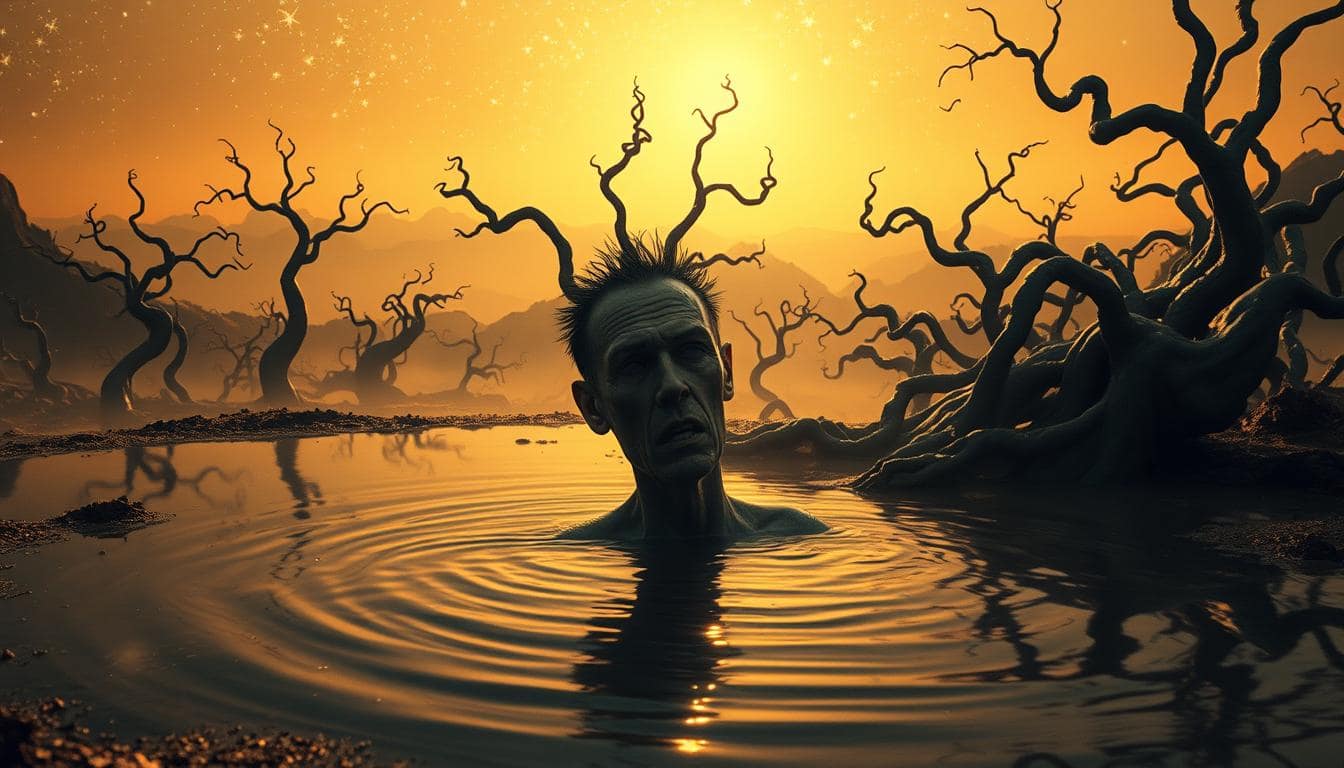
Imagine Salvador Dalí’s clocks hanging over Sigmund Freud’s chair like melted cheese. A couch turns into a canvas. This was more than art—it was a declaration of war on reality. When Freud published Interpretation of Dreams in 1900, he gave artists a key to the unconscious mind. They used it to unlock society’s secrets.
Dream analysis became surrealism’s secret weapon. Artists used Freud’s ideas to find symbolic gold in their subconscious. Dalí’s clocks symbolized humanity’s weak grasp on logic. Freud, on the other hand, didn’t like being art’s muse, but his ideas freed creativity.
This mix of psychology and art created waking dreams in art. Think of liquid landscapes and furniture with emotional baggage. Surrealists used dream logic to reveal society’s hidden fears. Freud’s ideas led to the 20th century’s most daring art movement, even if he didn’t want it to.
Introduction to Freud and Surrealism
Imagine Freud studying Victorian-era neuroses in his office. At the same time, André Breton was typing out manifestos like a machine gun. This was the start of something new and exciting. Freud’s “talking cure” inspired Surrealism, leading to a mix of medicine and art.
Breton’s 1924 manifesto took Freud’s ideas and made them bold. His automatic writing method made artists like psychic stenographers:
- No edits
- No logic
- Pure subconscious transcription
Freud’s methods were clinical, while Masson’s work was wild:
| Freud’s Free Association | Masson’s Automatism | |
|---|---|---|
| Tool | Couch | India ink |
| Goal | Diagnose trauma | Create anti-art |
| Result | Hysterical breakdowns | Gallery scandals |
Was this a deep dive into psychology or a bold artistic statement? It was both. Surrealists used Freud’s ideas to challenge the status quo. Their automatism in art was like a creative cheat code, letting the subconscious guide their work.
Freud might have seen Surrealism as a collective dream. But that’s why it was so powerful. By turning “doctor’s notes” into “automatic drawings,” they sparked a revolution.
The Unconscious Mind in Art History
Artists were exploring the unconscious long before Freud. Hieronymus Bosch’s The Garden of Earthly Delights is a 15th-century Rorschach test. It’s a feast of nightmares that makes Disney films look mild.

Medieval dream diaries show our ancestors grasped psychic automatism well. They mixed fantasy with reality in their art. Max Ernst later used collage to interpret dreams with glue sticks.
Goya’s Black Paintings feel like 3AM existential dread tweets. They show humanity’s ongoing battle with its shadow self. Goya’s murals were a rebellion against Enlightenment thinking, painted like graffiti.
Caravaggio’s use of chiaroscuro has a Freudian twist. His dramatic lighting wasn’t just for divine moments. It was about the id trying to break free from strict rules. He pioneered psychic automatism 300 years before the Surrealists.
The line from Bosch to Dalí is about sharing psychological secrets. Next time you see a Renaissance altarpiece, think about the artist’s inner thoughts. Is that golden halo about virtue, or repressed feelings?
Surrealist Appropriation of Psychoanalytic Theory
Surrealists took Freud’s ideas and ran with them, mixing them with Dadaist chaos. They created a unique blend of therapy and art. This mix included everything from floorboard rubbings to cheese-induced hallucinations.
Max Ernst’s frottage technique turned accidental textures into objective chance surrealism gold. By rubbing pencil over weathered wood, he created landscapes that Freud might’ve analyzed as repressed childhood memories. The results? Forestscapes that double as Rorschach tests for the art world.
Buñuel took a meatier approach in Un Chien Andalou. His infamous eyeball-slitting scene wasn’t just shock value—it weaponized Freud’s castration anxiety theory using a straight razor and sheep’s cornea. Talk about cutting-edge symbolism in surrealism.
Dalí’s paranoiac-critical method deserves its own TED Talk. Here’s the 4-step process even your weird cousin could try:
- Stare at decaying food until reality warps (Camembert optional)
- Document every irrational association
- Claim it’s genius, not sleep deprivation
- Profit from melted clock paintings
| Technique | Artist | Freudian Concept | Artistic Output |
|---|---|---|---|
| Frottage | Max Ernst | Objective Chance | Psychic landscapes |
| Disruptive Editing | Luis Buñuel | Uncanny Valley | Film surrealism |
| Paranoiac-Critical | Salvador Dalí | Paraphilias | Liquid chronologies |
These methods transformed psychotherapy into a form of creative breaking-and-entering of the mind. The symbolism in surrealism wasn’t subtle—it was a full-scale assault on rational thought, armed with Freudian theory and zero apologies.
Dream Analysis and Its Role in Surrealism
Imagine mixing Freud’s dream logic with paintbrushes. You get Salvador Dalí’s melted clocks dripping on canvases like wax from a psychedelic candle. Surrealists didn’t just paint dreams—they used Freud’s ideas to turn therapy into art.
Hans Richter’s 1947 film Dreams That Money Can Buy shows characters trading subconscious visions like rare Pokémon cards. It’s not just avant-garde cinema—it’s Freud’s condensation theory in action. Fans loved the illogical scenes, like abstract candy.
Magritte’s famous floating apple? That’s displacement 101—Freud’s idea of shifting emotional weight onto random objects. The Surrealists used these techniques:
- Juxtaposing razors and eyeballs (hello, Buñuel)
- Morphing elephants into spider-legged titans (thanks, Dalí)
- Painting bowler hats raining from the sky (classic Magritte)
When Freud met Dalí in 1938, it was a clash. The psychoanalyst saw pathology; the artist saw profit. Their meeting led to artworks that make therapists take notes.
Today’s AI-generated “surreal” Instagram filters? They’re just copies. True dream analysis surrealism needed artists to explore their subconscious deeply. They emerged with pure, uncensored weirdness.
Key Artists and Works Inspired by Freud
Freudian symbolism in art is like Where’s Waldo for intellectuals. Once you know what to look for, you’ll spot unconscious desires behind every brushstroke. Let’s explore three iconic works that turned Freud’s theories into visual dreams, perfect for classroom analysis or your next gallery-hopping conversation starter.
Salvador Dalí’s melting clocks in The Persistence of Memory aren’t just surrealist decor. They’re Freudian time capsules. Those droopy timepieces represent Freud’s concept of dream-time fluidity.
The ants crawling on the pocket watch symbolize decay and (dare we say it) castration anxiety. Dalí didn’t just read Freud – he lived Freud. He even arrived at a lecture in a diving suit while holding two Russian wolfhounds.
Frida Kahlo’s The Wounded Deer takes personal symbolism to operatic heights. That arrow-pierced stag with Kahlo’s face is a double metaphor for her physical pain and Freudian death drive. The crumbling column in her self-portrait The Broken Column is a spinal metaphor so Freudian it practically whispers “penis envy” through gritted teeth.
Pro tip for educators: Have students compare Kahlo’s visceral symbolism to Freud’s case studies. The connections will shock even your most jaded seniors.
Then there’s Meret Oppenheim’s Object (Luncheon in Fur) – the furry teacup that launched a thousand Freudian analyses. This 1936 masterpiece isn’t just a Dadaist prank; it’s a full-course meal of oral fixation symbolism. The tactile contradiction of fur meeting porcelain is the surrealism concept of “convulsive beauty” served piping hot.
It’s like Oppenheim distilled Freud’s entire Three Essays on the Theory of Sexuality into a single disquieting place setting.
For bonus psychoanalytic art bingo, consider Max Ernst’s The Elephant Celebes. What appears as a fantastical creature is actually a kitchen utensil-turned-phallic monument – a Rorschach test in oil paint. (Classroom drinking game idea: Take a sip of apple juice every time you spot a Freudian symbol. Disclaimer: You’ll be buzzed by slide three.)
These artists didn’t just borrow from Freud – they remixed his theories into visual anthems of the unconscious. The real question isn’t “What would Freud think?” but “Why does that furry teacup unsettle us 90 years later?” Now there’s a discussion prompt for your next art history seminar.
Classroom Activities: Analyzing Dreams in Art
Why settle for boring finger-painting when you can explore lobster telephones? Turn your art class into a fun, chaotic space. These activities make automatism in art exciting and real. I’ve tried them with people aged 14-60, and the results are amazing.

- Students draw while listening to loud shoegaze music.
- Switch papers every 90 seconds in a “musical chairs” style.
- They must add text from random Wikipedia pages to their final collages.
You’ll see amazing, mixed-up creatures that beat Dalí’s elephants. Remember, have antacids ready for parents worried about symbols.
| Activity | Traditional Approach | Surrealist Twist | Learning Outcome |
|---|---|---|---|
| Automatic Writing | Penmanship drills | Write blindfolded to Slint’s Spiderland | Unfiltered subconscious expression |
| Collage Making | Magazine cutouts | Use MRI scans & food delivery apps | Modern context for automatic writing surrealism |
| Art Analysis | Formal critique | Interpret works via dream journal entries | Subjective meaning-making |
MoMA’s Curriculum Meets TikTok Attention Spans
The museum’s Surrealism module gets a Gen-Z update. Try this:
- Analyze Ernst’s frottage through ASMR videos.
- Make Masson’s automatic drawings with smartphone glitches.
- Host Instagram Live “exhibitions” with dream interpretation polls.
Students will debate the meaning of melted clocks. It could be Einstein’s theory or Mom’s meatloaf. You’re welcome.
Remember, when explaining these activities to admins, ask: “Would you prefer another PowerPoint on color theory?” It always works.
Criticisms and Alternate Perspectives
Not every artist wanted to play Freudian charades with their paintbrushes. The Surrealist movement was full of drama, with Game of Thrones-like politics. André Breton’s leadership was criticized for turning psychic automatism into a strict rule.
Georges Bataille’s Acéphale group was like a book club obsessed with chaos and human nature. They opposed Breton’s “artistic Stalinism,” saying true surrealism needed chaos, not Freud. They saw Breton’s approach as missing the point, like using a ouija board for taxes.
When Breton backed Stalin in 1936, it was a big mistake. Marxist critics said it was hypocritical for artists to claim to tap into the unconscious while ignoring class struggles. This was seen as “gallery-grade hypocrisy” – radical art for career gain.
| Faction | Philosophy | Political Stance | View on Freud |
|---|---|---|---|
| Breton’s Surrealists | Controlled automatism | Communist Party alignment | Sacred text |
| Bataille’s Acéphale | Chaotic base materialism | Anti-authoritarian left | Overrated shrink |
| Dada holdouts | Pure anti-art | Anarchist tendencies | Bourgeois nonsense |
Today, scholars debate if objective chance surrealism was truly revolutionary. Was it a way to avoid hard work, or did it truly free creativity? It depends on who you ask.
Even Dalí’s famous melting clocks were criticized. Marxist critic Walter Benjamin said Dalí’s work was just capitalist decadence in Freudian clothes. Breton’s excommunications were as dramatic as his theories.
Legacy in Modern Art and Literature
Freud’s influence is everywhere today. David Lynch’s Twin Peaks and Yayoi Kusama’s art show Surrealism lives on. Now, it’s in VR and digital art.
Modern artists openly show their Freudian side. Kusama’s rooms are like id playgrounds. Lynch’s characters are dream surrealism with a twist.
TikTok’s #dreamcore trend is Surrealism for today’s fast-paced world. Videos like “liminal space” are Dalí’s work with a modern twist. AI art also shows Surrealism’s lasting impact.
When you use a face filter, you’re part of a bigger movement. It’s like Breton’s dream world, where reality is blurred. The question is, will we ever wake up from this digital dream?
Think about AI art that looks like glitch art. It’s not just bugs in the system. It’s your mind’s secret messages. Surrealism’s revolution is ongoing, and we’re using new tools to explore it.