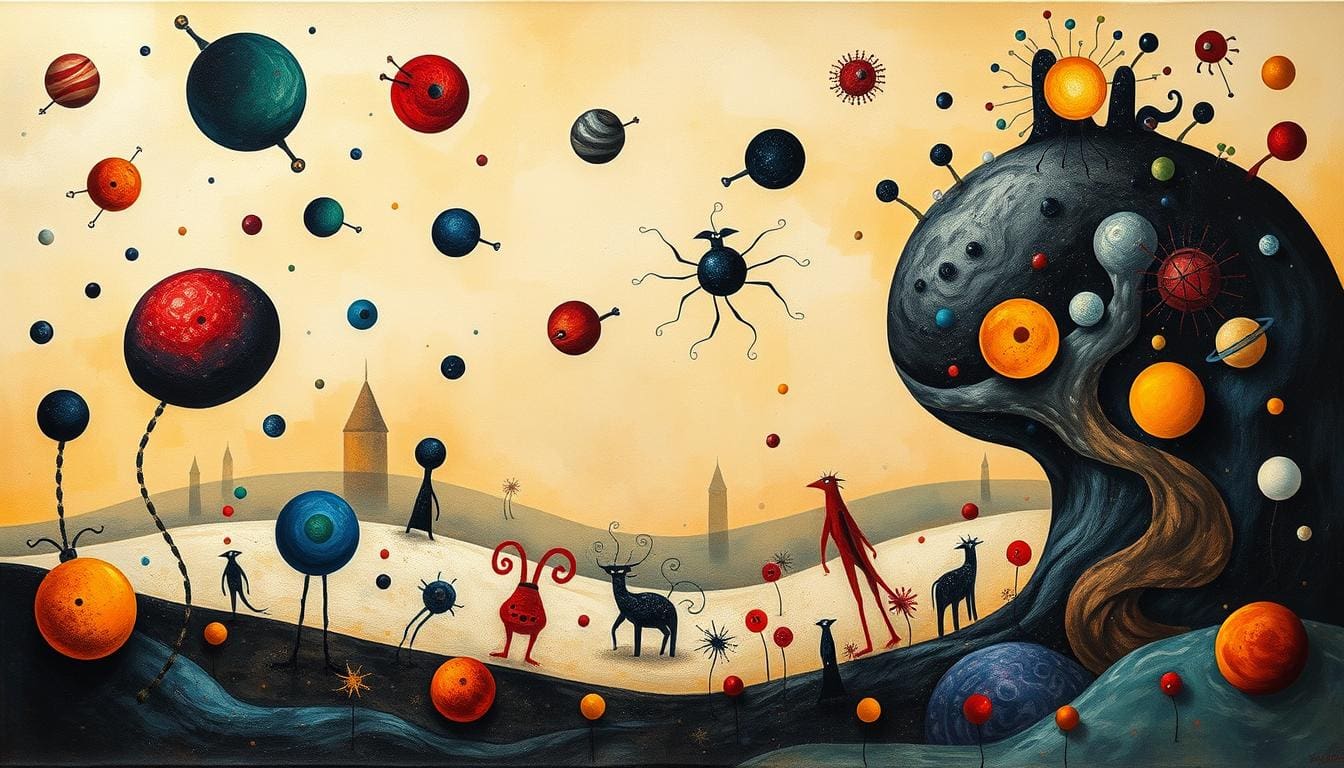
Imagine a Spanish surrealist movement with its own jazz musician. That’s Joan Miró, the painter who saw canvases as improvisational scores. Unlike Dalí, who melted clocks, Miró mixed Catalonia’s rustic beauty with subconscious scribbles that somehow work.
In The Hunter, his 1923 masterpiece, you see a chaotic dance of shapes. But look closer, and you’ll find Miró’s farmhouse memories hidden in automatism techniques. He didn’t just paint dreams; he used spontaneity to express raw emotion.
Hemingway called Miró’s work like “a good hard cider”—simple yet powerful. Miró joked about “assassinating painting,” but his biography shows deep intent. Behind playful constellations, he balanced control and chaos, proving abstract forms can be truer than realism.
MoMA’s archives highlight Miró’s unique approach. While Breton wrote manifestos, Miró lived them, turning canvases into Rorschach tests. His legacy? A reminder that sometimes the loudest revolutions are the quietest.
Early Years in Catalonia
Before Miró’s art took off, he faced ledger columns and his parents’ disapproval. Imagine young Joan, like Barcelona’s Kafka, turning into an artistic cockroach trapped by business books. His father’s accounting firm felt like Alcatraz, stifling his desire to paint Catalonia’s vibrant sunsets.
The 1918 Dalmau exhibition was his chance to break free. Critics mocked his early work, but Miró used their scorn to his advantage. His “The Farm” (1921) was more than a painting; it was a bold statement in simple forms and colors.
Through his diaries, we learn his breakdown was actually a creative explosion:
- Business ledgers became sketchbooks with profit/loss columns reimagined as color theory equations
- La Lonja art school lectures served as cover for clandestine poetry readings
- Traditional Catalan motifs mutated into proto-surrealist symbols
What did a failed accountant bring to surrealism? Precision in chaos. Miró’s Spanish surrealist roots are evident in his “Catalan Tango”. It shows the balance between earthy realism and abstract floating forms.
By 1921, his breakdown turned into a breakthrough. The man who once worked with numbers now painted the stars. Miró’s style was shaped by his commercial background, turning constraints into beautiful, unbalanced art.
Influence of Folk Art
Miró didn’t just paint dreams; he wove them with Catalan folklore threads. His Miró style blends Romanesque simplicity with 1920s Paris chaos. Imagine a pitchfork turning into a cosmic symbol. That’s how he transformed peasant tools into symbols of modern anxiety.
Let’s break down Catalan Landscape (The Hunter) like art students at a midnight session. The painting’s floating eyes and twisted trees come from medieval Catalan art. Miró’s 1924 sketchbooks show him turning village banners into secret symbols. Folk art was his key to unlocking new meanings.
Why should modern artists care? Miró’s method turns cultural scraps into a universal language. His process shows three key changes:
| Folk Element | Miró’s Twist | Modern Meaning |
|---|---|---|
| Peasant Tools | Elongated into cosmic lines | Humanity vs. industrialization |
| Village Masks | Fragmented into floating eyes | Surveillance culture anxiety |
| Romanesque Beasts | Reborn as biomorphic shapes | Primordial fears in atomic age |
This isn’t just art history; it’s a lesson in creative alchemy. Next time you’re stuck, think: What would Miró do with your grandma’s quilt patterns? The Spanish surrealist showed how local traditions can spark global change with bold imagination.
Entry to Surrealist Circles
Joan Miró, a soft-spoken Catalan, joined André Breton’s group in 1924. Parisian cafés buzzed with debates about automatic writing and Freudian slips. Miró brought pintura-poesia, a mix of painting and poetry that stunned everyone.

- 1925’s “The Birth of the World” – a canvas so raw it looked like cave art filtered through a Cubist blender
- Secret letters to Max Ernst (later intercepted by the FBI during WWII) plotting “artistic insurrections”
- His 1925 exhibition that out-Bretoned Breton himself with “This is the Color of My Dreams” – a blue splotch that became surrealism’s unofficial Rorschach test
While Breton focused on manifestos, Miró worked like a jazz musician. He improvised biomorphic shapes that balanced chaos and control. His peinture-poésie period was more than painting. It was visual haiku, using sparse lines and symbols to defy logic.
Art historians debate: Was Miró surrealism’s truest practitioner or its quiet dissident? The FBI files hold the answer. Agents found sketches of imaginary constellations in his letters. These sketches made Dalí’s paranoia seem normal.
Miró’s Abstract & Symbolic Language
Did you know Miró’s squiggles were more powerful than Picasso’s bombs? His biomorphic forms are not just random doodles. They are a powerful message. Let’s explore three key parts of his Miró style that turn simple drawings into deep messages:
- Automatic Drawing: Miró’s “accidental” lines were like jazz improvisations. He started with random marks and then searched for meaning. Art students, try this when you’re stuck. Let your coffee stains inspire you.
- The Hunter’s Hidden Arsenal: His 1924 masterpiece The Hunter (Catalan Landscape) hides deep messages. The figure with a rifle is actually Catalonia fighting against Franco’s regime.
- Dépaysement Technique: Miró’s method of removing objects from context makes shoes look like starving peasants. His 1937 Stil Life with Old Shoe shows a rotting apple, highlighting scarcity more than Picasso’s Guernica.
Miró’s work is unique. While Dalí melted clocks, Miró used simple shapes to make powerful statements. His ladder motifs are not just about reaching for something. They also show the traps of bureaucracy. A 1938 painting might show a ladder going up, but the cloud is actually a crumpled ration coupon.
Miró’s genius is in symbolic efficiency. He used a single wilting flower to show the suffering of many. His Miró biomorphs became a universal language. They speak softly but carry a big message.
Collaboration and International Career
While Picasso collected muses like stamps, Miró built an underground railroad for creative exchange. His Barcelona studio was a surrealist speakeasy. Poets debated metaphysics over absinthe, and painters traded automatic drawing techniques like baseball cards. The real magic happened when he partnered with artists who history nearly forgot – the women in surrealism who shaped his most revolutionary work.
Miró’s collaborations were like a United Nations of avant-garde talent:
- He choreographed Ballets Russes performances where dancers became living hieroglyphs
- He co-created alchemical texts with Leonora Carrington that made Alice in Wonderland look like an IKEA manual
- He designed tarot-inspired costumes with Remedios Varo that could’ve upstaged Bowie’s Ziggy Stardust
His 1958 UNESCO mural commission showed collaboration could outlast Cold War politics. While diplomats argued over nuclear treaties, Miró’s mural survived three regime changes and a rogue cleaning crew armed with bleach. Talk about surreal endurance.
The pièce de résistance? His 25-foot World Trade Center tapestry that transformed corporate lobby art from decorative afterthought to philosophical statement. When the towers fell, Miró’s surviving study drawings became ghostly prophets of resilience – proving even abstract art could carry concrete meaning.
Through it all, Miró championed surrealist poets and writers as equals in visual storytelling. His secret? Treating collaboration like jazz improvisation – set the key, then let soloists shine. A lesson modern artists struggle to learn from the master of creative diplomacy.
Sculpture, Tapestry, and Large Works
When Miró got tired of traditional canvases, he did something bold. He turned entire airports into his sketchbook. The Spanish surrealist’s 1970 Barcelona Airport mural is a carnival of shapes. It makes Jackson Pollock’s work look like kid’s art.

- Ceramic murals that melt like Dali’s clocks
- A 20-ton tapestry for the World Trade Center (1974) that survived corporate blandness until 9/11
- Bronze sculptures resembling alien artifacts at a yard sale
The Miró Foundation in Barcelona is a mix of museum and surrealist playground. Its courtyard has a 22-meter-long ceramic wall. It’s more like a public art takeover than a simple wall.
Classroom Hack: Try Miró’s textile techniques with this simple exercise:
- Grab burlap scraps and acrylic paints
- Create symbolic shapes using only primary colors
- Stitch random buttons as “constellations”
Pro tip: The Miró style works best when students think like 5-year-olds. As the artist said: “I try to apply colors like words that shape poems.” Just remember, don’t tell the janitor about the glitter.
Major Artistic Periods
Picasso’s Blue Period was like a sad song. Miró’s career was a mix of surrealism and abstract jazz. Let’s look at three key periods that amazed critics.
The 1920s Paris Bebop: Miró arrived in Montparnasse with a mix of Catalan and Parisian vibes. He painted The Farm (1921), a blend of Cubism and folk art. This work made Hemingway cry. It was his “Joan Miró joins the avant-garde” era, full of mysterious symbols.
1930s Political Rebop: When fascism spread, Miró’s Stil Life with Old Shoe (1937) spoke out loudly. His biomorphs became fierce, with eyes watching and forms twisting. Art historians argue over his Help Spain poster, if it helped or caused more debate.
1960s Abstract Freestyle: Imagine Jackson Pollock meeting Zen gardening. Miró’s late work was all about ink splatters and burnt canvases. It was like cave paintings from the future.
- 1921-1927: Cubist-Folk Fusion (Paris)
- 1934-1939: Political Surrealism (Barcelona/Paris)
- 1961-1974: Abstract Reductionism (Mallorca)
Want to teach this timeline? Use our Miró Periodization Chart. It’s perfect with absinthe. Play Miles Davis’ Bitches Brew while studying his 1970s works. It’s mind-blowing.
Final thought: Does any artist’s evolution feel as erratic as Miró’s? Or was he just playing a long game of artistic bait-and-switch? The Surrealist legacy says both, and that’s why we’re fascinated.
Legacy and Influence
Abstract Expressionism didn’t start in Greenwich Village lofts. Before Pollock’s work, Miró was creating art in Parisian cafés. His biomorphic forms inspired many artists, leaving a lasting Surrealist legacy.
Pollock’s “drip period” was influenced by Miró’s work. Miró used liquid stains in the 1940s. This laid the groundwork for later artists, including Motherwell and Frankenthaler.
The Foundation Miró in Barcelona is a museum and a time machine. It teaches art students to think symbolically and dream in colors. Scholarships here support creative mutiny.
Calder’s mobiles were inspired by Miró’s constellations. Gorky’s work was influenced by Miró’s cosmic scribbles. The Surrealist legacy continues to inspire artists today.
When you see a “revolutionary” abstract piece, look closer. You’ll see Miró’s ghost laughing through the canvas.
Conclusion
Seventy years after his first cosmic eye, Joan Miró’s work is more relevant than ever. His life was a rebellion against the norm, blending Catalan traditions with Parisian avant-garde. This mix created symbols that were ahead of their time, like the first NFTs.
Miró used simple shapes when art was all about complexity. His 1968 poster, a black fist holding a red sun, was a bold statement. Today, artists on TikTok follow his lead, making big ideas simple and shareable.
His art has stood the test of time. While others sought to shock, Miró built a language that keeps evolving. His work continues to inspire, from museum shows to digital art.
Does Miró’s art challenge us today? Think of the tourists in Barcelona looking at The Gold of the Azure or NFT collectors exploring Dutch Interiors. His legacy is timeless, always inviting us to think and create.