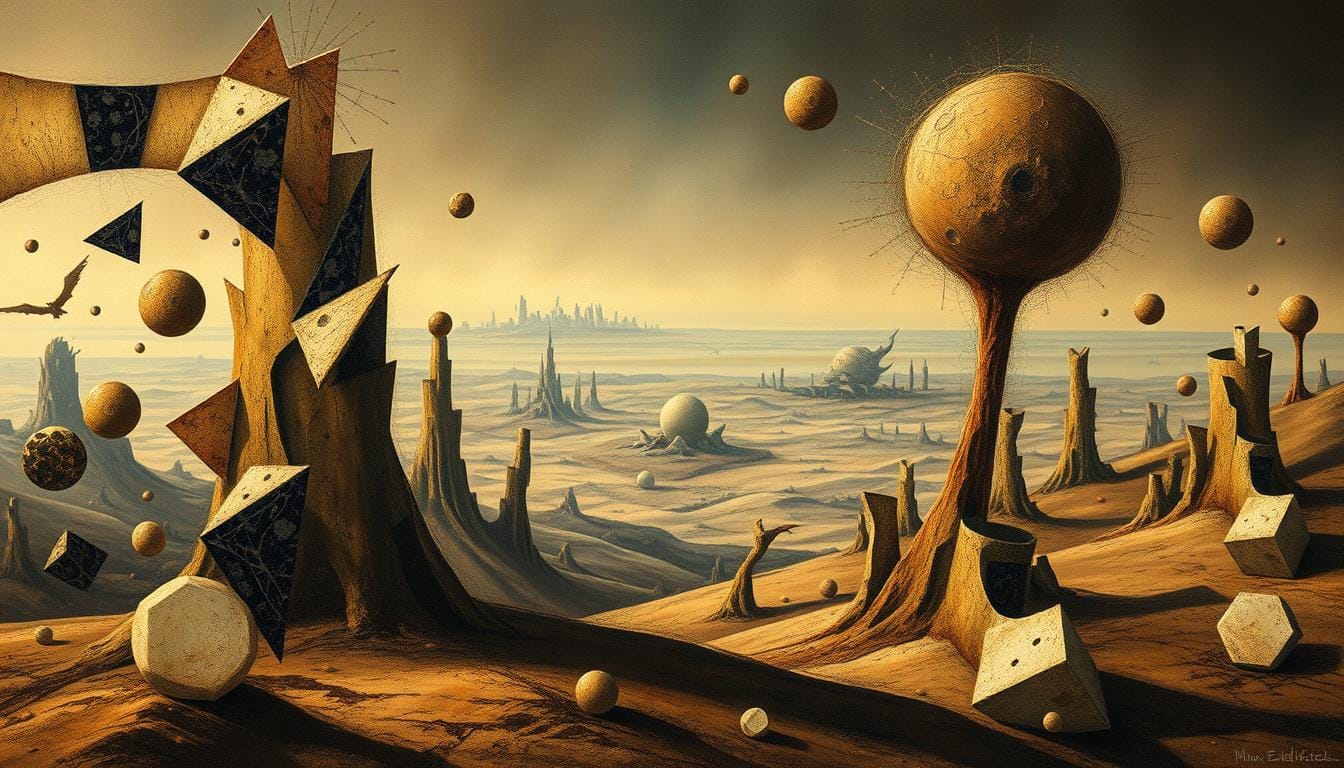
Imagine an artist who used paintbrushes like scalpels, cutting through reality to show its hidden side. This was the original art world disruptor. A self-taught thinker who mixed Freudian psychology with visual art. He started the trend of making the absurd normal, influencing how we see the world today.
Why should today’s digital folks care about a 20th-century artist who used glue and scissors? His collage techniques were ahead of our time, showing how we remix things today. He was like the Banksy of his era, using old prints instead of spray paint. His “grattage” method was like finding hidden layers in digital art, but back in the 1920s.
The Surrealist group’s story is like an avant-garde drama, with Ernst at its center. While men got the spotlight, women like Leonora Carrington changed the game. Together, they mixed poetry and painting, creating something new and bold. Their work didn’t just decorate; it challenged the status quo.
Art schools today focus on technique, but Ernst’s work shows the power of chaos. He asked: What if creativity is about strategic vandalism of the usual? His art tells today’s creators to think differently. It’s not about tools or algorithms, but about rearranging reality itself.
Life and Early Influences
What turns a philosophy student into an art-world magician? For Max Ernst, it’s a mix of Freudian family drama and Germany’s postwar identity crisis. Born in 1891, Ernst grew up in a strict Catholic family. His father painted cute landscapes, but Ernst rebelled by studying psychiatry – a big middle finger to his parents.
World War I changed Ernst’s life in two ways. He survived the trenches, then found his father had voluntarily committed him to a psychiatric ward. This betrayal sparked his creativity. The streets of Weimar Germany, where inflation was high and art was loud, taught him about surrealism and politics.
Three key influences shaped his art:
- The absurdity of neighbors burning money for warmth
- The hypocrisy of church leaders blessing war
- The liberation in André Breton’s call for art to follow thought
Ernst’s early collages were more than art; they were psychological shrapnel. By combining bird skeletons with middle-class homes, he showed the confusion of his generation. Today, this feeling of disorientation is seen in our own world, from TikTok to political cynicism.
Dada Beginnings
What do a vandalized bathroom gallery in 1919 Cologne and Banksy’s shredded Girl With Balloon have in common? Max Ernst showed us a century ago – with an axe.
Ernst’s 1919 Dada exhibition was more than just provocative. It was Weimar Germany’s first punk rock moment in art. When visitors entered his makeshift gallery, they found:
- Works mounted behind a toilet
- An axe chained to the wall
- Instructions to destroy disliked pieces
This wasn’t just about shocking people. It was a statement against the old art ways, like Dada’s love for chaos. While critics were shocked, surrealist poets like André Breton saw genius in the madness. They saw the start of a movement that would change art forever.
Ernst’s bathroom antics were like every modern art stunt you’ve seen:
| Element | Ernst’s 1919 Exhibit | Modern Parallel |
|---|---|---|
| Audience Participation | Destruction axe for viewers | Banksy’s self-shredding frame |
| Venue Disruption | Private bathroom as gallery | Guerrilla street installations |
| Media Frenzy | Local newspaper outrage | Instagrammable protest art |
The Cologne show was a turning point for Dada. It showed how absurdity could be a powerful message. When Ernst joined the surrealists, he brought this same spirit. His work with surrealist writers was not just about art. It was a battle against thinking too much.
Next time you see an artwork that seems simple, remember Ernst. He turned bathroom vandalism into deep theory. He showed us that sometimes, the act of destruction is the true creation.
Collage Inventions: Frottage, Grattage, etc.
Bob Ross loved happy accidents, but Max Ernst turned them into art revolutions. His frottage method involved rubbing graphite over textures like floorboards or leaves. It was like early texture mapping, but with pencil shavings and a hint of existential dread.

Ernst also used grattage, scraping wet paint to show hidden patterns. Critics saw it as “a kind of crime.” But we see it as the first glitch art, long before Instagram filters made it cool.
The table below shows how Ernst’s methods broke rules and sometimes floors:
| Technique | Process | Modern Equivalent | Art World Reaction |
|---|---|---|---|
| Frottage | Rubbing surfaces to capture textures | 3D texture scanning | “Childish scribbles!” |
| Grattage | Scraping paint layers | Digital layer masking | “Vandalism!” |
| Decalcomania | Pressuring wet paint between surfaces | NFT generative art | “Pure chaos!” |
Ernst’s surrealist legacy wasn’t just about rebellion. His frottage inspired Jackson Pollock’s drip paintings. It’s like art history’s version of sampling, a Dada beat drop through Abstract Expressionism.
Why does this matter? Every “distressed” graphic tee or AI art shows the surrealist legacy of Max Ernst. He didn’t just make collages; he hacked reality’s code.
Surrealist Years in France/USA
Imagine a German refugee teaching French intellectuals about surrealism. That was Max Ernst in 1941. He was an accidental revolutionary, fleeing Nazis and avoiding André Breton’s strict rules. His story is like a Dadaist movie: internment camps, rescue by Peggy Guggenheim, and a daring escape that changed modern art.
Breton, the self-proclaimed leader of surrealism, demanded total loyalty. But Ernst was different. He preferred the smell of paint to the sound of manifestos. Their relationship was complex, filled with mutual respect and creative competition. Breton called him “the most magnificently haunted mind in Europe,” but then kicked him out of the movement. Twice.
But there’s more to the story. While male surrealists wrote about the “femme enfant,” women like Leonora Carrington were breaking new ground. Ernst and Carrington created groundbreaking work together, but history often sees her as just his muse. That’s surreal.
| Surrealist Figure | Contribution | Recognition Status (1940s) |
|---|---|---|
| André Breton | Manifestos & Movement Leadership | Canonized |
| Max Ernst | Technical Innovation | Controversial Star |
| Leonora Carrington | Hybrid Mythology Creation | Marginalized |
Ernst’s time in America was electric. Imagine teaching Jackson Pollock about automatism while your work was in MoMA. His 1942 show with Piet Mondrian caused riots – the kind where critics get excited and art history changes.
Ernst was a paradox. He was a “reluctant surrealist” who became the movement’s biggest hit. His 1943 solo show sold out before it even opened. Yet, in letters to Carrington, he felt like a ghost in someone else’s revolution.
Marital and Creative Partnerships
Max Ernst didn’t just collect surrealist techniques; he also curated wives like living collages. Each relationship added explosive new layers to his artistic vision. Forget the tortured genius myth: this was collaborative alchemy where romance fueled avant-garde rebellion. Let’s dissect why brilliant women kept parachuting into Ernst’s chaos, not as damsels but as co-pilots steering surrealism’s wildest flights.
Enter Leonora Carrington – heiress, painter, and walking manifesto against bourgeois norms. Their 1938-1940 partnership wasn’t some Dalí-esque muse scenario (looking at you, Gala). Carrington’s Leonora Carrington biography reveals a two-way creative transfusion: her Celtic mythos bled into Ernst’s forests, while his grattage techniques informed her occult novels. When WWII separated them, both artists spiraled into parallel dreamworlds – hers through The Hearing Trumpet, his via Europe After the Rain.
Fast-forward to 1946 New York. Enter Dorothea Tanning – 26 years younger, equally allergic to the “artist’s wife” label. The Dorothea Tanning biography shows her redefining partnership dynamics:
- Co-designed experimental book Seven Gothic Tales
- Pioneered soft sculpture alongside Ernst’s decalcomania
- Hosted surrealist salons where Meret Oppenheim outshone male peers
Compare this power dynamic to Dalí’s Gala: while she monetized his madness, Ernst’s partners amplified their mutual weirdness. Their tableaux weren’t just paintings – they were manifestos for creative equality, smashing the patriarchy one distorted figure at a time.
| Partner | Creative Contribution | Lasting Impact |
|---|---|---|
| Leonora Carrington | Mythic symbolism | Expanded surrealism’s feminist dimensions |
| Dorothea Tanning | Domestic surrealism | Reimagined collaborative art-making |
So why does history frame these women as Ernst’s “rescuers”? Perhaps because watching a male surrealist share the spotlight threatened the movement’s machismo. Their true legacy? Proving that revolutionary art grows fastest when watered by equal partners – even if those partners occasionally set the garden on fire.
Notable Works
If Hieronymus Bosch threw a rave in a post-apocalyptic wasteland, Max Ernst would’ve been the DJ – and these paintings are his most unhinged tracks. Let’s dissect three works where surrealist legacy collides with political subtext like a Dadaist wrecking ball.
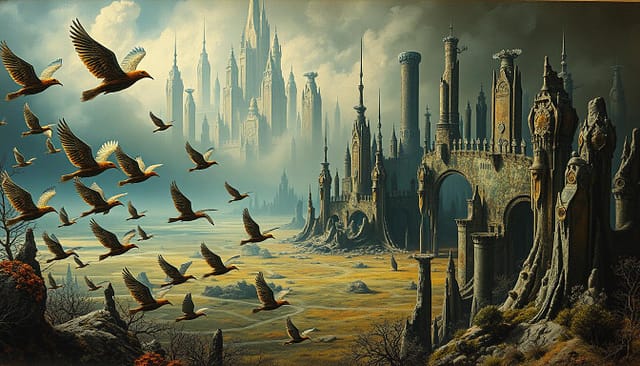
Europe After the Rain II (1942) isn’t just a painting – it’s a geological panic attack. Ernst’s grattage technique transforms crusted paint into collapsing cities, their spires melting like Third Reich wax figures. Notice the hybrid creatures? They’re not fantasy – they’re blueprints for modern body horror cinema. Guillermo del Toro’s sketchbook owes this piece royalties.
| Painting | Hidden Language | Modern Parallel |
|---|---|---|
| The Elephant Celebes (1921) | Mechanical eroticism meets colonial critique | Mad Max: Fury Road’s war rigs |
| Europe After the Rain II | Fascism as geological disaster | Blade Runner 2049’s dystopia |
| Angel of the Hearth (1937) | Domesticity as monstrous farce | Jordan Peele’s suburban horrors |
Ernst’s Angel of the Hearth plays the ultimate visual pun. That “angel” isn’t guarding homes – it’s a steel-toothed monument to toxic domesticity. The clawed feet? They’re crushing Bauhaus ideals into fascist kitsch. Modern viewers might recognize its DNA in TikTok’s absurdist anti-MLM skits.
Why does Europe After the Rain shock us? It predicted our climate anxiety era before Hiroshima’s fallout. Those mutated landscapes aren’t surreal – they’re documentary footage from our AI-generated future. The real question: Does Ernst’s surrealist legacy warn us, or simply hold up a funhouse mirror to our collective unraveling?
Ernst’s Place among Surrealists
Magritte’s pipes and Dalí’s lobsters are famous, but Ernst’s work is the real foundation of Surrealism. Ernst created a way to make the strange seem real. Was Surrealism about weird art, or was it about making new discoveries?
Dalí’s life was like a TV show, full of drama and weird art. Ernst, on the other hand, focused on texture and technique. Ernst made art that was groundbreaking, not just for shock value.
| Max Ernst | Salvador Dalí | René Magritte | |
|---|---|---|---|
| Approach | Methodical experimentation | Shock-value spectacle | Philosophical paradoxes |
| Key Work | The Elephant Celebes (collage) | The Persistence of Memory | The Treachery of Images |
| Legacy | Invented 3+ techniques | Pop culture icon | Conceptual art pioneer |
Magritte was influenced by Ernst. Ernst’s work, like the Loplop series, inspired Magritte’s famous images. Ernst’s use of everyday objects in new ways shows the power of Surrealism.
Dalí was a master of grabbing attention. But Ernst’s work changed how we see the world. Ernst’s art was about discovery, not just shock.
Teaching and Workshops
Max Ernst, known for gluing bird bones to canvases, became a key figure in Abstract Expressionism. He moved to Arizona after the war and started workshops that were more like Dadaist events than traditional art classes. His “oscillation” technique involved dangling paint cans over canvases to create random drips.
This method was not just for fun. It was a way to challenge traditional art forms, years before action painting became popular. Ernst’s approach was all about breaking free from strict rules.
Ernst also used chess to teach creativity. He would play games with surrealist poets and writers during lectures. He believed that losing pieces in chess was like destroying preconceptions in art.
This was not just a game. It was a way for art students to learn to overcome their creative blocks.
His teaching style was vastly different from today’s art programs. Here’s a comparison:
| Ernst’s Workshops | Modern Art Programs | |
|---|---|---|
| Curriculum | Sandstorm improvisation | Rubric-driven projects |
| Tools | Rusty nails, cactus spines | 3D printers, grant apps |
| Final Exam | Surviving a week in Sonoran heat | Thesis defense PowerPoints |
Ernst’s genius lay in turning limitations into opportunities. When dust storms made outdoor painting impossible, he had students scratch drawings into sunbaked clay. This accidental technique was decades ahead of land art.
Today’s art students could learn a lot from Ernst’s desert ingenuity.
The real question is not who Ernst influenced. It’s why MFA programs are so structured when Ernst showed that chaos can lead to breakthroughs. Next time you see a Pollock painting, remember the desert shack where creativity was truly unleashed.
Conclusion
Max Ernst’s surrealist legacy echoes through AI art, like a ghostly presence. His frottage method, which brings visions from floorboards, is similar to how AI creates patterns from random data. Ernst used chaos to his advantage, unlike algorithms that seek order.
The Met’s 2005 retrospective highlighted his collages’ boldness even today. He used scissors to cut through the norms, much like today’s algorithms create endless content. But where’s the shock, the surprise, that makes us feel alive?
Ernst foresaw our world of endless images and showed us how to escape. His paintings resemble alien codes, ready for future rebels to unlock. In a world where Instagram smooths out every detail, his work asks: When did we last see something new?
The true test is to give Photoshop to Ernst from the 1940s. Would he create endless versions of Europe After the Rain, or something that makes AI cry? His work challenges us to question, not just answer. It calls for us to hack the visual world, turning precision against itself. The patterns are there, waiting for someone bold enough to see them.