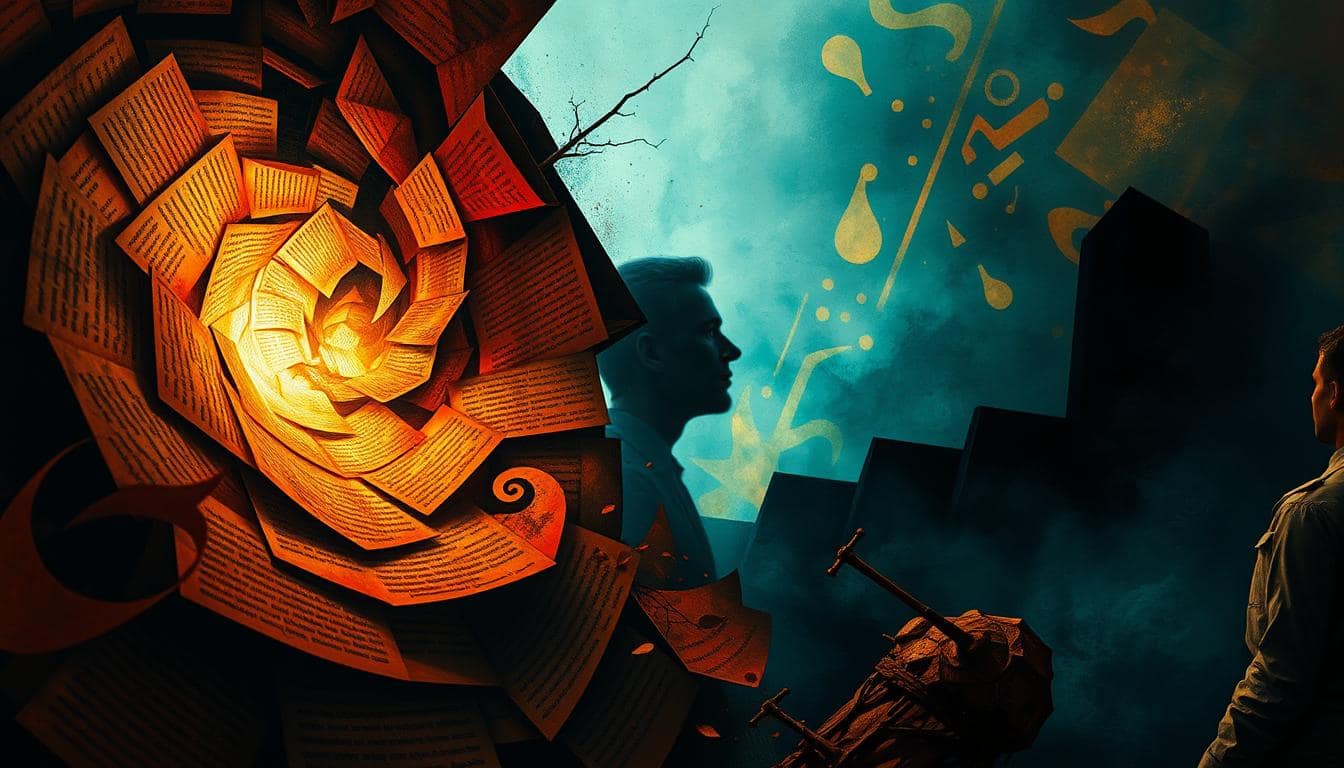
Imagine Paris in 1924. Cigarette smoke dances around typewriters as André Breton unleashes a groundbreaking idea. His Manifesto of Surrealism was more than a pamphlet. It was a bold challenge to the status quo.
Breton’s work was all about tapping into the subconscious. He believed in the power of dreams and freedom. His ideas were a call to break free from the ordinary and embrace the extraordinary.
Unlike other art manifestos, Breton’s text was full of passion and urgency. He saw dreams as a reflection of society’s true nature. It was a call to revolution, with creativity as its driving force.
Even today, Breton’s vision remains powerful. His manifesto is not just an explanation of surrealism. It is surrealism itself, bursting with imagination and creativity.
Prologue: The Power of Manifestos in Art
Before social media, artists used manifestos to shake things up. These surrealist declarations were more than just statements. They were like bombs of creativity, aiming to destroy old ways of thinking. André Breton was a master at turning Dada’s mess into Surrealism’s clear plan.
Here are three key points about manifestos:
- They’re like declarations of war in the art world
- They help create groups united by their desire to challenge the norm
- They leave a lasting mark, more than any museum could
Let’s look at how Breton’s manifesto was different:
| Manifesto | Weapon of Choice | Lasting Impact |
|---|---|---|
| Futurist (1909) | Machine worship | Inspired fascist aesthetics |
| Dada (1916) | Nihilistic chaos | Burned bright but fast |
| Surrealist (1924) | Freudian dream logic | Shaped 20th-century art |
Breton’s brilliance was in learning from both Dadaism and Surrealism but avoiding their destructive sides. While Dadaists broke things, Surrealists opened doors to the subconscious. This shift made Surrealism stand out.
The manifesto’s first line is telling: “Pure psychic automatism… in the absence of any control exercised by reason.” It means letting your subconscious guide you, but with a goal. It’s the difference between random splatters and a masterpiece like Pollock’s.
When you see viral posts or influencer opinions, think of Breton. He showed how to spark change with words, not just emojis.
André Breton’s Background and Influences
André Breton’s life was a wild ride from being a medic to leading surrealism. He studied medicine by day and read Freud by night. This mix of science and dreams sparked surrealism’s origins.

During World War I, Breton moved from surgery to treating soldiers. The trenches were his lab, where reality and fantasy mixed. This experience made him fascinated with the unconscious mind.
Three big things shaped Breton:
- Freud’s dream theories (discovered while treating psychiatric casualties)
- Dada’s anti-art rebellion (a temporary creative methadone)
- Medical dissection techniques (repurposed for societal analysis)
The 1921 Vienna meeting with Freud was a turning point. It was like Steve Jobs pitching Wozniak, but with free association. Breton left with Freud’s blessing and a plan for change.
| Medical Training | Surrealist Practice | Freudian Influence |
|---|---|---|
| Anatomy studies | Obsession with bodily metaphors | Dream symbolism as diagnostic tool |
| Trauma triage | Automatic writing as psychological first aid | Unconscious as battlefield |
| Clinical observation | Manifesto as medical treatise | Repression = societal disease |
Breton’s genius was blending medical rigor with irrationality. He used dream analysis to diagnose society’s problems. This mix of logic and madness spread surrealism worldwide.
Who would have thought stethoscopes and stream-of-consciousness would go together? Breton’s manifesto didn’t just reject reality—it changed it.
Dissecting the Surrealist Manifesto (1924)
If TikTok existed in 1924, Breton’s manifesto would’ve broken the internet. This 30-page grenade tossed at logic’s front door remains the ultimate “how to be weird properly” handbook. Let’s peel back its layers like a Dali clock melting over analytical rigor.
Key Passages and Literary Style
Breton’s writing is like a jazz improv session between Freud and a drunk raccoon. His “exquisite corpse” technique—where collaborators build phrases blindly—birthed gems like “The umbrella drinks the color of insects”. The manifesto’s opening salvo? “Beloved imagination, what I most like in you is your unsparing quality.” Translation: Reason is canceled, effective immediately.
Three hallmarks define Breton’s literary anarchy:
- Automatic writing: First-draft rawness over polished prose
- Dream logic: “Man cut in half by window” visions
- Provocative contrasts: Juxtaposing revolvers with sewing machines
Core Beliefs: Automatism, the Unconscious, and Revolution
Surrealism wasn’t just art—it was psychological warfare. Breton weaponized Freud’s dream theories like a psychoanalytical AK-47. The manifesto’s three pillars:
| Concept | Breton’s Take | Modern Equivalent |
|---|---|---|
| Automatism | Writing without conscious control | Stream-of-consciousness tweets |
| Unconscious mind | Art’s true dictator | Algorithmic recommendations |
| Revolution | Overthrow rational tyranny | Cancel culture for logic |
Breton’s automatism wasn’t just creative method—it was resistance. By channeling raw subconscious material, artists became revolutionaries dismantling “the dictatorship of reason”. That window-sliced man? A blueprint for seeing reality through cracked lenses.
Freud’s influence looms large, but with a twist. Where the psychoanalyst sought to interpret dreams, surrealists weaponized them. Random imagery became grenades tossed at bourgeois sensibilities. Breton’s manifesto didn’t just describe art—it prescribed cultural chemotherapy.
Immediate Reception and Controversies
In 1924, Parisian cafés were shocked by Breton’s manifesto. It mixed Freudian theory with anarchist poetry, shocking the art world. It was like Jackson Pollock splattering paint on a Renaissance fresco.
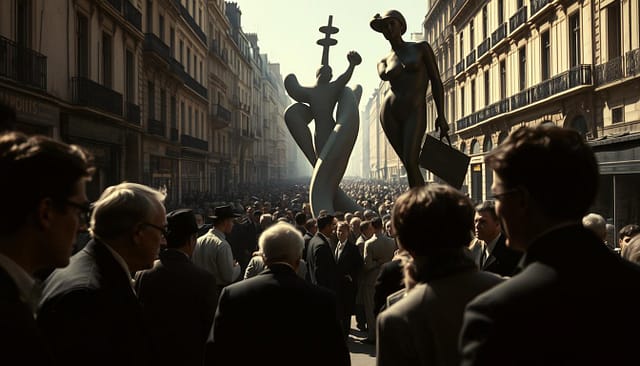
Allies and Adversaries in Paris
Breton’s circle was like a Game of Thrones cast with paintbrushes. Salvador Dalí was a wild card, praising automatic writing but secretly mocking Breton. Their feud reached a peak when Breton excommunicated Dalí for making money off surrealism.
Georges Bataille was another key figure, but he was also a critic. He saw surrealism as a dreamy escape for the rich. Breton hit back, calling Bataille’s work “excrement wrapped in philosophy.”
Breton’s ideological purity tests were a major issue. Artists had to prove their true selves, not just their talent. Picasso watched from afar as surrealists turned on each other.
This infighting was surrealism’s downfall. Breton’s strict rules made the movement its own Trojan horse. Newer art movements like abstract expressionism eventually took over. The rulebook was too thick, stifling creativity.
Manifesto’s Impact on Visual Arts
When Breton declared war on rational thought, paintbrushes became weapons. The Surrealist Manifesto didn’t just inspire poets—it gave visual artists permission to weaponize weirdness. It was like a creative license to kidnap logic and ransom it for dream currency.
How the Manifesto Shaped Surrealist Painting and Beyond
Magritte’s “This is Not a Pipe” was a middle finger to literal thinking. His work showed Breton’s idea to “resolve dream and reality”. Ernst took this idea to heart, inventing frottage to tap into the unconscious.
Dalí’s melting clocks in The Persistence of Memory didn’t just bend time—they snapped it like a breadstick at a Venetian café.
The manifesto’s influence went beyond canvas. Disney’s 1946 Destino project with Dalí is a prime example. It was a dancing cactus meets clock-faced nymphs animation that sat shelved until 2003. This shows that André Breton surrealism can outlast even corporate boardrooms.
- Automatism in action: Miró’s biomorphic shapes looked like Rorschach tests for aliens
- Revolutionary framing: Man Ray turned photographs into visual paradoxes
- Pop culture infiltration: 2023’s Everything Everywhere All At Once owes its bagel multiverse to surrealist DNA
Galleries today show works that feel like visual hangovers from Breton’s 1924 fever dream. The real question: When your nightmares are this profitable, who wants to wake up?
Legacy: From 1924 to Modern Art
Did you know Breton’s 1924 rant is more popular than ever? The Surrealist Manifesto has become a cultural icon. It has influenced everything from TikTok filters to AI-generated art.
Its impact? It turned reality into a game where logic is optional. It’s like a choose-your-own-adventure book.
Continued Relevance in Culture
Want to play “Spot the Surrealist”? Banksy’s shredded art is a classic example. Warhol’s soup cans also show the influence of Magritte’s pipe.
Even your cousin’s deep-fried memes pay homage to Dalí’s melting clocks. The manifesto’s spirit is in:
- AI art generators creating “automatic” hybrids
- Protest signs with Magritte’s apple saying “This is not capitalism”
- Netflix algorithms with dream-logic twists
Modern activists use surrealism’s shock tactics. Climate protesters glue themselves to “The Persistence of Memory” replicas. Street artists turn logos into Dali-esque nightmares.
Even ChatGPT sometimes writes poetry that sounds like Breton.
| Surrealist Era (1924) | Digital Age | Political Twist |
|---|---|---|
| Automatic writing | AI text generators | Fighting algorithmic bias |
| Exquisite corpse drawings | NFT collaborations | Decentralized art ownership |
| Dream photography | Deepfake technology | Truth decay in media |
The real twist? Surrealism’s revolutionary core drives global protests. Protestors wear Magritte bowler hats as a symbol of resistance. Meme armies use absurd humor against oppressive regimes.
Breton’s “beautiful as the chance encounter” is effective against TikTok bans and bourgeois art.
Teaching the Manifesto Today
Imagine Breton’s surrealist declarations in today’s world of TikTok and AI art. Teachers use Instagram reels with Salvador Dalí filters to teach automatism. Students analyze memes through dream logic.
The internationalization of surrealism is real. It’s seen in São Paulo’s augmented reality murals and Tokyo’s glitch poetry. These places show surrealism alive today.
Classrooms now use Google Arts & Culture’s surrealism hub instead of old books. Professors work on “exquisite corpse” projects with MidJourney algorithms. Khan Academy even breaks down Breton’s ideas in short videos.
But does making manifesto study easy to digest water down its power? Some say TikTok lessons make surrealism just a trend. Others believe it’s a way to keep surrealism fresh and exciting.
Can these new ways of teaching really challenge the status quo, or just make things look better? Breton’s spirit might be amused by deep dream art. Or he might want students to dream in real life.
His manifesto is where old meets new. How will you see his surrealist declarations tomorrow?