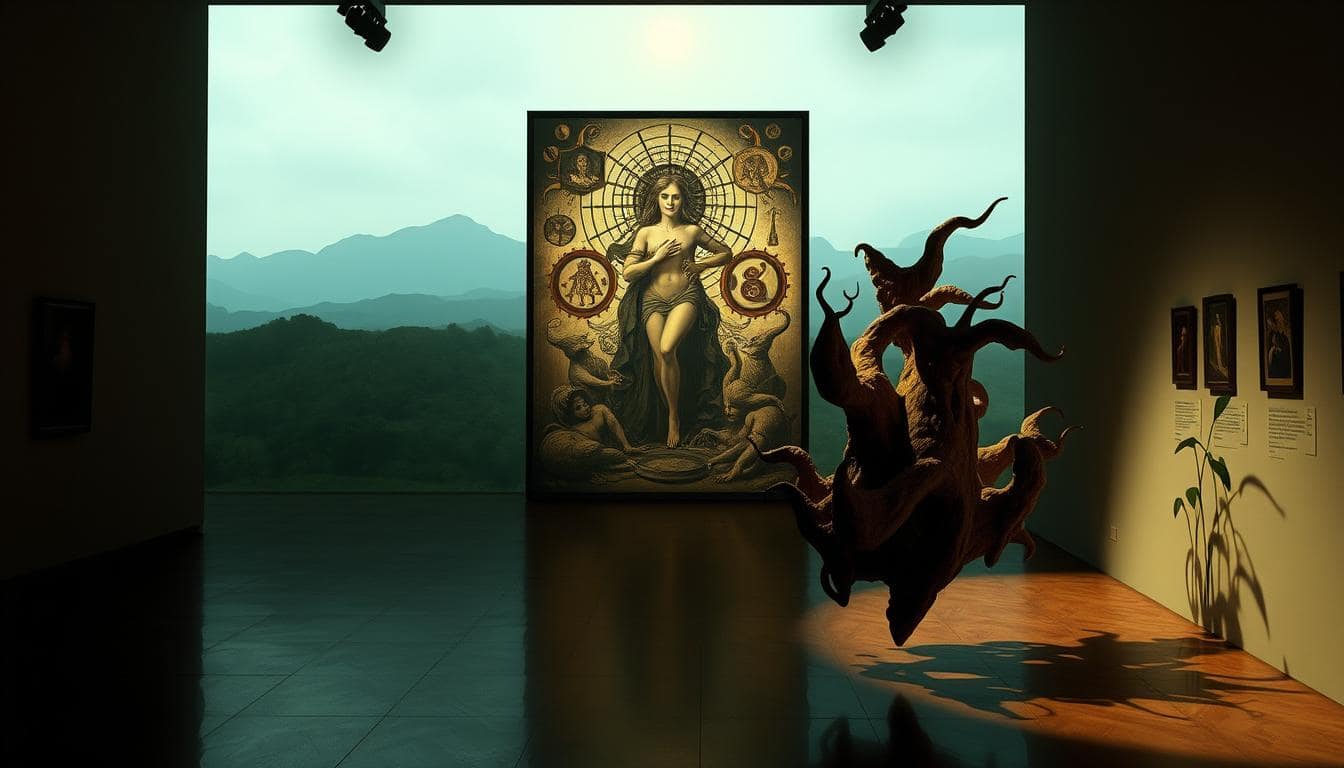
Imagine Salvador Dalí’s melting clocks meeting Marie Curie’s lab notes. That’s what the Art Institute Chicago’s “Science Fictions” exhibit is all about. It features 60+ works by Remedios Varo, blending reality like a Rubik’s Cube. Often called surrealism’s “best-kept secret”, Varo gets her due with bilingual texts that reveal her mix of women in surrealism and scientific curiosity.
Curator Barbara Haskell says Varo’s work is like a protest sign and a chemistry textbook combined. Unlike Magritte and Ernst, Varo created entire worlds. Her paintings show gears turning sacred wheels and figures decoding cosmic secrets. It’s like Hieronymus Bosch meets STEM TikTok from 1950s Mexico City.
Varo’s surrealist legacy shines because she didn’t play by the boys’ club rules. Her paintings, like 1961’s “Creation of the Birds”, seem like secret collaborations with Leonora Carrington. Together, they redefine “weird science” through exile, feminism, and occult geometry.
So, why does this matter today? The exhibit’s VR installations show Varo’s work is even more relevant now. Her mix of political allegory and alchemical whimsy speaks to our AI age. Her art doesn’t just decorate walls; it challenges us to rethink reality.
Spanish Roots and Exile
Imagine growing up where your dad teaches you hydraulic blueprints before you learn math. For Remedios Varo, Spain’s strict education was her start to rebel. Her dad’s engineering books turned into her sketchbooks, with gears becoming alchemical devices before she joined the Surrealist group history.
Franco’s Spain was like Kafka’s world, but worse. When civil war hit in 1937, Varo left for Paris. But, in 1941, Nazis chased her out again. These moves made her a “geopolitical tumbleweed”, picking up art from everywhere.
Parisian surrealist salons were her playground. She painted like no one else, mixing physics with the mind. Her work was a twist on reality.
Mexico City became her last creative home. Forced to leave, she made her best work. Her paintings show her childhood drawings and nods to Bosch’s Garden of Earthly Delights.
Varo’s exile was her alchemy. She turned political pain into art that spoke truth. While men dreamed of Freud, she mixed science and magic in her art. She turned her pain into something beautiful.
Varo’s Entry into Surrealist Circles
Paris in the 1930s was a dream world of absinthe and new ideas. Varo joined the Surrealist movement, but it wasn’t easy. She had to deal with strong male egos and the need for men to approve her art.
Parisian Crucible
Benjamin Péret became Varo’s lover in 1935, introducing her to André Breton. But there were rules: she was seen as muse, mistress, and colleague, not just an artist. Her cadavre exquis drawings were a way to sneak in her own messages.
The 1938 International Surrealist Exhibition was a chance for Varo to shine. But Breton showed her work like it was something to be studied. Her response was “Eyes on the Table”, a silent protest against being seen as just a muse.
Varo’s relationship with Péret showed the gender issues in surrealism. He supported her, but critics saw her as his student. Their bond was complex, with each influencing the other. Varo’s art even surpassed the surrealists’ own.
Main Artistic Themes—Science, Magic, Dream
Forget Freud’s couch—Varo’s canvases are like dissection tables. They mix alchemy and astrophysics under a microscope. Her work is like a Renaissance Maker Faire hosted by a time-traveling witch. It’s a mix of laboratory and tarot den, all revolutionary.
Here, the Varo motifs of celestial machinery and arcane symbols are more than just decorations. They are blueprints for understanding existence itself.
The Alchemist’s Laboratory
Varo treated her studio like a quantum embroidery hoop. She stitched Schrödinger’s equations into medieval bestiaries. Unlike male surrealists, she used “women’s work” in a subversive way:
- Astrolabes drawn with needlepoint exactness
- Fumage smoke manipulated like lace patterns
- Mechanical birds engineered via 15th-century grimoires
This 1957 masterpiece is like Da Vinci’s Codex meets The Magic School Bus. An owl-eyed scientist brings life through prismatic light refraction. Varo mixed real science with her sorcery:
| Element | Science | Magic |
|---|---|---|
| Central prism | Hoyle’s steady-state cosmology | Philosopher’s Stone symbolism |
| Mechanical birds | Optical physics | Homunculus creation myths |
| Background texture | Fumage technique | Alchemical smoke rituals |
Varo out-Dalí’d Dalí. While he painted dreamscapes, Varo built thought experiments with gears. Her Surrealist legacy is not just melted clocks. It’s the quiet rebellion of turning embroidery hoops into particle accelerators.
Mexico Period—Iconic Works
Frida Kahlo’s bold self-portraits were all over Mexico’s art scene. But Remedios Varo was quietly creating her own magic. She mixed art with mysticism, turning Mexico City into a place where women could defy the patriarchy through their art.

The Three Witches Collective
Varo and her friends, Leonora Carrington and Kati Horna, formed a secret group. Their 1955 Diana Gallery show was more than just art. It was a bold statement, a esoteric coup that changed surrealism forever.
They had their own code name for creativity, “Star Catcher.” They hid messages in their art, like cosmic yarn and spinning stars. They turned homes into places of rebellion, crossing into other worlds.
Varo’s “Sympathy” (1955) shows their genius. It looks like a simple scene of a woman knitting. But look closer, and you see the yarn connects to the stars. The stove is burning books, a sign of rebellion.
| Artist | Thematic Arsenal | Secret Weapon | Legacy |
|---|---|---|---|
| Varo | Alchemical machinery | Feminist cryptography | Cerebral surrealism |
| Carrington | Mythic hybrid creatures | Eco-feminist parables | Mystical storytelling |
| Horna | Photographic surrealism | War-era symbolism | Documentary magic |
Varo and her friends showed that women could change art history without male approval. While men argued in Paris, they were creating a new kind of surrealism. It was a world where ovens baked freedom and broomsticks were paintbrushes.
Influences: Alchemy and Esoterica
What do medieval spellbooks and 20th-century geopolitics have in common? Remedios Varo found a link through her art. She mixed occult symbols with coded messages. Her life, marked by exile and survival, infused her work with alchemy and rebellion.
Occult Techniques as Political Resistance
Varo’s art was more than just painting. It was a guide for change. Her grattage and soufflage techniques were like hiding in plain sight. They showed her ability to transform and survive.
Her 1956 work, Useless Science, is a powerful statement. It shows a woman creating stardust while factories pollute. It’s a mix of magic and reality, challenging the status quo. Diane Taylor highlights Varo’s use of alchemy and astrology as a form of resistance.
| Alchemical Process | Immigrant Reinvention | Varo’s Symbol |
|---|---|---|
| Transmutation | Identity reshaping | Spinning wheels |
| Prima Materia | Cultural hybridity | Floating cities |
| Magnum Opus | Artistic legacy | Mechanical birds |
Varo’s art was like secret messages. Clockwork owls and aludel flasks carried her messages. In a world of science, she showed the power of art and imagination. Her surrealist legacy continues to inspire today, reminding us of the importance of creativity and resistance.
Exhibitions and Later Reception

The art world rarely sees such dramatic changes, but Remedios Varo’s 2023 show in Chicago was an exception. The “Beyond the Mistress Myth” exhibit at The Art Institute drew 125,000 visitors in just three months. This number would have amazed André Breton.
What made this show special was not just the paintings. Curators showed Varo’s preparatory cartoons alongside her finished works. It was like seeing Da Vinci’s shopping lists next to the Mona Lisa.
From Marginalized to Canonized
Varo’s journey from being seen as “Breton’s muse” to a major artist is inspiring. The Chicago show had bilingual labels, welcoming her back in a big way. It was a strong statement against Franco’s regime that had exiled her.
Visitor Maria Mansano captured the essence of the show: “I didn’t just see her art – I got teleported into her trippy clockwork universes.”
| Exhibition Era | Attendance Figures | Language Support | Key Partners |
|---|---|---|---|
| 1960s Shows | 500 visitors | Spanish only | Local galleries |
| 2023 Chicago | 125,000+ visitors | Bilingual (EN/ES) | INBAL, AIC |
This transformation wasn’t accidental. The INBAL partnership brought 13 never-exhibited sketches from Mexico City archives. These sketches were like artistic deleted scenes.
Curators placed “Creation of the Birds” next to its original pencil studies. This showed how Varo combined science notebooks with witchy symbolism.
Curatorial genius made this exhibit a journey through Varo’s worlds. Visitors moved from “exile corridors” to “alchemy chambers”. Each step revealed more about art history’s sexist past. Being seen as a “surrealist sidekick” for decades made her later recognition even more meaningful.
Varo in Contemporary Curriculum
Remedios Varo’s paintings are more than museum pieces—they’re changing how we learn. Her work, once overlooked, now sparks courses in art, physics, and more. Her alchemical visions are seen as keys to breaking down old learning walls. Now, her art teaches everything from feminism to complex math.
Teaching the Unseen
Varo’s work isn’t just a nod to women in surrealism. Scholar María González Madrid shows how Varo’s motifs—like spiraling towers and hybrid creatures—help us understand complex systems. Today, teachers use her art to bridge different subjects.
- Art history meets quantum theory through Harmony’s musical staffs mapping cosmic vibrations
- Gender studies courses dissect her witch-adjacent figures as proto-feminist resistance symbols
- STEM programs analyze her intricacies as early biomimetic design models
Why choose Dali’s clocks when Varo’s looms teach students to weave ideas across disciplines? Her painting The Creation of the Birds is a must-see in ornithology, not for its realism but for its vision of evolution.
Physics TAs use Varo’s Varo motifs to explain string theory. Her veils in Celestial Pablum represent quantum fields. Her labyrinths? They’re the blueprint for non-Euclidean geometry. It’s a twist that would make Pythagoras proud.
Conclusion
Varo died in 1963 at 54, leaving her as surrealism’s Cassandra. She was a prophetess ignored until her visions were clear. Now, her Spanish-Mexican surrealism can fetch up to $5 million at Sotheby’s.
But does this recognition honor her as a political resistance, or just make money off her tragic end? It’s a question we must ponder.
In Chicago’s Art Institute, people are drawn to “Star Catcher” like moths to a flame. Her Surrealist legacy shines, not in digital art, but in the real world. Her unique, hand-stitched art offers a break from our digital overload.
Her work shows that true magic is in the imperfections. While Dall-E creates endless copies, Varo’s “Creation of the Birds” stands alone. It’s a powerful statement against automated art.
Spanish-Mexican surrealism teaches us to see beyond screens. It shows us worlds where telescopes are also paintbrushes.
When you’re tired of algorithmic art, think of Varo’s clockwork women and floating cities. That shiver you feel? It’s her ghost-laugh, reminding us of the magic in the world.
The real magic isn’t in her auction prices. It’s in how her paintings make us remember the beauty of moonlight.