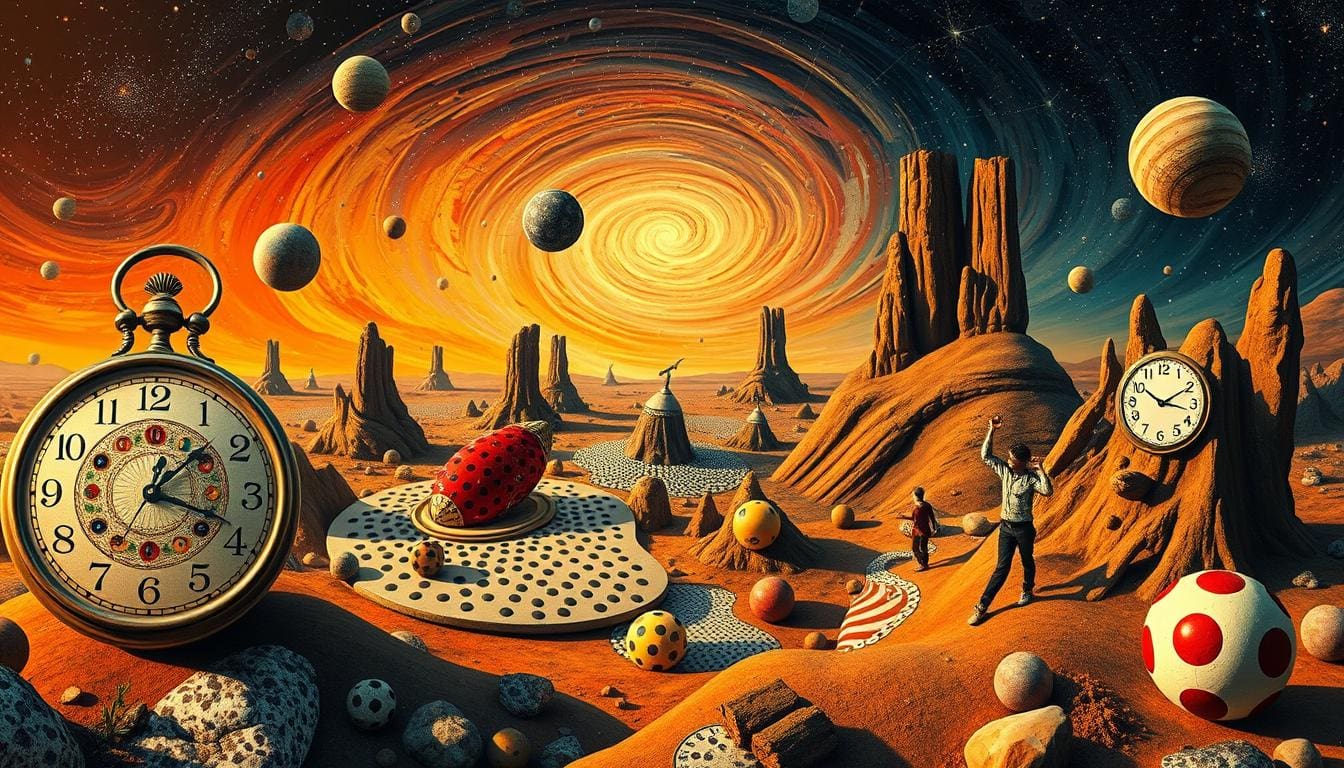
Imagine Paris in 1924, filled with smoke and artists. They were trying to make sense of the world after World War I. André Breton started surrealism, aiming for a psychological revolution through art and words.
He introduced the idea of “pure psychic automatism.” This idea would spread quickly, beyond Europe. It was like saying “Ceci n’est pas une pipe.” in a way that shook the world.
The word surrealism was first used in 1917. Guillaume Apollinaire described a ballet with it. The movement grew from the trauma of World War I.
Artists, including shell-shocked veterans, turned to surrealism. They used their art to question reality. They asked, “Why should reality get all the good press?”
Surrealism traveled the world, changing cultures. Frida Kahlo added a touch of Mexican mysticism. Salvador Dalí challenged traditional thinking. Even Japan’s artists used surrealism to deal with the atomic age.
This wasn’t just art. It was a global psychic warfare against reason. Surrealism became a shared language of the subconscious.
So, how did surrealism become a global phenomenon? It’s a story of art without borders. Let’s explore the world where time and space are fluid.
Early Expansion Beyond Paris
Surrealism didn’t just spread—it spread like spilled absinth at a Dadaist house party. While André Breton watched over Parisian cafés with his Surrealist Manifesto, other artists were sneaking radical ideas across borders. It was like an avant-garde black market, with forbidden Freud and dream logic hidden in luggage.
The movement had Dada’s rebellious spirit. Max Ernst’s 1921 The Elephant Celebes is a prime example. It mixed African sculpture with industrial decay. This was more than art; it was a way to hack Europe’s rational system.
By 1925, Brussels became surrealism’s first base outside Paris. The La Peinture Surréaliste exhibition was like an artistic VPN. It let artists dodge Breton’s rules. Three key things came out of this:
- Hybrid techniques merging collage with automatic writing
- Proto-meme culture through subversive image pairings
- Freudian symbolism repurposed as political critique
Critics said it was “weird.” We see it as augmented reality 1.0—mixing war-trauma with dreams long before “metaverse” was coined. The real magic? Brussels rebels turned surrealism into a fast-spreading virus, adapting quickly.
Surrealism in the Americas, Asia, and Africa
In Paris, surrealists debated dream journals in cafés. But artists in the Americas and Asia were using their brushes to fight back. They mixed revolution and colonial resistance into their art.
Latin American surrealism didn’t just borrow European ideas—it hacked them. Frida Kahlo’s twisted self-portraits challenged patriarchy. Cuban artist Wifredo Lam combined African masks with jungle surrealism to mock colonialism. Latin American artists used surrealism to resist 1940s dictatorships.
In Cairo, the Art et Liberté group took a stand against colonialism and traditional art. Their 1938 manifesto was a call to action. Their exhibitions were like watercolor shows that were actually Molotov cocktails, illegal under British rule.
- Mexico’s estridentistas blended Aztec myths with typewriters
- Haitian poets used surrealist imagery against Duvalier’s regime
- South African painters used dreamscapes to bypass apartheid censorship
Koga Harue’s 1929 Umi is a Japanese masterpiece. It features floating eggs, robotic fish, and geometric waves. It’s a commentary on industrialization or a protest against militarism. Or maybe it just shows surrealism can thrive without Freud.
The real magic happened when international surrealists stopped imitating Europe. They started speaking in their own visual dialects. Brazilian Tarsila do Amaral mixed cannibalism metaphors with modernist shapes. Egyptian painter Mayo used hieroglyphic symbols to critique monarchy. Each adaptation was a middle finger to the idea that surrealism had one birthplace.
Key International Figures and Groups
Surrealism didn’t just travel—it transformed. André Breton’s Parisian manifestos started it all. But it was the artists worldwide who really made it magic. They mixed Freudian psychology with local myths, turning dreams into global movements.
Revolutionary Minds Across Continents
Salvador Dalí’s 1936 London show was more than just clocks melting. It was a marketing masterclass in surrealism. Imagine him lecturing in a diving suit, with journalists scrambling for words.
Wolfgang Paalen moved from Paris to Mexico’s jungles. He mixed Mayan glyphs with atomic age fears in DYN magazine.
Leonora Carrington was an alchemist and feminist icon. Her painting The Lovers brought Celtic folklore to Mexico’s art scene. Wifredo Lam, the Cuban Picasso, used Afro-Cuban spirituality to fight colonialism. His The Jungle was a call for decolonization in green.
| Artist | Region | Signature Move | Legacy |
|---|---|---|---|
| Salvador Dalí | Europe/North America | Lobster phones & paranoid-critical method | Made surrealism a pop culture virus |
| Leonora Carrington | Mexico/UK | Feminist alchemy | Bridged occultism and eco-activism |
| Wifredo Lam | Cuba | Afro-Cuban surrealism | Redefined postcolonial identity |
| Wolfgang Paalen | Mexico/Austria | Fumage technique | Pre-invented abstract expressionism |
| André Breton | France/Global | Surrealist manifestos | The Karl Marx of dream politics |
When Breton met Trotsky in Mexico City in 1938, it was more than a debate. Diego Rivera’s murals were their backdrop. They wrote the Manifesto for an Independent Revolutionary Art, blending Marxist theory with surrealism. Freud would have been intrigued, then charged them for therapy.
These international surrealists didn’t just adapt the movement—they transformed it. Dalí made paranoia profitable. Paalen turned smoke stains into cosmic maps. They showed that surrealism’s legacy is about reimagining the world, not where you’re from.
Adaptation and Local Influence
What makes a cultural trend stick around? Cubism and Dada faded away, but surrealism thrived. It did this by cultural shape-shifting, blending in while staying true to its dreamy roots.
Cultural Alchemy
In 1930s Japan, artists mixed “Scientific Surrealism” with Hokusai’s waves and quantum physics. Unlike European surrealists, Japanese artists combined avant-garde with Shinto symbols. This created art that was far beyond anything Magritte could imagine.
In 1954 Colombia, filmmakers used Dalí’s lobster to criticize dictatorship. La Langosta Azul (The Blue Lobster) showed surreal images to reveal harsh truths. It was cultural jiu-jitsu, using absurdity to expose the truth.
| Movement | Adaptability | Political Engagement | Global Reach |
|---|---|---|---|
| Surrealism | Chameleon-like | Coded resistance | 6 continents |
| Cubism | Paris-centric | Neutral | Limited |
| Dada | Self-destructive | Overt protests | Select cities |
| Abstract Expressionism | U.S.-dominated | Cold War tool | Controlled spread |
Czech artist Toyen hid anti-Nazi messages in her art. Her paintings of melting clocks and floating eyes were more than just art. They were a form of resistance. Surrealism adapted to local issues without losing its core, unlike other movements.
The key to surrealism’s success was its escape clause. Unlike Bauhaus and Futurism, it encouraged artists to mix the strange with the familiar. This created a global network of dreamers, speaking in their own secret language.
Major International Exhibitions and Publications
If surrealism were a rock band, its exhibitions would’ve been the mosh pits of the art world – chaotic, confrontational, and impossible to ignore. These weren’t your grandmother’s gallery strolls but carefully orchestrated assaults on bourgeois sensibilities. Let’s dissect how these events became Trojan horses smuggling radical ideas across borders.
Shockwaves Through the Art World
The 1936 International Surrealism Exhibition in London redefined immersive art decades before Instagram filters. Salvador Dalí nearly drowned in his own performance piece – delivering a lecture while wearing a deep-sea diving helmet. When attendants scrambled to remove it with a wrench, the scene became the perfect metaphor: surrealism choking on its own audacity while audiences panicked.
Across the Channel, Nazi-occupied Europe birthed surrealism’s samizdat movement. Belgian journal De Schone Zakdoek (1941) operated like an artistic resistance network. Its creators distributed hand-stitched copies containing coded imagery that mocked fascist aesthetics – think Magritte’s bowler hats photoshopped onto goose-stepping soldiers.
| Event | Location | Impact | Subversive Twist |
|---|---|---|---|
| 1936 International Exhibition | London | Reached 2,000+ visitors | Live coal scuttles as decor |
| De Schone Zakdoek | Brussels | 15 clandestine issues | Hidden anti-Nazi symbols |
| 1942 Exposición Surrealista | Mexico City | Fused Mayan motifs | Used pre-Columbian censers |
These exhibitions functioned as cultural EMPs, short-circuiting conventional art consumption. The London show’s organizers buried phonographs playing insane laughter beneath the gallery floor – an early prototype of 4D experiences. Visitors left either converted or furious, which was precisely the point.
Today’s immersive Van Gogh shows owe their existence to these surrealist pioneers. But where modern exhibitions soothe with projection mapping, the originals weaponized discomfort. The real masterpiece? Making censorship agencies argue about whether a lobster telephone was really political propaganda.
Cross-Cultural Collaborations
Imagine an art game that’s like a Rorschach test and a diplomatic summit. Salvador Dalí’s mustache might meet Japanese woodblock prints across four continents and three languages. This wasn’t just artists being quirky. It was surrealism’s secret way to bring cultures together decades before “think globally, act locally” became popular.
Exquisite Corpses and Borderless Creations
The cadavre exquis game is surrealism’s answer to cultural exchange. Artists build hybrid images through folded paper. When Frida Kahlo and Lucienne Bloch played in 1932, their collage was a mix of Mexican and European styles. Today’s AI art collaborations are just digital versions of this old-school chaos.
In the 1950s, Martinique’s surrealist circle mixed Caribbean vodou with Freudian dreams. Imagine a cultural mojito: French thought mixed with Caribbean mysticism and Marxist theory. Their manifestos were like hallucinogenic travel guides, showing the subconscious from Port-au-Prince to Paris.
- 1932 Mexico City: Kahlo/Bloch’s folded-paper hybrids merge Day of the Dead motifs with Bauhaus geometry
- 1954 Fort-de-France: Martinique group’s “Tropical Uncanny” exhibition fuses planteur’s hats with Dadaist typography
- 1968 Tokyo: Japanese surrealists remix exquisite corpse techniques into manga-influenced “Kyōdō Bōrei” (Shared Ghosts)
These weren’t just art projects. They were ideological handshakes made with scissors and glue. When the Martinique crew layered African masks over Magritte’s bowler hats, they mocked colonial power. It’s like Banksy’s street art activism, but with more rum and automatic writing.
Surrealism’s Global Legacy Today
Surrealism didn’t die—it just evolved. Today, it uses TikTok filters and NFTs instead of ink and oil. It’s everywhere in our digital world, from memes to corporate Zoom backgrounds.
From Memes to Museums
The Met’s 2022 Surrealism Beyond Borders exhibition was a hit. It showed Dalí clocks and proved our love for weird art. Visitors took selfies with Man Ray’s objects, making it a social media sensation.
Banksy’s Love is in the Bin stunt was surrealism’s big moment. It was a painting that was shredded live on auction night. This stunt showed the power of art in the digital age.
Here are some modern surrealist moments:
| Medium | 20th Century | 21st Century |
|---|---|---|
| Collaboration | Exquisite corpse drawings | Reddit’s r/Place experiment |
| Shock Value | Un Chien Andalou’s eye scene | Deepfake celebrity mashups |
| Institutional Impact | 1936 MoMA exhibition | 2022 Met’s VR companion app |
Our phones are like dream journals now. Instagram’s #surrealmemes has 4.7 million posts. Even Microsoft used surrealism in its 2023 ad campaign.
The real legacy of surrealism? It made us question reality. With Zoom calls and AI art, we’re all living in a surreal world. The question is, have we all become surrealists by accident?
Art Education and International Surrealist Studies
Surrealism has pulled off a clever trick. It’s now a key part of art education, despite once challenging traditional norms. Today, students learn more than just art history. They get to dive deep into the movement’s core.
At Yale University, students can explore Max Ernst’s collages in detail. They can also compare them to André Breton’s views on art. This approach helps students understand surrealism’s impact.
Decoding the Dream Curriculum
The 1968 Brno Surrealist Exhibition catalogue is now a key part of college courses. It shows how art can challenge political systems. Salvador Dalí’s works, like lobster telephones, are studied as symbols of resistance.
Art schools are now like crime scenes, where surrealism is analyzed with precision. Students learn about automatic writing and other techniques. It’s a mix of art and science.
Universities worldwide are exploring surrealism through different lenses. Students trace Frida Kahlo’s influence in anime or Leonora Carrington’s symbols in Nigerian art. They use digital tools to compare old manifestos with modern memes.
This approach brings up interesting questions. How do you grade work that rejects logic? Can you test someone’s subconscious? The answers might be found in archives or dream journals.
Surrealism’s final act of defiance? It’s made academia focus on its every detail. This shows the movement’s lasting impact on art and education.