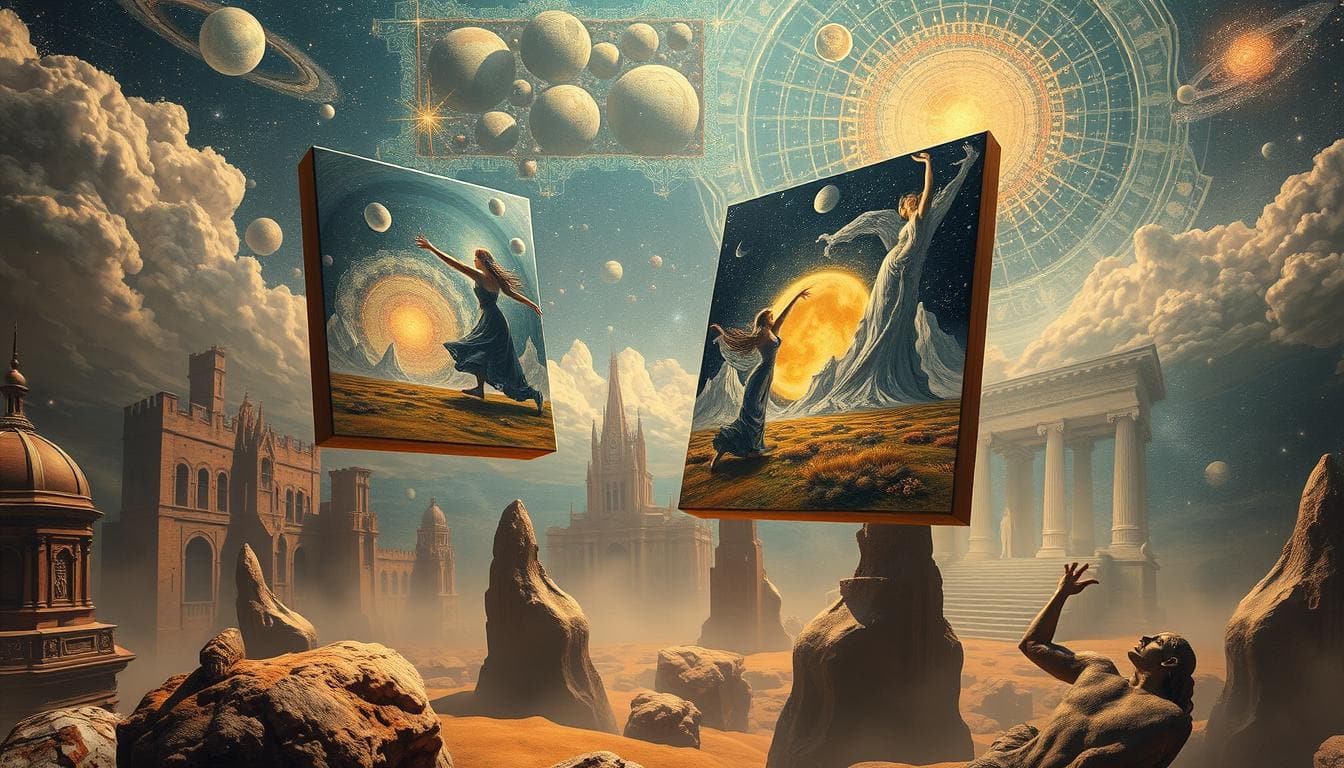
Salvador Dalí’s melting clocks didn’t just warp time – they bent reality itself into a cultural Rorschach test. Nearly a century later, that dripping watch face remains shorthand for the bizarre beauty of surrealism. But here’s the twist: André Breton’s 1924 manifesto now reads less like an art movement’s birth certificate and more like a user manual for our meme-saturated world. Imagine scrolling through TikTok at 3 AM – that’s post-surrealism in action.
Dalí, born 120 years ago this year, would’ve thrived in our era of deepfakes and AI-generated nightmares. His collaborator Breton? The original hype-man for subconscious rebellion. Together, they built a visual language that outlived them both – one that contemporary artists like Julie Curtiss weaponize with Jungian precision. Her painting of a hairy Thanksgiving turkey isn’t just unsettling; it’s a Freudian slip served with cranberry sauce.
Modern art’s relationship with surrealism isn’t mere homage – it’s genetic modification. Today’s creators blend Dalí’s dream logic with Warhol’s pop sensibility, creating works that feel like Kafka collaborating with a Twitter bot. The movement’s legacy survives not in museum replicas, but in our collective willingness to ask: What happens when we stop making sense… on purpose?
Surrealism in the Postwar Era
Imagine New York City in 1946. Male surrealists meet in dim cafes, talking about Freud over cigarettes. Leonora Carrington, in Mexico City, mixes magic with ibex horns and mirrors. The story we often hear is like a boys’ club field trip. But the real magic was made by the women.
Carrington didn’t just paint strange creatures. She created an alchemical bestiary that turned pain into something greater. Her 1944 escape from a psychiatric hospital, after Max Ernst’s arrest, inspired The Giantess. It shows motherhood as a cosmic battle.
Across town, Remedios Varo made paintings like Creation of the Birds. They mixed quantum physics with medieval mysticism. Their studios were like witchy surrealism labs, not just places for doodles.
Now, think about Jackson Pollock’s drip paintings. We say they came from surrealist “automatic drawing.” But when men do it, it’s seen as genius. When women like Penny Slinger use their bodies in art, it’s called “craft.” The era had a rule: authentication (male) vs. decoration (female).
Varo and Carrington’s work makes us question things. Why do art books focus on Breton’s group at Café Cyrano? How many women visionaries were forgotten while their male peers made millions? Next time you see a Pollock, wonder: Is it abstract expressionism, or just a macho Rorschach test?
Surrealist Influence on Abstract Expressionism, Pop, Conceptual Art
Let’s play Six Degrees of André Breton. It’s amazing how Yves Tanguy’s dreamscapes and James Turrell’s light baths are connected. Jeff Koons’ balloon dogs and Joan Miró’s constellations also share a common thread. The surrealist movement spread widely in postwar America, touching Abstract Expressionism and Pop’s colorful nihilism.
Take Miró’s “Constellation” series from the 1940s. These cosmic doodles are like jazz improvisations. Fast-forward to 1994, and Koons introduces “Balloon Dog”. Its reflective surface distorts reality, much like a funhouse mirror.
Both artists play with form, stretching shapes into something almost familiar yet absurd.
Tanguy, the surrealist of existential dread, painted “Mama, Papa is Wounded!” in 1927. It looks like a Dali desert after a nuclear blast. Turrell’s Roden Crater installations share a similar eerie vibe, using volcanic rock and moonlight.
Rauschenberg’s “Combines” feature a stuffed goat in a tire and a paint-splattered bed. These works are like Duchamp’s readymades, but with a twist. They reflect the surrealist love for accidental beauty and Pop’s fascination with consumer culture’s waste.
Rothko’s color fields are like Surrealist landscapes having an existential crisis. His hazy rectangles evoke Tanguy’s barren vistas, but with emotional colors. It’s as if Dalí’s Persistence of Memory was melted down into pure mood.
Miró’s journey from Spain to America in the 1940s connected European Surrealism with American avant-gardes. His automatic drawings inspired Pollock’s drip paintings, making the subconscious abstract.
Tanguy’s story is a tale of darkness. A Parisian dropout who found success in America, his work reflected postwar trauma. His empty landscapes are like Camus’ The Stranger, capturing the surreal feeling of a generation after the atomic bomb.
Today’s art, from Koons’ kitsch to Turrell’s light shows, is deeply influenced by surrealism. The movement didn’t die; it just evolved.
Literature and Film
Surrealism didn’t just splash paint on canvas—it changed how we tell stories. Think of Paul Delvaux’s haunting train stations with spectral nudes. These weren’t just paintings, but frozen screenplays waiting for David Lynch to hit record.
Meret Oppenheim’s fur-lined teacup (Object, 1936) is the ultimate plot twist. It’s a tactile poem that whispers “discomfort is the price of wonder.”
Modern surrealist poets like Mary Reid Kelley take this tension to eleven. Her autopsy-themed verse—delivered through characters with mouths where ankles should be—updates Buñuel’s eyeball-slicing shock for TikTok attention spans. It’s Un Chien Andalou meets ASMR: visceral, intimate, and designed to make you squirm deliberately.
Dalí’s Hollywood dalliances show surrealism’s blockbuster power. His dream sequences in Hitchcock’s Spellbound (1945) didn’t just decorate scenes—they invented visual language for depicting psychosis. But his unfinished Disney collaboration Destino (2003) matters more than any NFT: a 50-year-old storyboard proving surrealism outlives tech trends by weaponizing timeless human unease.
Why does this fusion of text/visual haunt us? Three reasons:
- It hijacks collective subconscious (thanks, Freud)
- It weaponizes absurdity as social critique
- It makes subway ads for antidepressants look bland by comparison
From Delvaux’s railway ghosts to Kelley’s flesh-puppets, surrealist writers and filmmakers remind us: reality’s just the first draft. The real magic happens when we edit with a chainsaw.
21st Century Surreal Collectives
If Dalí traveled to 2024, he’d likely swap his melting clocks for TikTok filters and crypto-art. Today’s surrealist groups aren’t just in Parisian cafés. They’re mixing the movement’s essence with digital avatars and algorithmic chaos. Let’s explore how post-surrealism lives on in meme culture and decentralized art markets.

Claude Cahun’s gender-fluid portraits were groundbreaking in the 1920s. Now, they’re Instagram AR filters. Her identity experiments seem almost prophetic today. Eileen Agar’s seashell sculptures have evolved into Beeple’s $69 million NFT collages. Her “fetish objects” idea? Now, crypto-bros buy pixelated phalluses as status symbols.
Today’s surrealist legacy is built on three key elements:
- Hybrid mediums: Nathaniel Mary Quinn’s photomontage paintings blend Victorian portraits with street art grit
- Digital collectives: Groups like MSCHF use absurdity (see: their “Satan Shoes” controversy)
- Outsider reinvention: London’s Museum of Everything gives dementia patients’ art surrealist framing
Is Banksy’s shredded “Girl With Balloon” the ultimate surrealist prank? The stunt challenged expectations during its auction debut. It’s a mix of Bretonian “pure psychic automatism” and clever capitalism. Either way, it shows the surrealist legacy thrives in viral moments, not just manifestos.
Today’s collectives don’t just question reality; they’ve created entire alternate worlds. From Quinn’s fractured identities to crypto-art’s fluid value systems, surrealism’s heirs are rewriting the rules. Again.
Digital and Political Surrealisms
In today’s world, deepfakes are changing how we see surrealism. Kay Sage’s skeletal landscapes, once symbols of postwar fears, now vanish as NFT burn art. Dorothea Tanning’s 1942 painting Birthday has been remixed into AI apps that show dystopian Airbnb listings. These examples challenge our views on capitalism and art.
Artists today are using surrealism to make a political statement. Jonathan Meese in Berlin creates anti-art installations that attack political symbols. VR artists are building dream worlds inspired by Dalí, where users face ICE detention centers with melting clocks. The question is, can these digital works have the same impact as traditional art?
| Traditional Surrealism | Digital Evolution | Political Impact |
|---|---|---|
| Tanning’s domestic unease | AI-generated haunted interiors | Critiques algorithmic bias in housing |
| Sage’s barren landscapes | Self-destructing NFT art | Comments on crypto environmental costs |
| Magritte’s visual paradoxes | Deepfake propaganda | Exposes truth decay in democracies |
When politicians outdo surrealists in absurdity, does protest art need to get even crazier or more subtle? A TikTok filter that changes faces with Méret Oppenheim’s teacup might go viral. But will it really change our minds? As we dive into warped realities, surrealism’s power today might be in making us notice the normal before it changes beyond all recognition.
Resources for Educators
Teaching surrealism in 2024? Forget dusty textbooks. Today’s classrooms need meme generators and algorithmic corpse games. The movement’s legacy thrives when educators embrace its weirdness, blending analog traditions with digital tools.
Start with the subversive: The Dalí Theatre Museum offers curriculum guides that turn mustache-twirling into math lessons. Their “Lobster Phone Physics” module? Pure genius. Pair it with MoMA’s Surrealist Meme Toolkit—because nothing teaches juxtaposition like Gen Z humor meets Magritte’s bowler hats.
For women in surrealism, dive into Claude Cahun’s gender-bending photography through the Tate Modern’s lesson plans. Students dissect her self-portraits using modern filters, proving identity fluidity isn’t just a 21st-century concept. Pro tip: Compare Cahun’s work to Inka Essenhigh’s liquid graphite techniques—a perfect bridge between 1930s radicalism and contemporary digital art.
- Salvador Dalí’s Dream Journal Templates (K-12 adaptable)
- André Breton’s Exquisite Corpse Slack Bot (algorithmic collaboration for the ADHD generation)
- Leonora Carrington’s Feminist Bestiaries Coloring Books
Literature teachers, rejoice: The Poetry Foundation’s Surrealist Poets and Writers database lets students remix Éluard’s verses into TikTok scripts. Why let them merely analyze automatic writing when they can battle-rap Gherasim Luca’s love poems?
Pro move: Host a “Surrealist Salon” where students defend Meret Oppenheim’s fur teacup as either climate commentary or breakfast critique. Bonus points if they cite Dorothea Tanning’s dream diaries as primary sources. After all, if education isn’t slightly unhinged, are we even doing surrealism right?
Conclusion
Dalí’s melting clocks now connect to quantum physics. His “nuclear mysticism” from the 1950s foresaw art from subatomic particles at CERN. These particles move like The Legacy of Surrealism in data visualization.
The Denver EMP Museum shows Breton’s revolution didn’t stop with paint. They’ve made a VR version of Un Chien Andalou using Python code. This brings surrealism into the TikTok era.
Modern art galleries now feature glitches. Cindy Sherman’s self-portraits and Damien Hirst’s sharks are influenced by Magritte. Surrealism also shows in AI-generated deepfakes, like Marilyn Monroe in blockchain videos.
We’ve given our unconscious to algorithms. But who programs the programmer’s dreams?
EMP’s Code-Dreams: Surrealism 4.0 exhibition uses neural networks on Dalí’s diaries. Visitors interact with chatbots quoting Lautréamont. It’s like an art movement turned operating system, fixing reality’s bugs.
Next update is coming Tuesday.