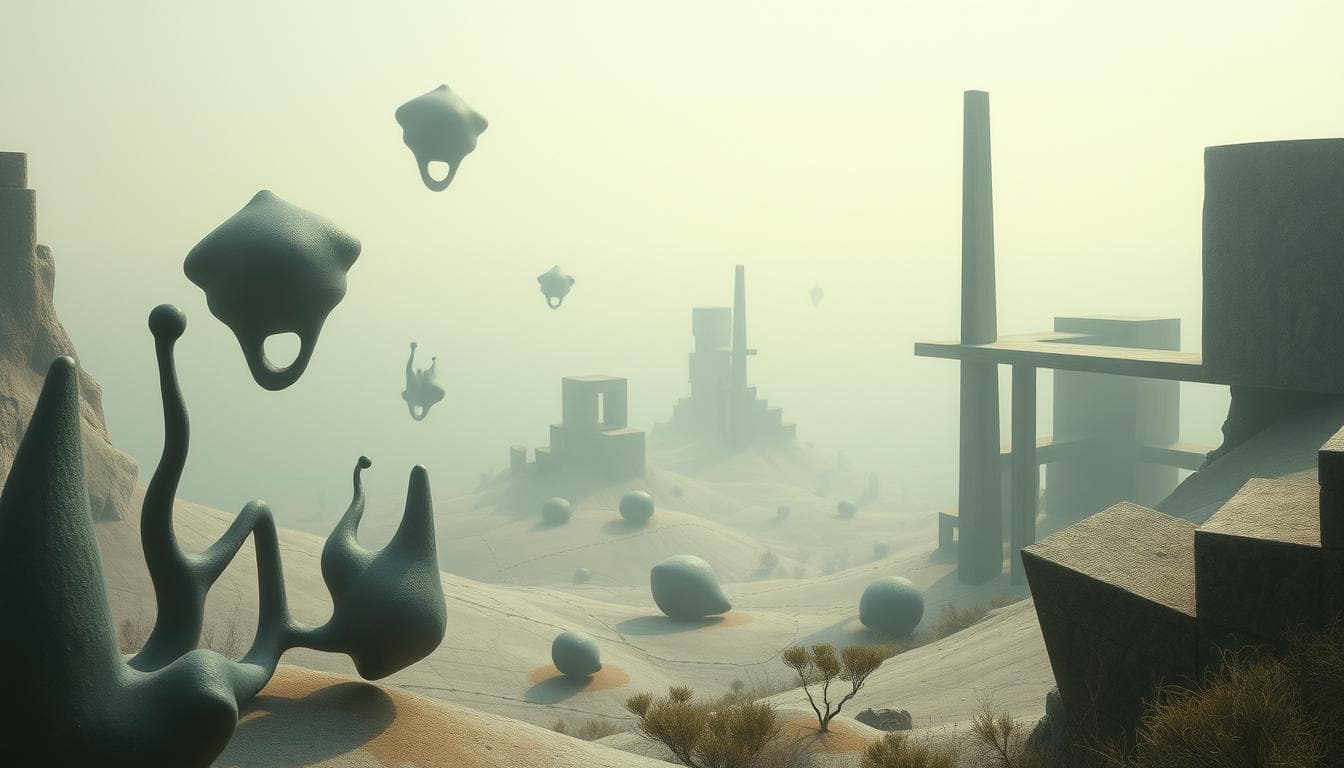
Imagine a Parisian sailor who traded compasses for paintbrushes. This man turned Freudian daydreams into alien terrains. His work is so detailed, it would make a cartographer cry. Yves Tanguy’s biography is like a Surrealist manifesto, full of automatism and geological obsession.
In 1930, Tanguy left Paris for North Africa’s bright sun. This trip inspired Second Message III, a painting that mixes Saharan rocks with subconscious symbols. Picture Dali’s clocks melting over a Martian quarry, and you’re close. But Tanguy wasn’t alone. Surrealist landscapes were part of a global network, connecting artists from Mexico City to Cairo.
André Breton’s “mafia” gets all the fame, but women played a big role too. While Tanguy drew his white spires, Leonora Carrington rewrote myths with menstrual ink. It’s time to give women their due in Surrealist history.
Tanguy’s art is full of paradoxes. His maps of nowhere are incredibly detailed, and his brushstrokes seem both random and controlled. His paintings ask us to imagine a world where therapists analyze mountains. It’s a journey from our minds to the universe.
Childhood, Strange Fascinations
Before Yves Tanguy picked up a brush, his eyes transformed the ordinary. The Breton coast was more than fog and sea to him—it was a canvas of endless possibilities. Imagine a boy studying cloud shapes like a UFO hunter, and you’ll see where his surreal art began.
Tanguy’s love for André Breton’s manifestos wasn’t random. His childhood, with crumbling cliffs and grey seas, was his first art book. The Atlas Mountains were not just mountains; they were a canvas for his dreams.
Three key things shaped Tanguy’s early art:
- Coastal pareidolia: Seeing faces in rocks was his first art
- Nautical nightmares: Stormy ferry rides inspired his floating shapes
- Logbook larceny: Stealing a ship’s journal at 14 was his first “found object”
| Childhood Element | Artistic Manifestation | Surrealist Technique |
|---|---|---|
| Breton coast fog | Ethereal backgrounds | Atmospheric perspective |
| Ship rigging patterns | Biomorphic shapes | Automatic drawing |
| Tidal pool creatures | Hybrid lifeforms | Unconscious biomorphism |
The seasick ferry ride was more than a teenage tantrum—it was his first art piece. The wobbly horizon he drew while seasick? That was surrealism at its purest, before anyone called it that. Breton’s ideas just gave shape to what the sea had already shown him.
Psychologists might say it was environmental influence. We call it the greatest art heist of the 20th century—a kid stealing reality’s secrets to create better dreams.
Self-Taught Artist
While art schools focused on perspective, Tanguy learned in café smoke and museum shadows. His real education came from stolen Louvre visits, late-night poetry, and debates with Breton’s Surrealist group. He traded textbooks for absinthe-fueled dreams.
His approach differed from Frida Kahlo’s, who drew from personal pain. Tanguy explored collective dreams. Dalí’s work was polished, unlike Tanguy’s raw forms. He was guided by Rimbaud’s spirit and Parisian graffiti.
| Artist | Training | Creative Fuel | Signature Move |
|---|---|---|---|
| Yves Tanguy | Café debates | Automatic drawing | Bone-like landscapes |
| Frida Kahlo | Self-portraiture | Physical trauma | Symbolic realism |
| Salvador Dalí | Madrid Academy | Freudian theory | Meticulous melting clocks |
Tanguy’s method was alchemy and rebellion. He treated canvas like a Ouija board. His brush captured subconscious shapes while café philosophers debated.
Modern surrealist autodidacts take note: Tanguy showed you don’t need credentials to create dream machines. Just madness, a thirst for the uncanny, and late nights at La Coupole.
Entry into Surrealism
The 1927 Galerie Surréaliste exhibition was more than an art show. It was a theatrical playground where Breton introduced Tanguy like a circus master unveiling a star. Breton called him Surrealism’s “new Columbus,” asking if he was exploring new creative territory or just selling tickets. Let’s look into the manifesto’s fine print.

Breton’s Bureau de recherches surréalistas was like a spy agency and PR firm combined. Their biggest stunt? Sabotaging conservative art shows by releasing live crabs painted gold. Tanguy’s biomorphic forms became the movement’s visual symbol. But Breton’s cocktail recipes, like the “Automatic Inspiration” drink, fueled its philosophy.
- 2 oz absinthe (for “dissolving bourgeois inhibitions”)
- 1 dash of laudanum (“to taste history’s bitterness”)
- 3 coffee beans (“representing revolution’s caffeine”)
Their real bond was their relationship. Breton needed Tanguy’s dreamlike canvases to bring Surrealist theory to life. Tanguy, in turn, entered Paris’ avant-garde circle. Their 1927 collaboration was more than art—it was a cultural flip, turning the art world’s expectations upside down with absurdity.
But there was real innovation behind the show. Tanguy’s floating mineral forms at the exhibition were more than decorations. They were Rorschach tests for a generation dealing with Freudian theory. Breton’s biography shows the madness had a method: “We didn’t break rules—we showed rules were already broken.”
Visual Hallmarks—Surreal Topographies
Dalí’s melting clocks are like a train schedule. Tanguy’s Surrealist landscapes are like a geological Rorschach test. His paintings are not just alien terrains; they are alien terrains. They are filled with biomorphic shapes that go against biology and physics.
Imagine Salvador Dalí and a geologist working together after three espressos. That’s close to understanding Tanguy’s mineralogic madness.
Second Message III looks like the Moon after a psychedelic earthquake. The painting has jagged spires and floating boulders. These aren’t just rocks; they are fossilized subconscious impulses.
While Max Ernst used frottage to capture nature’s textures, Tanguy’s forms seem unearthed from dreams. His biomorphic shapes look like vertebrae, mushrooms, and artillery shells in a slow-motion ballet.
What makes these Surrealist landscapes so captivating? It’s the mix of precision and ambiguity. Tanguy’s shadow-casting is very realistic, yet his “rocks” don’t follow any known laws.
The result is a visual language that’s both scientific and poetic. Freud would have charged a lot to analyze these paintings.
Here’s something interesting: Tanguy never visited a desert. His landscapes are a mix of childhood fascinations and automatic drawing. Next time you see his work, wonder: Are these landscapes maps of the mind, or mind-bending maps? Either way, you might need a compass… and a therapist.
Automatism & Dream Imagery
Imagine painting like your brush is a Ouija board planchette – that’s Tanguy’s abstract surrealism in action. His canvases became psychic battlegrounds where conscious control surrendered to what André Breton called “pure mental automatism.” But was this artistic channeling spiritual mediumship or subconscious meth cooking? Let’s break down the chemistry.
Tanguy’s process resembled a surrealist séance. He’d enter trance-like states, letting his hand drift across the canvas like a drunk GPS. The results? Those eerie landscapes where geological forms seem to remember being alive. Freud would’ve charged double for analyzing these dreamscapes – floating bones, molten architecture, and shapes that defy Euclid and common sense.
Compare his method to other automatism pioneers:
| Artist | Technique | Freudian Connection |
|---|---|---|
| Jackson Pollock | Drip painting | Action as id release |
| Salvador Dalí | Paranoiac-critical | Conscious hallucination |
| Yves Tanguy | Guided chance | Archaeology of dreams |
The titles tell their own story – lifted from Charles Richet’s parapsychology texts like inside jokes from the unconscious. Mama, Papa Is Wounded! isn’t just a painting name – it’s a Freudian slip wearing a party hat. This linguistic gamesmanship makes Rorschach tests look like children’s connect-the-dots.
Modern neuroscientists might call Tanguy’s process predictive processing gone rogue. His paintings feel like screenshots from a brain’s defragmentation sequence – familiar yet alien, like discovering your childhood home has been rebuilt as an MC Escher print. The real question: When we stare at these works, are we analyzing art or being analyzed by it?
Tanguy’s American Years

When surrealist exiles from Europe arrived in America, Yves Tanguy made Connecticut his new home. He turned its diners, deserts, and drive-ins into his canvas. Imagine a French surrealist sipping coffee at a diner, drawing strange creatures on napkins while truckers talk about baseball.
This wasn’t just a way to escape—it was a way to mix cultures. Tanguy’s studio in Connecticut became a meeting place for artists from all over. He worked with the Chilean Mandrágora group and US artists, creating paintings that combined Navajo sandpainting motifs with Duchamp’s chess ideas.
Highway billboards and motel neon lights inspired Tanguy’s art. His painting, “The Sun in Its Jewel Case”, shows Arizona’s Painted Desert with a twist of nuclear fear. His sketches of diners show landscapes where jukeboxes turn into alien statues.
This was more than just art—it was a form of mental battle. While others missed Europe, Tanguy explored America’s visual world. He used:
- Roadside dinosaur statues as dream symbols
- Drive-in movie screens to show the collective unconscious
- Gas station maps as doors to new worlds
Connecticut’s hills were just a cover for the battle in his mind. Tanguy showed that you don’t need fancy Parisian salons to create art. Greasy spoon metaphysics and interstate dreams were enough.
Marriage to Kay Sage
Frida and Diego’s love story is well-known, but Tanguy and Sage’s is less talked about. Their 1940 marriage was a blend of art, not gossip. Kay Sage brought her architectural style, while Yves Tanguy added his organic forms. Together, they created a unique art world.
Three key things made their art special:
- Architect vs Biologist: Sage’s buildings were the base for Tanguy’s living creatures
- Sketchbook Wars: They competed in their notebooks, with Sage drawing straight lines and Tanguy adding curves
- Cocktail Alchemy: They had deep talks at parties, where Dalí’s mustache was just a side note
But history often sees Sage as just Tanguy’s wife. This is unfair to women in surrealism. In 1941, her art show was a hit, beating Tanguy’s. MoMA bought her Tomorrow Is Never in 1948, showing her influence on Tanguy’s work.
Their 1955 joint show tells their story. Sage’s notes and Tanguy’s sketches show their collaboration. Even after Tanguy’s death in 1955, Sage’s last words were about him.
Why is this important? It’s about recognizing Kay Sage’s role in surrealism. She was:
- A pioneer in surrealist architecture
- Helped Tanguy escape Nazi-occupied France
- Curated his first big U.S. show
Their marriage was more than a love story. It was a meeting of two artists that changed surrealism. Next time you see Tanguy’s art, think of Sage’s influence.
Major Works
X-rays reveal secrets in Tanguy’s paintings, mixing biomorphic shapes with hidden stories. His Second Message series is like a surrealist crime scene. Experts found up to seven layers of paint, showing decades of his creative journey.
Tanguy’s “ectoplasmic oozes” started with house paint experiments. He mixed industrial grit with delicate glazes. Look closely at Second Message pieces and you’ll find André Breton’s profile, a secret joke with the Surrealist leader.
The real excitement is in his 1926 black landscapes. They’re like Rothko’s work but with a Parisian twist. These early pieces show Tanguy’s vision.
- Volcanic colors under monochrome surfaces
- Architectural fragments that break geometry rules
- Fossilized brushstrokes that capture moments
Conservators found hidden compositions under later works. It’s like finding deleted scenes from Un Chien Andalou. Tanguy’s biomorphic shapes were not random but calculated accidents.
His “mineralized dream algebra” follows hidden rules. Diagonal lines and warm/cool contrasts suggest depth. It’s abstract surrealism with a hidden grid, blending Pollock’s chaos with Mondrian’s order.
Conclusion
Yves Tanguy’s surrealist legacy lives on, even when logic takes a nap. His unique forms inspire today’s artists, like Boghossian’s Night Flight. This piece echoes Tanguy’s dreamlike landscapes.
Now, digital artists use AI to create strange worlds. Midjourney and DALL-E’s work looks like Tanguy’s next projects. It’s as if they’ve earned their coding degrees.
The 1960s psychedelic posters also drew from Tanguy’s style. Today, VR developers build spaces that feel like Tanguy’s sketches. Every glitch art or deepfake we see is like peeking into his mind.
Instagram’s algorithm might even be influenced by Tanguy’s work. It often shows #weirdart posts, as if seeking his approval.
Tanguy’s paintings were ahead of their time. They predicted our love for meta-reality. His 1930s works seem like AR filters ready to be discovered.
As neural networks create endless versions of The Sun in Its Jewel Case, we’re helping Tanguy’s work live on. We’re dreamers, but our dreams are in high definition.