
Imagine David Lynch painting over Salvador Dalí’s sketchbook. That’s the eerie charm of Kay Sage’s work. Her figures are like ghosts on canvases, haunting us like the Red Room’s doubles in Twin Peaks.
While European surrealists drew melting clocks and sexy muses, Sage created white towers in empty landscapes. Her work from the 1940s didn’t just challenge the male-dominated art world. It also changed the rules of surrealism with a practical American touch.
Scott Stockton’s digital art might use AI, but it shares Sage’s sense of unease. Both artists ponder: What happens when you trap infinity in geometric cages? But Sage’s legacy is often overshadowed by her marriage to Yves Tanguy, seen as a way to diminish her role in American surrealism.
Here’s the question: How does an artist break free from a movement obsessed with femme-enfant fantasies when they’re armed with palette knives, not pom-poms? Sage’s figures are shrouded, hinting at answers in the empty spaces. They stand as symbols of women artists overlooked by history. Her towers don’t lean; they judge, casting long shadows over today’s debates about authorship and recognition.
So let’s lift the curtain. Beyond the “muse industrial complex” lies a trailblazer who mapped the subconscious with precision. Sage didn’t just paint dreams; she designed them.
Aristocratic Roots and European Travels
While F. Scott Fitzgerald’s expats enjoyed gin in Paris, Kay Sage sketched Venetian balconies with great detail. Born into New York’s aristocracy, her family’s wealth was as vast as Indiana Jones’ adventures. Her upbringing was more about exploring the world than living the Great Gatsby life.
- Florentine palazzos that whispered Renaissance geometry into her sketchbooks
- Egyptian temples where shadows played tricks worthy of De Chirico
- Japanese shōji screens that later materialized as spectral planes in her paintings
Dalí was making a splash in New York, but Sage was exploring Europe’s decaying edges. In 1936, she wrote in her Venetian diary: “Titian’s ghost outnumbers tourists here—perfect for cataloging corrosion.” Her fascination with decay fueled her American surrealism. It turned rotting buildings into haunting paintings of the mind.
Stockton’s cultural scene was a feast for her. She learned about Egyptology and Kabuki theater. Her 1942 masterpiece, Tomorrow Is Never, shows a desert citadel. It’s a mix of a Florentine dome and a Saharan storm, trapped in twilight.
When surrealism moved to America during WWII, many artists were new to the scene. Not Sage. Her knowledge of European architecture helped her create a visual language for those feeling homesick.
Surrealist Entry and Group Dynamics
Imagine joining a secret society with a weird initiation. Kay Sage joined André Breton’s 1938 Exposition Internationale du Surréalisme with a ritual of psychic automatism and public shame. This event was a mix of art and theater, testing her as she entered a world that valued chaos but demanded strict beliefs.

Breton’s circle, including Max Ernst and René Magritte, was like avant-garde royalty. Women artists faced a strange challenge: they had to tap into their subconscious, unless they studied art. Sage, with her architectural skills, stood out among the self-proclaimed “visionary illiterates.” Critic Patrick Waldberg once said: “Breton wanted mediums, not painters.”
Now, let’s compare Sage’s experience to Leonora Carrington’s:
| Artist | Surrealist Cred | Breton’s Verdict | Legacy Status |
|---|---|---|---|
| Kay Sage | Formal training | “Too architectural” | Posthumous recognition |
| Leonora Carrington | Mythic narratives | “Authentic medium” | Lifetime acclaim |
Of the 63 artists in Breton’s 1938 show, only 7 were women. Sage’s architectural surrealism didn’t fit the movement’s love for biomorphic shapes. But her work brought to life the hidden corners of the mind.
Three main factors influenced Sage’s role:
- Breton’s dislike for technical skill
- The group’s obsession with “madness”
- Changes in surrealist politics after WWII
Her geometric desolation – with its sharp lines and empty buildings – quietly challenged the male-dominated surrealist world. While men created melting clocks and floating eyes, Sage built structures that held secrets.
Relationships: Yves Tanguy and Others
Surrealism’s power couples often played a game of artistic hide-and-seek. Leonora Carrington escaped Max Ernst’s shadow through mythic self-reinvention. Kay Sage and Yves Tanguy’s 1940 marriage was a shared dreamscape divided by barbed wire. It was intimate yet fiercely independent, as one critic noted.
Consider the gender politics at play:
- Tanguy muse became Sage’s accidental job title despite her equal gallery presence
- Critics framed her architectural precision as “support beams” for his biomorphic forms
- Their Connecticut studio enforced separate workspaces – his chaotic, hers monastic
Sage’s 1942 painting Margin of Silence reveals her sly rebuttal. The canvas features her signature veiled figures beside Tanguy-esque shapes. But notice who’s obscuring whom. Those draped forms achieve what no femme-enfant surrealist ever could – rendering the male artist conceptually invisible.
| Couple | Dynamic | Legacy |
|---|---|---|
| Sage & Tanguy | Competitive collaborators | Mutual anonymization |
| Carrington & Penrose | Muse-as-protégée | Mythological rebranding |
| Ernst & Tanning | Master-apprentice | Eventual divergence |
Stockton’s analysis of “men with obscuring faces” in Sage’s work hits harder when you realize she held the drapery pins. Each veiled figure became a wry commentary on surrealism’s girlfriend problem. Her 1955 journal entry says it best: “They want me to be his shadow? Fine – but shadows swallow objects whole at dusk.”
This tension between collaboration and erasure defined Sage’s Yves Tanguy biography within their marriage. While he collected exotic objects for inspiration, she collected aliases – Kay Sage, K.S. Tanguy, “that American widow who paints.” A masterclass in controlled visibility.
Sage’s Pictorial Motifs—Isolation and Architecture
What do mid-century California gas stations and 18th-century Italian etchings have in common? Kay Sage’s Sage paintings connect these worlds with skeletal structures. They look like Googie diners and Piranesi prisons at the same time. Her American surrealism doesn’t just show isolation—it builds it, piece by piece.
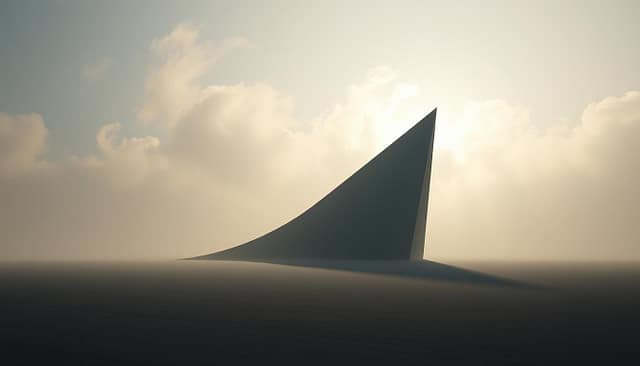
Look at Tomorrow Is Never. It sounds like a sign from a retro motel. Its towers remind us of Stockton’s Art Deco buildings, now fading like forgotten dreams. But Sage’s structures are more than just decaying; they’re actively questioning.
Do the zigzagging staircases in her work lead to freedom or dead ends? Are the faceless figures trapped in these shapes, or are they the ones designing them?
Compare her sharp voids to Hopper’s neon-lit loneliness. While Hopper’s figures are under bright lights, Sage’s characters move through surrealist zoning laws. Her landscapes don’t just isolate; they think about isolation through structures that challenge both physics and psychology.
Stockton’s Googie-style ruins, once meant to shout “Tomorrowland!”, become monuments to abandoned futures in Sage’s work. Her paintings ask: Is modern architecture a safe haven or a self-made maze? The answer, like her staircases, keeps going in circles.
Artistic Crisis & Resilience
In 1955, Dalí was making money by selling lobsters. But Kay Sage was burning her canvases, a bold statement against conformity. Her act was a radical feminist gesture, destroying the old surrealist rules.
Pollock dripped paint, but Sage incinerated her art. Post-WWII surrealism had turned into a boys’ club. Sage’s fiery act showed society’s fears of the atomic age.
Leonora Carrington turned to alchemy and tarot cards. Sage chose to destroy and reinvent. Her works were like landmines, challenging the status quo.
Dorothea Tanning painted dark scenes in cozy rooms. But Sage turned her studio into a pyre. Women in surrealism faced a choice: be a muse or set things on fire. Sage chose the latter.
Sage’s art wasn’t madness—it was method. Her work was bold, unlike Pollock’s chaotic drips. While men made surrealism a business, Sage preserved its surrealist legacy through her destruction.
By 1963, Sage’s life took a darker turn. She lost her eyesight and became isolated. Yet, she kept writing, exploring the limits of surrealism. Her late work showed a mind dissecting the movement, searching for its true magic.
Recognition & Posthumous Exhibitions
Kay Sage’s journey from MoMA’s storage to Venice’s Biennale is a surreal twist. For years, her art was overlooked while men like Dalí got the spotlight. But the 21st century brought a change, revealing her surrealist legacy to the world.
In 2019, Venice’s Biennale showcased Sage alongside Remedios Varo. This event marked a turning point. The Stockton Gallery’s 2021 “Chronologies of the Strange” exhibition further celebrated Sage’s work.
- Early architectural studies resembling haunted dollhouses
- 1940s draped forms that predated Bourgeois’ sculptures
- Late-career collages dissecting personal mythology
This revival is similar to Varo’s delayed recognition. Sage’s paintings are loud and bold, unlike Varo’s subtle whispers. Here’s how they differ:
| Artist | Lifetime Recognition | Posthumous Breakthrough | Major Exhibition |
|---|---|---|---|
| Kay Sage | 5 solo shows | 2019 Venice Biennale | Stockton Gallery (2021) |
| Remedios Varo | 2 solo shows | 2000 MoMA Retrospective | Art Institute Chicago (2018) |
Today, scholars study Sage’s work through feminist and geopolitical views. Her 1955 “Tomorrow Is Never” is seen as more than personal angst. It’s a reflection of the cold war era. The irony is that Sage’s story is now more appealing when she’s gone.
Conclusion
Kay Sage’s life story is like a surrealist movie. She was once an aristocrat, but became an artist. She loved exploring the unknown and the empty.
Her paintings are like Rorschach tests, asking us to find our own meanings. Dealer Julien Levy once called her work “post-apocalyptic real estate brochures.” This was a perfect description of her unique style.
Sage’s work is a key part of the Surrealist legacy. She connected the dots between Dalí and Rothko, even before others saw it. Her art, with its draped forms and gauze layers, whispers secrets to us.
Today, AI creates endless dreamlike images. But Sage’s work, with its deliberate emptiness, was groundbreaking. Her paintings challenge us to embrace the silence and find meaning in it.
In our world filled with too much information, Sage’s art is more relevant than ever. Her enigmatic paintings might just be coming into focus for us now.