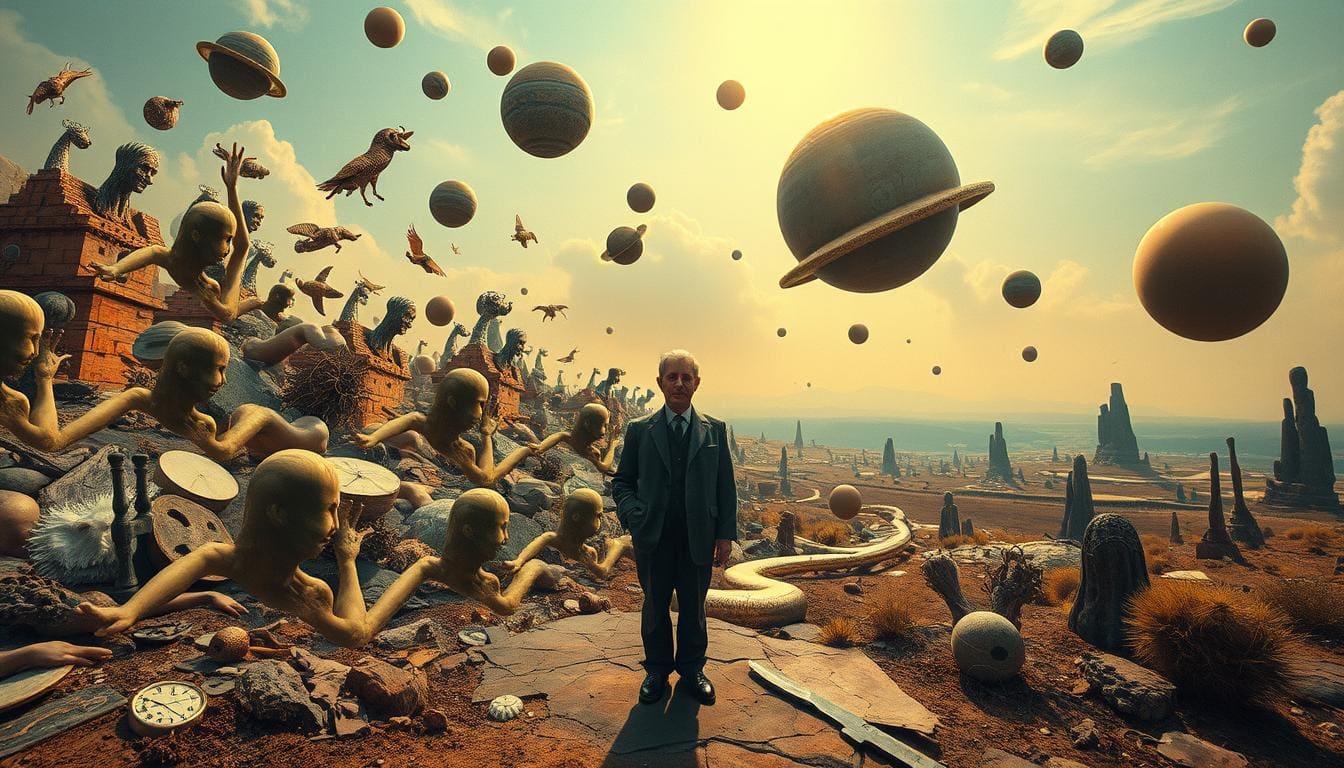
Imagine Paris in 1922. A group of poets gathered in candlelight, eating dog biscuits and talking about unsolved murders. It wasn’t a wild party—it was André Breton’s hypnosis lab. Here, the origins of surrealism started to form.
As a former medical student, Breton used Freud’s ideas to make creativity intense. Who needs logic when you can write automatically and use dog food?
The movement didn’t start in empty art studios. It mixed the chaos of Dadaism and surrealism. Dadaists in Zurich smashed typewriters, while Breton’s group added order to the madness.
They traded in nihilistic pranks for deep, meaningful manifestos. They showed that rebellion could be stylish and sophisticated.
Breton’s big idea was that dreams aren’t just bedtime stories. His “psychic automatism” experiments were like therapy sessions with a twist. Artists would write while eating pet food, blending art and mental health.
Early Life and Literary Beginnings
Before André Breton became surrealism’s leader, he worked as a medic in WWI. Born in 1896 in Normandy, he switched from poetry to medicine at 19. This change would deeply influence surrealism.
His early life was marked by a love for Rimbaud’s poetry and the harsh realities of war. As a young man, he saw the worst of war and was deeply affected.
Working in neurological wards, Breton listened to soldiers’ stories under morphine. These tales, full of irrational thoughts, inspired him. Imagine him writing “man cut in two by window” on bloody paper, unknowingly starting surrealism.
Three key influences shaped him:
| Influence | Source | Impact |
|---|---|---|
| Trauma Surgery | WWI Medical Training | Obsession with fractured realities |
| Psychoanalysis | Freud’s Studies | Automatic writing techniques |
| Avant-Garde Poetry | Rimbaud & Reverdy | Juxtaposition as artistic principle |
Breton started in Dadaist circles but faced challenges due to his medical background. He saw truth in what others saw as nonsense. His 1919 work, Les Champs Magnétiques, mixed automatic writing with scientific method.
The war’s effects stayed with him. He used the speech of shell-shocked soldiers in his writing. Morphine’s effects inspired his art, showing the power of the human mind.
By 1922, Breton was ready to lead. He shed his medical gloves for manifesto pens. Paris was about to see a revolution, led by a poet and a medic.
Paris in the 1920s: Forming the Surrealist Circle
Paris in the 1920s was more than a city—it was a dream world. André Breton’s surrealist group made the Latin Quarter their playground. They mixed poetry with performance art, creating something that would make today’s TikTok stars jealous.
Their “sleeping fits” were a unique feature. Think of it as adult nap time, but with a hint of existential fear. Robert Desnos, their star sleeper, acted like Marcel Duchamp’s alter ego Rrose Sélavy while asleep. René Crevel, on the other hand, brought a dark edge to dinner parties with his fascination with group suicides.
Was this art or “absinthe-fueled theatrics”? Let’s explore:
- Cultural Alchemy: Their café séances turned Freudian theory into performance art
- Group Dynamics: They were both collaborators and rivals, like the Beatles with more ink stains
- Legacy Launchpad: The 2023 London exhibition “Surrealism Beyond Borders” shows their lasting impact
Breton’s circle was like a surrealist poets wrestling match. Everyone was trying to pin reality down. They didn’t just break rules; they burned the rulebook and danced in the ashes. When Desnos wrote in trance states, was he unlocking secrets or just improvising? History’s espresso stains hold the answer.
The Surrealist Manifesto and Leadership
In 1924, Breton launched the Surrealist Manifesto. It was more than a statement—it was a challenge to logic. Imagine Freud and Marx at a wild tea party, with absinthe and poetry. The manifesto mixed psychoanalysis, politics, and creativity.
At its heart, psychic automatism was key. It’s about tapping into your imagination without thinking. Breton used Freud’s ideas and Lautréamont’s famous line about a sewing machine and umbrella. It was a call to shake up reality.
The manifesto’s ideas are bold and timeless:
- Automatic writing: Write freely, without worrying about what others think
- Dream supremacy: Dreams are more real than our daily lives
- Revolutionary vibes: Art can be a tool for change, not just beauty
Breton’s leadership was like a firework show. He made Surrealism a “collective experiment”. Artists like Dalí and Man Ray contributed to this movement. Breton wanted to mix art with politics, aiming to challenge the status quo.
Some saw it as pretentious, others as confusing. But history sees it as groundbreaking. Breton created a world where creativity and rebellion were key. His vision was far ahead of its time, even compared to artists like Jackson Pollock.
Breton’s Writings and Artistic Philosophy
Imagine mixing Freud’s couch, Marx’s manifesto, and a typewriter left out in the rain. You get André Breton’s philosophical grenade. It’s a mix of psychoanalysis, revolution, and imagination. His view was anti-disciplinary, blending dreams and dialectics.

Freud’s Shadow on the Surrealist Wall
Breton didn’t just read Freud; he weaponized him. The 1924 Manifesto of Surrealism made automatic writing key. It treated the subconscious like a political prisoner needing freedom.
Think of it as Freudian free association with a bullhorn. “Why should rationality get all the good real estate in our minds?”
Breton’s automatism wasn’t just about personal dreams. He saw it as collective ammunition for mass psychological liberation. Stalinists hated this, seeing it as a threat to their doctrine.
Marxism Meets Melting Clocks
The 1938 Mexico summit between Breton and Leon Trotsky was like a Dali painting. They co-authored the Manifesto for an Independent Revolutionary Art. They argued for absolute freedom of creation.
Their thesis was that true revolution needs artists as society’s “antennae.” Not propaganda puppets. The Communist Party saw surrealism as counter-revolutionary decadence.
Breton called their “worker’s paradise” unimaginative. This wasn’t just a breakup. It was an ideological divorce with manifesto broadsides.
The Impossible Trinity
Breton’s ultimate contradiction makes Icarus look cautious. He tried merging:
- Freud’s individual subconscious
- Marx’s collective class struggle
- Rimbaud’s systematic derangement of senses
The result was a philosophy as unstable as a three-legged stool in a hurricane. Yet, this instability sparked surrealism’s creative voltage. Breton didn’t seek coherence; he wanted creative detonation.
Conflicts, Expulsions, and Group Dynamics
André Breton was more than a leader; he was a strict enforcer of the Surrealist movement. He enforced a revolutionary discipline that was both artistic and strict. Salvador Dalí’s 1934 trial is a prime example. He showed up in 47 layers of clothing, including a thermometer, to prove his dedication. But his “paranoia-critical method” of accepting corporate sponsorships led to his expulsion.
Breton’s leadership was full of contradictions:
- He allowed Luis Buñuel to include graphic violence in Un Chien Andalou as “revolutionary violence”
- He criticized Dalí’s lobster telephone designs as too capitalist
- He kicked out members for political reasons while supporting Marxist theory
This surrealist authoritarianism reached its peak during World War II. Breton, fleeing the Nazis, continued to expel members from exile. Recent scholarship reveals these expulsions were not just personal. They were a desperate attempt to keep control as surrealism’s anti-establishment message clashed with its growing fame.
Was Breton a visionary leader or a tyrant? The evidence shows both sides:
| Year | Expulsions | Notable Victims |
|---|---|---|
| 1926 | 8 | Antonin Artaud |
| 1933 | 12 | Georges Bataille |
| 1947 | 5 | Roberto Matta |
Breton’s strict rule created a paradox. He championed automatic writing as a form of freedom but controlled who was truly part of the movement. His group was like a dysfunctional family, filled with arguments and dramatic exits. Yet, this chaos led to some of the most lasting art of the 20th century.
Breton’s Global Influence and Travels

Imagine a French poet who became a cultural leader, sneaking surrealism past customs like it was a secret dream. André Breton didn’t just share ideas; he spread imagination worldwide. He turned local art scenes into places where people challenged rational thinking.
In 1936, Breton launched his first big move in London. People expecting normal art saw 16 miles of labyrinthine string instead. Salvador Dalí even gave a lecture while wearing a diving suit. Critics were shocked, but many were also intrigued.
What made Breton’s work so appealing? He knew the British loved being a bit odd. He made automatic writing seem like a fun intellectual game. It became the new thing to do, like a modern version of afternoon tea.
When World War II started, Breton saw a chance to spread his ideas further. He moved to New York in the 1940s and introduced surrealist baseball. Max Ernst designed the bases to represent compass points to the unconscious. The FBI saw him as a threat, showing that fear knows no borders.
In Mexico City, Breton teamed up with Frida Kahlo during the war. Together, they created an exhibition that mixed pre-Columbian myths with dream logic. This blend became a model for cultural hybridity in postcolonial art. Diego Rivera even joked they started “revolutionary tourism,” blending politics with fun.
After the war, Paris welcomed Breton back, but he never stayed long. In 1947, he showed riotous installations in Paris that mocked the Cold War. His writings also inspired magical realists in Latin America. Surrealism had grown beyond him, becoming a global virus of imagination.
Later Life and Changing Legacy
By the 1950s, Breton’s Surrealists were seen as rebels in a world that wanted something new. Post-WWII Europe turned to existentialism, leaving Surrealism behind. Sartre’s ideas were all the rage, while Surrealism’s dreams were seen as old-fashioned.
The movement’s protests against the Vietnam and Algerian Wars were met with indifference. It was like trying to hold a “Revolution of the Mind” exhibition in 1960s Paris, while students were outside tearing up cobblestones. Breton’s followers were seen as passionate but out of touch with the times.
Then, in 1968, the famous graffiti “Under the paving stones, the beach!” appeared. It was a Surrealist idea taken up by young people who had never read Nadja. This raised questions about Surrealism’s relevance and whether it had become just a slogan. Breton’s death in 1966 left these questions unanswered.
| Era | Surrealist Influence | Cultural Impact |
|---|---|---|
| 1940s | War resistance manifestos | Marginalized |
| 1960s | Protest aesthetics | Commercialized |
| 2020s | Meme culture | Neo-surreal revival |
Today, Surrealism’s legacy is seen in modern art museums’ gift shops. Dali clocks and Magritte apple totes show how Surrealism has been co-opted by capitalism. This is exactly what Breton’s manifestos warned against.
But in our era of deepfakes and AI-generated images, Breton’s ideas might seem less radical. The decline of Surrealism as a movement shows its ideas have become part of our everyday lives. This is both a blessing and a curse.
Assessing Breton’s Place in Art History
André Breton’s surrealism legacy is a mix of philosophy and art challenge. It stands out among other art movements. While Abstract Expressionism had Pollock’s drips and Pop Art had Warhol’s cans, surrealism gave us Dalí’s melting clocks and today’s reality-bending filters.
The magic of surrealism is its lasting impact. Breton used Freudian psychology and Marxist critique in a way that feels modern. Today, digital absurdities like AI-generated images owe a debt to his 1924 automatism experiments.
Critics often see Breton as just an eccentric leader. But his work was more than that. It was a blueprint for seeing the world in new ways. Surrealism’s influence can be seen in protests, fashion, and online discussions.
While Rothko’s art whispers in museums, Breton’s ideas shout from street art and TikTok. His work continues to blur the lines between art and life. Has a Jackson Pollock ever made you question reality while on your phone?