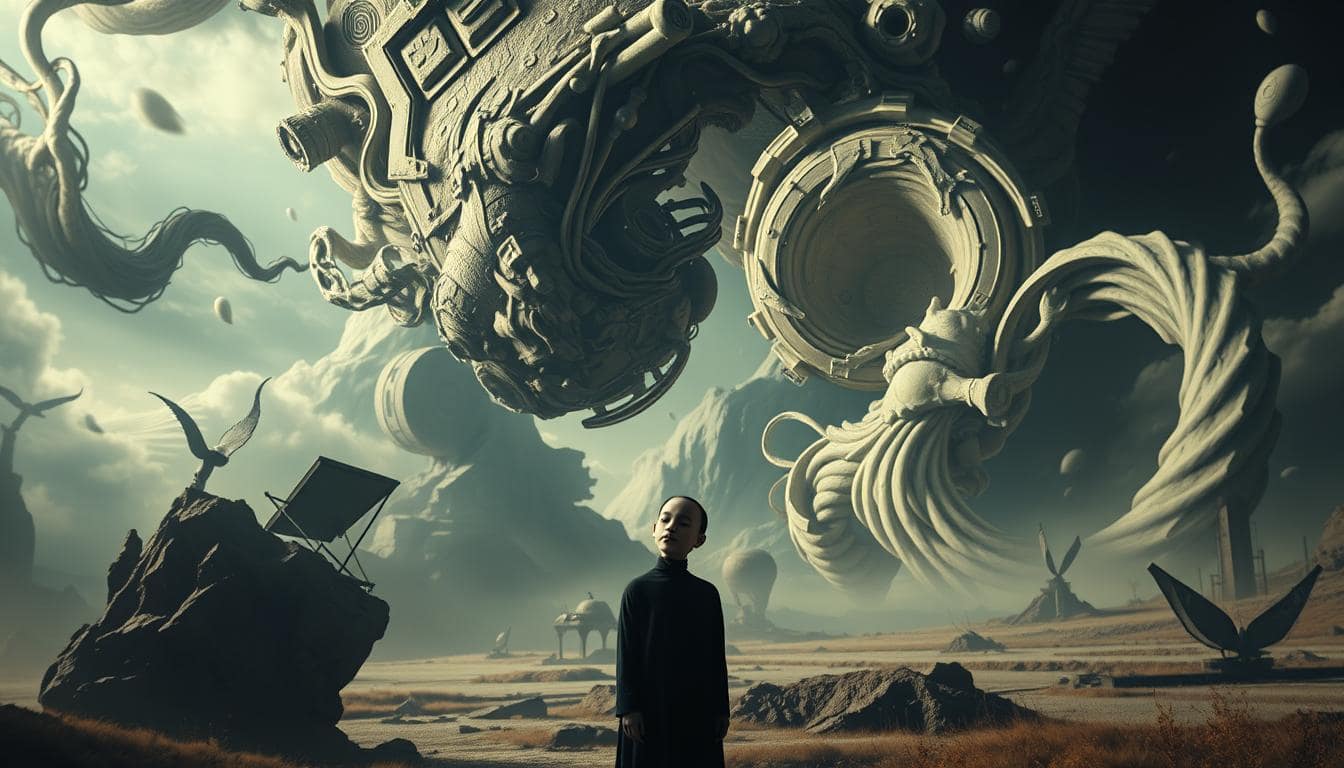
Imagine Salvador Dalí’s melting clocks flowing like liquid time across Sigmund Freud’s chair. This was more than art—it was a battle against reality. After World War I, Europe’s artists dug into Freud’s ideas on the unconscious.
In the 1920s, Paris buzzed with creativity. André Breton’s 1924 Surrealist Manifesto mixed Freud’s theories with bold action. Artists saw dreams as tools for change, not just for understanding.
Freud might have been surprised by how his ideas fueled surrealism. The movement explored hidden desires in art. It was like a bold statement against the norm, mixing psychoanalysis with rebellion.
This mix of psychology and art didn’t just create weird images. It changed how we think about creativity. The surrealists aimed to rewrite reality with Freud’s insights. And we’re all trying to figure out the results.
Freud’s Theories: Basics and Influence
Freud didn’t just analyze dreams; he gave artists a powerful tool. His 1905 work on dream interpretation became the psychoanalytic playbook for Surrealists. They wanted to change reality. Think of the unconscious mind as a rogue gallery curator.
It condenses memories into surreal collages and displaces desires onto bizarre symbols. Suddenly, a cigar isn’t just a cigar—it’s Freud’s id winking from the canvas.
Freud’s concept of repression mechanisms gave artists permission to reveal awkward truths. Why paint bowls of fruit when you could expose society’s buried kinks? Magritte’s apple-faced businessmen? That’s textbook displacement—social norms getting fruit-punched by subconscious urges.
Dali’s melting clocks? Condensation at its finest, where time and mortality ooze into one.
The real kicker? Freud argued repressed desires always resurface, like bad tattoos from your college years. Surrealists took this as a creative mandate: “Make the unconscious so visible it haunts brunch conversations.” They became psychological plumbers, unclogging society’s mental pipes through:
- Automatic drawing (id’s version of drunk texting)
- Dream journaling (field notes from the libido’s guerilla warfare)
- Paranoiac-critical method (seeing erect phalluses in every cloud formation)
Freud’s theories turned art into a therapy session where the couch was a canvas. Suddenly, psychoanalysis in art wasn’t just about diagnosing individuals—it was society lying on the chaise lounge, rambling about its mother issues. The Oedipus complex became less family drama, more avant-garde paintbrush.
And that, dear reader, is how Freud accidentally founded the first rule of Freudian art: If it doesn’t make your Victorian aunt blush, you’re not trying hard enough.
Breton’s Encounter with Freud
Imagine a French medical student-turned-poet entering Freud’s office. This is how Andre Breton surrealism began. Unlike Dadaists, who played pranks on icons, Breton used medical tools to revolutionize art. His 1924 surrealist manifesto aimed to improve reality, not just reject it.
Breton’s medical background gave him a special advantage. While Dada was all about chaos, Breton approached art with a scientist’s precision. He saw Freud’s theories as a blueprint for art.
- Dadaism: Anarchic destruction (“Burn the museums!”)
- Surrealism: Strategic reprogramming (“Let’s rebuild the mind first”)
The manifesto was a bombshell, saying: “Surrealism rests on the belief in the superior reality of certain forms of previously neglected associations.” In simple terms, Breton used Freud’s dream theories to unlock the mind. He wasn’t just interpreting dreams; he was freeing consciousness.
Now, things get interesting. Breton’s group didn’t just contrast Dadaism and Surrealism; they took over the avant-garde. The manifesto mixed Freudian ideas with art:
- Automatic writing as free association’s artsy cousin
- Dream journals repurposed as creative briefs
- Psychoanalytic theory as anti-bourgeois propaganda
But the revolution wasn’t all smooth. Breton ruled his movement like a strict leader. Those who disagreed were quickly kicked out. His strict rules made Freud’s couch seem like a laid-back spot.
The real magic was Breton turning Freud’s theories into an artistic playbook. Parisian surrealists saw art in what Viennese analysts saw as sickness. It was a mix of creativity and absinthe.
Automatism and Dream Imagery
If Freud gave artists a map to the unconscious, Surrealists saw it as a treasure hunt. They used automatic brushes and dream logic as their tools. Their surrealist techniques were more than art-making. They were rituals to tap into the raw psychic material.
André Masson’s automatic drawings are a great example. He doodled without thinking, letting his hand reveal what was hidden. It was like Jackson Pollock’s work, but with more Freudian angst. This led to the Bureau of Surrealist Research in 1924, where artists explored automatist techniques like:
- Frottage (Ernst rubbing graphite on wood grain to “reveal” hidden forms)
- Exquisite Corpse (collaborative word/image games)
- Hypnagogic states (painting between wakefulness and sleep)
Buñuel and Dalí pushed it further. Their film Un Chien Andalou used dreams to explore repressed desires. Dalí’s “paranoid-critical method” turned paranoia into a creative tool. He obsessively repainted melting clocks and ants until they were full of symbolic meaning.
These methods thrived because they were imperfect. Ernst’s frottage had crumpled textures that were like Freudian slip-ups. Surrealism’s global reach wasn’t about uniformity. It was a worldwide collaboration where artists tapped into their unconscious mind, showing that libidinal symbols are universal.
Surrealist Techniques Rooted in Psychoanalysis
Imagine Cubism and Surrealism in an art-history rap battle. Picasso’s geometric diss tracks versus Dalí’s Freudian freestyles. Cubism played chess with reality, fracturing perspectives into angular puzzles. Surrealism, on the other hand, opted for psychological MMA, pinning subconscious impulses to the canvas.

Take grattage – the Surrealist practice of scraping paint to reveal textures beneath. Compare this to Cubism’s controlled brushwork:
| Technique | Cubism | Surrealism |
|---|---|---|
| Primary Tool | Ruler and compass | Unconscious mind |
| Surface Treatment | Planned fragmentation | Accidental revelation |
| End Goal | Visual analysis | Psychological autopsy |
Then there’s the exquisite corpse – that gloriously unhinged group drawing method. Dadaists used randomness as protest, like Duchamp’s urinal. Surrealists, on the other hand, weaponized it as psychic archaeology. Their collaborative sketches weren’t just anti-art; they were group therapy sessions with ink stains.
Abstract Expressionists like Pollock splattered emotions like paintball grenades. But Surrealists? They X-rayed those feelings through Freud’s lens. Miró’s biomorphic blobs didn’t just decorate canvases – they mapped neural pathways, turning id-driven doodles into high art’s ultimate glow-up.
Major Artworks Inspired by Freud
Freud’s ideas didn’t just haunt European salons. They threw a global party, inspiring artists from Mexico to Switzerland. They turned their subconscious into canvas confetti. Let’s look at three iconic works that show the internationalization of surrealism was more than a trend—it was a psychic revolution.
Salvador Dalí’s The Persistence of Memory (1931) is a symbol of Freud’s ideas. The melting clocks show a rebellion against time, filled with anxiety about death. Dalí said he painted them after looking at camembert cheese. It’s a weird way to show existential dread.
Dorothea Tanning’s Birthday (1942) is a funhouse of Freud’s uncanny valley. It’s a self-portrait with wild hair and a mythical creature. It’s not a happy birthday but a journey into trauma. It became a symbol for female surrealists fighting patriarchal norms.
| Artwork | Freudian Theme | Cultural Impact |
|---|---|---|
| Max Ernst’s Europe After the Rain | Post-war collective unconscious | Reimagined post-WWII anxiety as apocalyptic dreamscape |
| Meret Oppenheim’s Object (fur-lined teacup) | Oral fixation meets tactile taboo | Made Freud’s theories literally palpable |
| Frida Kahlo’s The Wounded Deer | Personal trauma as universal myth | Proved surrealism could salsa, not just waltz |
Kahlo’s work is like a psychoanalytic mixtape. Her Broken Column (1944) turns spinal pain into a crumbling pillar. It’s raw emotion mixed with Mexican magical realism. It shows surrealism’s origins were diverse.
Even Switzerland’s Meret Oppenheim joined in. Her 1936 fur-lined teacup is a Dadaist prank. It’s Freud’s oral stage made real. Imagine drinking Earl Grey from a bear’s back. It’s uncomfortable, but that’s your superego judging you.
These works ask if art can be both personal and universally Freudian. The answer is yes, as seen in their global spread. Surrealism didn’t just borrow Freud’s ideas; it rewrote them in many languages.
Critics and Alternative Psychoanalytic Approaches
Surrealism wasn’t all fun and games. By the 1930s, it faced harsh criticism. People saw it as “bourgeois navel-gazing with better PR”, a jab that hurt more than Dalí’s waxed mustache.
The issue was trying to blend Freud’s psychoanalysis with Marx’s communism. It was like mixing absinthe and milk, a bad idea.
Breton’s flirtation with communism ended badly. His 1935 speech praising Stalin was a major misstep. It aged poorly, like meat left out too long.
Georges Bataille’s group, Acéphale (meaning “Headless”), was a bold statement. They rejected Breton’s idealism for raw critiques of power. Their first journal cover showed a headless man with a flaming heart. They were not subtle.
The decline of surrealism sped up with WWII. Artists like André Masson were scattered, leaving behind paint splatters. But this chaos led to something unexpected: the first global art movement.
Exiled surrealists in New York and Mexico City became cultural ambassadors. They showed that Freud’s ideas could cross oceans.
Marx and Freud were like bad roommates. One wanted to change the world, the other to understand it. Surrealism’s focus on politics and manifestos was its downfall. As Bataille said, “Revolution without blood is like coitus without erection.” It was a harsh statement, but true.
Freud’s Ongoing Legacy in Art
Surrealism didn’t disappear with Breton; it evolved. It moved from absinthe to algorithms and from automatic writing to machine learning. Freud’s Interpretation of Dreams now influences TikTok filters and AI landscapes. This shows the unconscious mind’s ability to thrive in the digital world.
Want to see it for yourself? Check out Instagram’s #surreal hashtag. There, Dalí’s clocks are remixed as glitch art, and Freudian slips turn into memes.
Artists like Glenn Brown twist classical portraits into psychological puzzles. Their faces scream “the id wants what it wants” through oil paint. Tim Burton’s gothic shows and Yayoi Kusama’s mirrors reflect Freud’s uncanny theory.
Even Pop Art’s soup cans, critiquing consumer desire, pay homage to Freud’s libido symbolism.
Let’s explore how surrealism’s DNA evolved across different mediums:
| Era | Medium | Freudian Element | Modern Example |
|---|---|---|---|
| 1920s Paris | Automatic Drawing | Unfiltered subconscious | Masson’s chaotic ink blots |
| 1960s NYC | Pop Art | Consumerist desires | Warhol’s Marilyn Diptych |
| 2020s Digital | AI Art | Algorithmic dream logic | MidJourney’s “Surrealist Poetry” series |
VR artists create labyrinths for users to face digital repressions. It’s like Freudian therapy with a twist. But, when an AI generates 10,000 versions of The Persistence of Memory in 30 seconds, is it exploring the collective unconscious or just data mining?
The true brilliance of Freudian art is its ability to adapt. Infinity rooms that make Gen Zers cry are the same existential dread from the 1920s, now as Instagrammable moments. Freud’s spirit doesn’t mind; it’s busy haunting neural networks and meme pages.
Teaching Psychoanalysis and Art Today
Imagine grading papers where students analyze TikTok surrealism memes through Freudian frameworks. MoMA’s Surrealist curriculum now includes interactive Dalí AI dream generators alongside scans of Breton’s original manifestos. We’ve traded inkblot tests for augmented reality Rorschach filters – same psychological probing, better Instagram aesthetics.
The internationalization of surrealism shows up in Seoul art students remixing Magritte’s bowler hats into K-pop merch. Or Mexico City collectives blending Kahlo’s symbolism with Jungian archetypes. Digital archives make surrealist psychology accessible worldwide, turning Parisian salon debates into global Discord server discussions.
Modern teaching uses surrealist techniques to fight attention economy fatigue. Why lecture about automatism when students create AI-powered Exquisite Corpse poems that trend on X? The movement’s subversive core thrives in new mediums – every glitchy NFT and vaporwave playlist proves Freud’s theories about desire’s slippery relationship with technology.
Educational resources now resemble surrealist psychology experiments. MoMA’s online courses pair Dalí’s paranoiac-critical method with UX design principles. The Tate Modern offers VR tours where you debate Lacanian theory inside a virtual Lobster Telephone. Your final grade might depend on how well you argue that a Grimes music video channels Un Chien Andalou’s disruptive energy.
Breton’s ghost must be both horrified and delighted. His avant-garde movement has become classroom curriculum and viral content strategy – the ultimate victory for surrealist psychology’s infiltration of daily life. The unconscious mind now scrolls vertically, eats Tide Pods, and occasionally pauses to retweet Marx-Freud meme hybrids. Pass the pop quiz.