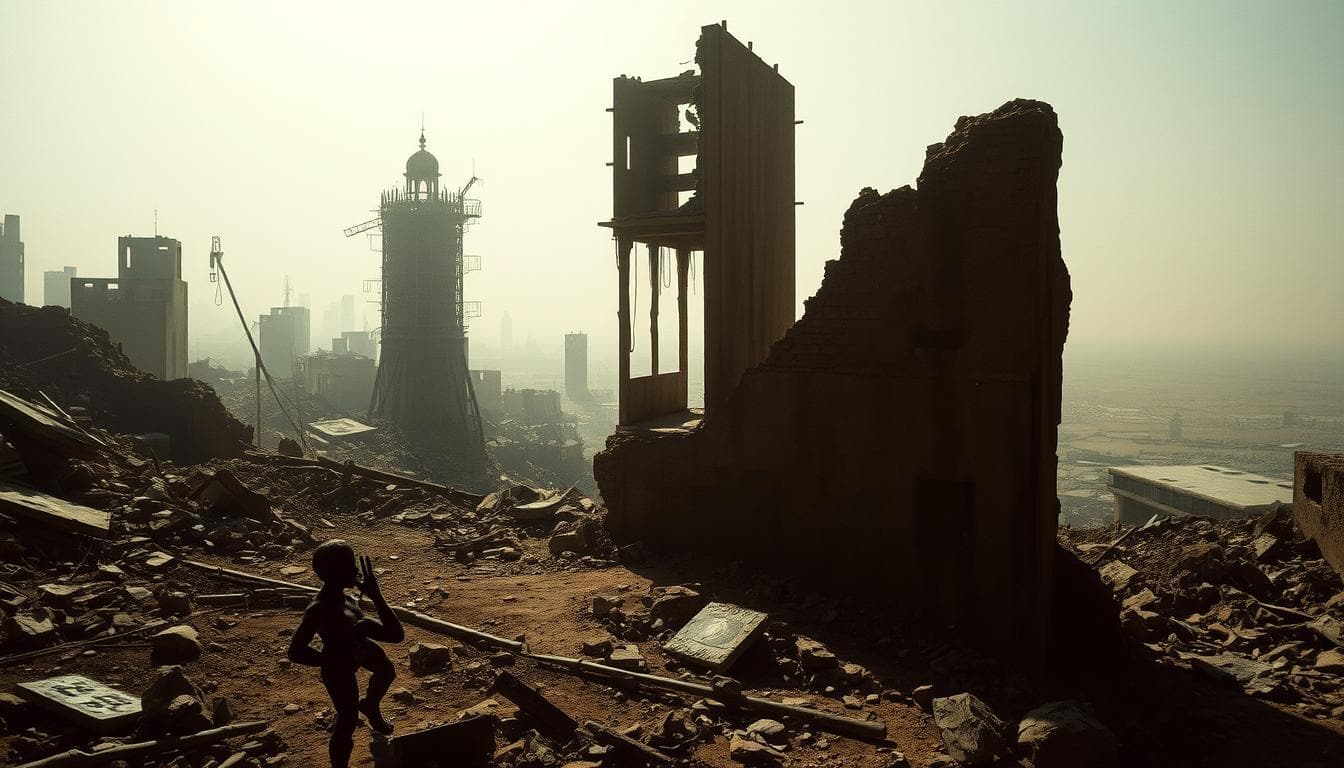
Imagine a spiderweb that’s too thin—that’s surrealism by 1945. André Breton started it all in 1924 with a call for “absolute rebellion”. But by the war, it had broken apart, leaving artists scattered.
The dreamy landscapes of surrealism began to show darker truths. Freud’s ideas on hidden desires were no longer just intellectual games. They were seen as ways to understand the war.
Breton had dreamed of merging dreams and reality. But postwar, reality was harsh. Artists were displaced, and politics were in chaos. Even Salvador Dalí, the face of surrealism, worked with Disney, leaving many wondering if he had sold out.
The surrealists were scattered, but they found new sparks in New York. The city’s art scene welcomed European refugees, mixing new ideas with American practicality. But the movement’s core was torn between individual freedom and group action. Can a revolution survive its own success? By 1950, surrealism’s impact was seen in its broken, yet enduring, spirit.
The Impact of WWII on Surrealist Circles
World War II changed everything, scattering surrealists far and wide. Max Ernst and Peggy Guggenheim played chess in New York, while André Masson and Sartre debated in Paris. The war made surrealism global, with ideas spreading like wildfire.
This migration made surrealism international, but it lost its edge. Breton spoke out against war from New York, while Dalí became a Hollywood darling. The movement’s message became unclear, seen as either bold or just trendy.
Three big changes happened:
- European exiles spread surrealism in the Americas
- Secret groups in Prague and Tokyo created new styles
- Money made the movement less radical
In Czechoslovakia, surrealists hid from the Gestapo, mixing magic with politics. In Japan, Vivo combined traditional art with Freudian themes. Tristan Tzara said, “War made surrealism international but diluted its madness.”
The line between surrealism and politics grew fuzzy. Breton’s ideals clashed with Dalí’s fame-seeking. In Mexico and Buenos Aires, artists mixed local and European styles, creating “tropical surrealism.”
By 1945, surrealism was a mix of everywhere and nowhere. It survived but lost its unity, leading to identity issues later on.
Internal Conflicts and Shifting Artistic Foci

Imagine if your group chat’s most opinionated member became a dictator of dreams. That’s what happened with André Breton. He went from leading surrealism to being called the “Stalin of the subconscious”. His leadership was more like a dictatorship, with a focus on ideology over art.
The movement’s politics became as heated as a Dali clock in July. Breton’s Communist leanings clashed with:
- Aragon’s socialist realism
- Bataille’s focus on erotic mysticism
- Dalí’s market-friendly paranoia (leading to his infamous 1934 expulsion)
Breton’s 1938 “Dictionnaire abrégé du surréalisme” was more like a political manifesto than an art guide. Former friends became “deviationists” overnight. The movement’s ideals of “pure psychic automatism” were lost in the fighting.
By 1947, surrealists had their own power struggle. Young artists, inspired by Antonin Artaud, rebelled against Breton’s rule. This Neo-Surrealist mutiny led to new forms of art:
| Old Guard | Rebel Factions | Cultural Impact |
|---|---|---|
| Automatic writing | Body art rituals | Punk aesthetics |
| Dream journals | Street interventions | Culture jamming |
| Paris salons | Anti-art collectives | Guerilla theatre |
The real tragedy was the civil war within surrealism. It made Duchamp’s urinal seem prophetic. As surrealism’s politics fell apart, its ideas influenced everything from Situationist détournement to Banksy’s stencil art. Breton’s paradox was wanting revolutionary art while ruling like Robespierre at a tea party.
The Rise of Abstract Expressionism and Other Rivals
CIA agents and artists worked together, changing modern art. Surrealists talked about dreams in Paris, while Abstract Expressionists used big canvases. The Cold War wanted American art with muscle, not subtle dreams.
Then came Jackson Pollock, who took surrealism in a new direction. His drip paintings were like Breton’s dreams come to life. No need for manifestos, just paint and intuition.
The CIA helped make this movement a Cold War weapon:
- Secret funding through groups like the Congress for Cultural Freedom
- Global shows made Abstract Expressionism seem like “free world” art
- It contrasted with Soviet art’s strict rules
Dali explored dreams, while Rothko captured existential fears. It was more than just new styles; it was geopolitical rebranding. The State Department used American art to show its cultural side.
Surrealism’s decline wasn’t just because it got old. MoMA became its home, while Abstract Expressionism brought museums market-friendly appeal. By 1960, Rothko’s work sold more than Magritte’s, showing the art market’s power.
Emigration and Diaspora of Artists
When war turned Europe into a burning chessboard, surrealist artists became rooks in exile. They were forced to leap continents while redefining the game. Their displacement didn’t just save lives; it created the internationalization of surrealism. This transformed a Parisian avant-garde into a global conversation.
New York became surrealism’s unexpected foster parent. Max Ernst traded Montparnache cafés for Arizona’s Sedona desert. There, his “painted hallucinations” merged with Navajo landscapes. Wifredo Lam brewed Afro-Cuban mysticism into his canvases, showing surrealism could thrive outside Europe.
Three cities became diaspora hubs:
- New York: Where Dalí’s lobster phones rang off the hook at Bonwit Teller
- Prague: Toyen’s underground resistance art that made Nazis scratch their heads
- Tokyo: Where Koga Harue fused ukiyo-e with dream logic
The real magic happened in the contrasts. Dorothea Tanning’s Connecticut domesticity produced haunting bride sculptures. Toyen’s Prague basement workshops screamed political dissent through erotic insect hybrids. Surrealism had become a shape-shifter, adapting to whatever soil it touched.
| Artist | Location | Cultural Fusion |
|---|---|---|
| Dorothea Tanning | Connecticut | American domesticity × Gothic symbolism |
| Toyen | Prague | Czech resistance × Sexual surrealism |
| Man Ray | Los Angeles | Hollywood glam × Dadaist portraiture |
Let’s not forget Man Ray’s Hollywood chapter. His Sunset Boulevard studio became exile chic central. Rita Hayworth’s portraits got the “dépaysement” treatment. Who knew that California sunlight could cast such deliciously uncanny shadows?
This diaspora didn’t dilute surrealism; it pressure-cooked the movement into new forms. The surrealism legacy became a global remix. It was part refugee survival tactic, part creative cross-pollination. After all, what’s more surreal than finding your artistic voice while dodging geopolitics?
Surrealist Techniques in Postwar Art
Surrealism didn’t end after WWII; it just changed its look. It evolved into postwar art through automatism, frottage, and a new take on Freudian free association. Artists turned subconscious doodles into masterpieces. Your aunt’s book club might have missed the point.
Jackson Pollock’s action painting was influenced by André Masson’s sand techniques. Masson used sand to create dreamscapes, while Pollock splattered industrial enamel on canvases. This created a bold, American twist on automatism, something Freud would have found surprising.
Robert Motherwell’s collages became like Rorschach tests in the 1950s. His Elegy to the Spanish Republic series featured inkblot shapes and torn paper. It let viewers explore their own thoughts while sipping martinis. It’s like Freud’s Interpretation of Dreams got a modern update.
| Technique | Prewar Application | Postwar Adaptation |
|---|---|---|
| Automatism | Masson’s controlled sand drawings | Pollock’s chaotic drip paintings |
| Frottage | Ernst’s textured rubbings | Motherwell’s layered collages |
| Exquisite Corpse | Collaborative Parisian parlor game | Suburban cocktail party icebreaker |
1950s housewives playing exquisite corpse between tuna casseroles shows Surrealism’s cultural shift. They giggled over collages, not knowing they were mocking Breton’s manifesto. It became a Mad Men-era party trick.
Freud’s ideas were treated like IKEA instructions, with a creative twist. Surrealism’s id meeting America’s ego led to art that was both therapy and Rorschach test. The real masterpiece was convincing critics it was more than just happy accidents.
Neo-Surrealism and Later Revivals
Surrealism didn’t die; it just evolved. By the 1960s, Chicago’s art scene became a new home for it. Here, “beatniks with better aesthetics” blended Freudian symbols with jazz vibes. It was like Dalí attending a poetry slam in a smoky basement.

In the 1980s, Neo-Surrealism emerged. It was more about artistic karaoke night than revolution. H.R. Giger’s biomechanical art, seen in Alien, replaced Dalí’s melting clocks with industrial fear. It was surrealism for the MTV era, all flash, no substance.
Tokyo, on the other hand, took surrealism in a new direction. Takashi Murakami’s Superflat theory combined ukiyo-e and anime, showing Japan’s unique take. His colorful works made Parisian surrealism seem dull by comparison.
- 1960s Chicago: Whiskey-fueled collages questioning capitalist reality
- 1980s Neo-Surrealism: Giger’s chrome-plated nightmares vs. original dream logic
- 2000s Superflat: Murakami’s consumerist fever dreams outselling Magritte
These revivals ask: Can you capture lightning twice? The answer is yes, in the form of pricey Murakami plushies and Dalí moustache keychains. Surrealism’s legacy? It’s now a story you can choose to follow, without needing to write it yourself.
Critical Reception and Historical Reassessment
Salvador Dalí’s melting clocks made you question reality. Now, modern critics are questioning surrealism’s macho image. They’re looking at it through new lenses, and it’s getting heated.
In the 1970s, feminist scholars first challenged surrealism. They pointed out André Breton’s group was all men, treating women as muses, not artists. Claude Cahun’s gender-bending portraits were a big middle finger to Dalí’s views. One curator said, “Women’s work was more powerful in surrealism.”
The 2020 MET’s “Surrealism Beyond Borders” exhibition tried to make surrealism seem modern. They said surrealists talked about identity before it was cool. But, their record on queer and feminist issues is mixed.
Today’s critics are not just tearing down old idols. They’re building new ways to see art. They’re looking at:
- Leonora Carrington’s creatures that challenge colonial views
- Méret Oppenheim’s fur-lined teacup as a feminist symbol
- Dorothea Tanning’s door paintings as a commentary on home life
This historical reassessment doesn’t erase surrealism’s impact. It makes us think about its flaws. The MET show showed that even old art can start new conversations. It’s a twist to see a century-old art movement as a test for today’s identity politics.
Legacy in Contemporary Art
Surrealism in modern art is alive and well, blending algorithms with absurdity. Banksy’s street art, with its dystopian rat stencils, echoes Max Ernst’s collage nightmares. This echoes the 1920s Parisian galleries.
Instagram accounts now mix Magritte’s bowler hats with Apple logos. AI generators create Dall-E monstrosities that could be seen as a “collective automated unconscious.”
Young British Artists like Damien Hirst kept surrealism’s shock alive with formaldehyde sharks. But digital surrealism has changed the game. TikTok filters can warp faces into Dalí-esque mutations instantly.
Meme culture uses surreal juxtapositions, like flying toasters with Renaissance paintings. It’s a way to share humor and surprise.
Today’s creators don’t just borrow from surrealism; they improve it. Neural networks trained on Magritte and Carrington create endless variations. They ask if machines can dream of electric sheep.
Augmented reality apps let users place virtual melting clocks in their homes. This turns everyday spaces into personal exhibitions. Surrealism didn’t disappear; it evolved into code, memes, and algorithmic glitches. It shows that reality is often the least interesting option.