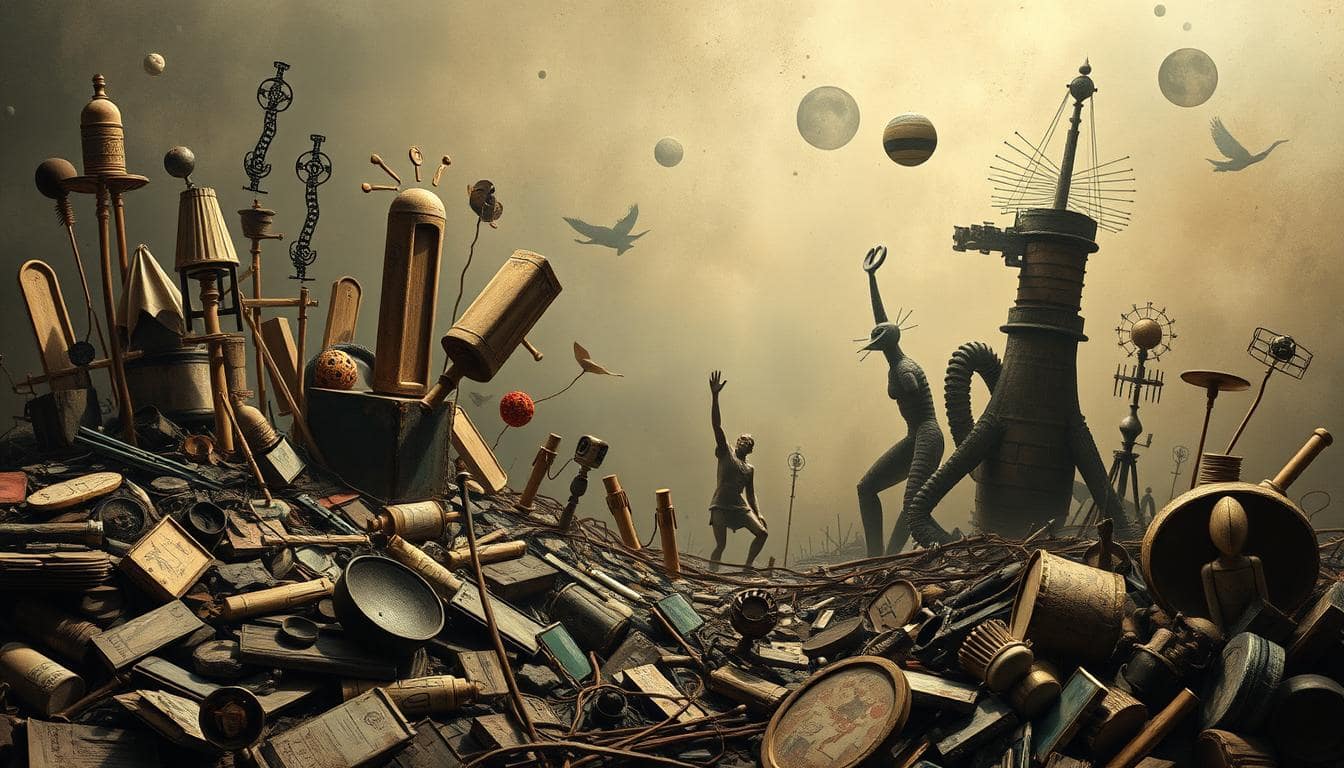
Imagine a Zurich basement in 1916. Artists were spitting poetry through megaphones. They were also cutting up their manifestos with literal scissors. This scene is not just art history. It’s a clash between chaos and consciousness.
The Dada to Surrealism shift was more than just a change in style. It was a move from the trauma of World War I to the looming threat of World War II. In Zurich, the Cabaret Voltaire crew used absurdity as a weapon. In Paris, Breton’s Surrealist group explored the human mind with automatic writing.
Why does this matter today? These movements showed us that artistic rebellion is about more than breaking rules. It’s about changing how we see reality. Dada’s broken pieces became Surrealism’s dreamlike landscapes, showing the power of avant-garde art.
Think I’m exaggerating? The same spirit that turned a urinal into “Fountain” made melting clocks popular. Both movements asked: Can art survive when logic doesn’t? Their answer changed how we view creativity, from something mundane to something deeply psychological.
Introduction: Artistic Rebellion in the 1910s
Imagine Zurich in 1916. A man in a lobster costume screams poetry through a megaphone. Artillery shells explode 200 miles away. This was cultural trench warfare, not just performance art.
The Great War destroyed old art rules, making way for anti-art movements. These were more radical than Jackson Pollock’s splatters.
Three things turned artists into rebels:
- Industrialized slaughter: Machine guns ended 19th-century dreams
- Collapsing empires: Four dynasties fell like stale strudel
- Existential whiplash: Freud’s ideas clashed with war’s chaos
This led to a creative battle where Dadaists turned galleries into demolition sites. Marcel Duchamp’s 1917 Fountain – a urinal signed “R. Mutt” – was a bold statement. It was artistic mutiny, like throwing tea into Boston Harbor.
| Era | Cultural Mood | Artistic Response |
|---|---|---|
| Pre-War (1900-1914) | Optimistic futurism | Cubist puzzles, Fauvist colors |
| WWI Years (1914-1918) | Existential crisis | Dada chaos, photomontage shrapnel |
| Post-War (1920s) | Trauma processing | Surreal dreamscapes, Freudian inkblots |
Why does this matter for the transition Dada Surrealism? The war’s effects led to two art strategies:
- Dada’s scorched-earth policy: If society’s burning, why polish the silver?
- Surrealism’s salvage operation: Let’s rebuild using dream logic and subconscious blueprints
By 1919, Tristan Tzara’s Dada Manifesto was like an anarchist guide. Yet, Salvador Dalí’s melting clocks were already hinting at surreal rebirth.
What was Dadaism?
Dadaism was more than just breaking rules—it was a complete rejection of them. It started in 1916 in Zurich and was all about challenging traditional art. Imagine typewriters and grenades making music together, and urinals becoming deep thoughts. That’s Dada’s world.
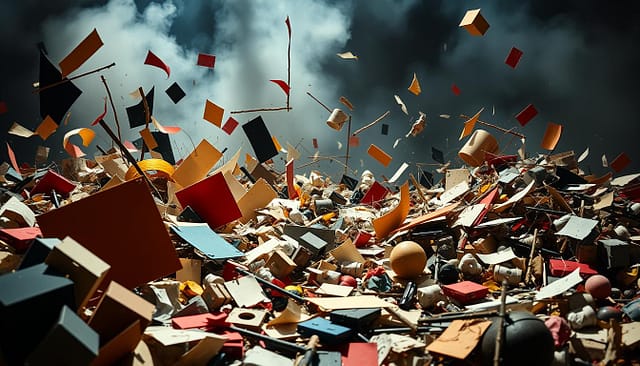
Origins, Main Figures, and Anti-Art Principles
In Zurich’s Cabaret Voltaire, Hugo Ball recited poems while artillery shells went off. This was Dada’s beginning. Tristan Tzara led the movement, creating manifestos by picking words from a hat. Their goal was to destroy all fake truths.
In New York, Marcel Duchamp turned a urinal into art. His 1917 Fountain asked, Who decides what art is? Duchamp and others used absurdity to challenge museums and critics.
Key tactics included:
- Photomontage: Hannah Höch cut up magazines to criticize Weimar Germany
- Chance poetry: Tzara’s random writing rejected control
- Performance chaos: Ball’s nonsensical recitals challenged war’s logic
Dada was a bomb thrown into the art world. Its effects lasted long after it faded in the 1920s. It influenced everything from punk rock to memes. To see how Dada led to Surrealism’s dream world, check out the differences between Dada and Surrealism.
Dada’s Decline and Surrealism’s Rise
By 1924, Dada’s wild parties had ended, leaving Parisian artists looking for something new. The movement that once epitomized chaos had grown too big for itself. André Breton, a poet and leader, used Freud’s ideas to explore the subconscious.
Paris and the Shift in Artistic Focus
Why did Freud’s ideas replace Dada’s chaos? It was because of Breton’s 1924 Surrealist Manifesto. This manifesto changed the focus from nothingness to the mind’s depths. Automatic writing became the new way to express thoughts, unlike Dada’s destructive acts.
Paris became Surrealism’s playground, where artists explored:
- Dream journal analysis (the original “mind mapping”)
- Paranoiac-critical method (seeing double before drinking)
- Exquisite corpse drawings (group therapy for creatives)
The movement spread globally, with Breton attracting artists from Madrid to Cairo. But this growth also brought its own rules, making the rebels seem like a club.
| Aspect | Dadaism | Surrealism |
|---|---|---|
| Core Method | Chance operations | Automatic writing |
| Philosophical Drive | Nihilistic absurdity | Subconscious exploration |
| Leadership Style | Chaotic collectives | Breton’s “Pope of Surrealism” |
| Legacy | Anti-art protests | Dream imagery revolution |
This change was more than just art—it was a shift in how we see the world. Dada shouted into the void, while Surrealism recorded it. The origins of surrealism show us that every rebellion becomes mainstream, with its own rules and products.
Comparing Philosophies: Dada vs Surrealism
Imagine Nietzsche and Freud arm-wrestling in a Zurich cabaret—that’s the battle between Dada and Surrealism. Both rebelled against reason but in different ways. Dadaists threw meaning away, while Surrealists dug through Freud’s dreams to find it.
Nihilism, Absurdity, and Search for Meaning
Dada’s manifesto was like a paper shredder. Tristan Tzara said artists should “cut out words from a newspaper article, shake them in a bag, and call it poetry.” It was art against logic, celebrating chaos.
Surrealists, on the other hand, looked into Freud’s dreams. André Breton’s 1924 Surrealist Manifesto attacked reality with a psychoanalyst’s tools. Automatic writing was their method, blending Dada’s randomness with Freud’s dream theory.
| Dada | Surrealism | |
|---|---|---|
| Philosophical Anchor | Nietzschean absurdity | Freudian subconscious |
| Key Technique | Chance operations | Automatism |
| View of Subconscious | Chaos to embrace | Mystery to decode |
| Political Stance | Anarchic protest | Revolution through revelation |
The table shows 20th-century existential crises. Dadaists were nihilistic pranksters. Surrealists were like existential interior designers. Both hated bourgeois norms and war.
Freud’s impact on Surrealism was huge. While Dada laughed at the void, Surrealists used Freud to understand it. Dream analysis was their key to decoding reality, unlike Dada’s love for burning dictionaries.
Artists Who Bridged the Movements
If Dada and Surrealism were rival nightclubs, these creators had VIP passes to both. The early 20th century’s avant-garde scene wasn’t just about picking sides—it was about reinventing the game entirely. Let’s meet the art world’s ultimate double agents.
Max Ernst: The Rorschach Revolutionary
Ernst didn’t just cross the Dada-Surrealism bridge—he built it. His frottage technique (rubbing pencil over textured surfaces) created accidental landscapes that looked like proto-Rorschach tests. Was that a bird? A forest? A subconscious scream? Exactly. When he swapped Zurich’s cabarets for Parisian salons, his work became the Rosetta Stone connecting Dada’s chaos to Surrealism’s dream logic.
Man Ray: Photography’s Mad Scientist
This American expat turned darkroom alchemy into high art. His 1932 Glass Tears—with its impossibly perfect droplets—proved reality could be more surreal than dreams. Man Ray’s genius? Using Dada’s love for shock tactics to fuel Surrealism’s obsession with hidden truths. Who needs Instagram filters when you’ve got solarization?
The Unsung Shapeshifters
Let’s not forget composer Stefan Wolpe, whose Dada-era jazz collages morphed into Surrealist symphonies that sounded like orchestrated hallucinations. Or Hannah Höch, whose photomontages critiqued Weimar Germany while whispering secrets to future Surrealists. Their career pivots make modern “rebranding” look like child’s play.
These artists didn’t just witness the transition from Dada to Surrealism—they became the transition. Their work proves that in art, as in life, the most interesting paths are never straight lines.
Social and Political Backdrop
Art movements don’t start in empty spaces. They’re born from chaos, economic downturns, and shared fears. The 20th century turned art studios into battlefields. Artists used their brushes to fight against fascism, capitalism, and each other. 
Bullets to Brushstrokes: Art’s Survival Tactics
Dadaists rejected not just art, but the world that led to World War I. Zurich’s Cabaret Voltaire became a place for absurdity. Tristan Tzara’s poetry clashed with the sound of machine guns.
Surrealists, like André Breton, mixed Freudian theory with politics. They believed revolution starts in the subconscious.
Here are some key contrasts:
| Movement | War Response | Political Playbook | Lasting Impact |
|---|---|---|---|
| Dada | Anti-war nihilism | John Heartfield’s anti-Nazi photomontages | Punk rock’s DIY ethos |
| Surrealism | Freudian resistance | Breton’s Communist Party flirtations | Modern protest art aesthetics |
Breton’s 1924 Surrealist Manifesto was like a Marxist-Leninist dream. It called for art to “resolve the previously contradictory conditions of dream and reality”. But by 1938, Salvador Dalí was drawing fascist-inspired versions of Venus de Milo. This shows even revolutionary movements can have traitors.
Surrealism spread like wildfire across the globe. Artists like Frida Kahlo in Mexico and Art et Liberté in Egypt applied Breton’s ideas to their local struggles. It’s like art’s version of viral memes, adapting to new cultural fronts.
The Enduring Spirit of Dada in Surrealism
André Breton’s 1924 surrealist manifesto planted Dada’s seeds in fertile ground. Today, we see the surrealism legacy in works like Magritte’s floating hats and Dalí’s melting clocks. Warhol’s soup cans also show Dada’s influence, commenting on consumerism and nodding to Duchamp’s urinal.
Banksy’s “Girl With Balloon” stunt was more than just a trick. It was a nod to Dada’s spirit, seen in Meret Oppenheim’s fur teacup and Lady Gaga’s meat dress. John Cage’s silent compositions also echo Dada’s nonsensical sound poems, turning silence into art.
Postmodernism owes a debt to Dada’s 1916 Zurich anarchists. It’s all about challenging the status quo, from memes to Instagram collages. Both Dada and Surrealism questioned the purpose of art, asking why it should comfort when it can provoke.
Today, culture factories grapple with this legacy. Every viral hit, from Jeff Koons’ balloon dog to Gucci’s reality-bending ads, reflects Dada’s spirit. The revolution may have adapted to survive capitalism, but it continues to disrupt, one bold move at a time.