
Imagine taking apart the world and rebuilding it to show hidden truths. This is the power of surrealist collage and photomontage. They are not just art. They are tools for changing how we see reality.
Hannah Höch, a Dada movement leader, used photomontage to create a new reality. Her work connects historical art to today’s digital creativity. The key strategies—juxtaposition, scale shift, and substitution—are timeless.
These methods help artists and business people overcome creative blocks. They make us see things differently and find new meanings in visual culture. It’s not just art history. It’s a way to think innovatively and solve problems.
Historical bridge from Dada to Surrealism
The world was shattered after World War I. A new art language was needed. In Weimar Germany, people felt lost and rejected old ways.
Hannah Höch was different. She used cut images with great skill. Her work questioned society, unlike many men who just played with words.
Her unique style linked Dada to Surrealism. Her work explored the subconscious. It showed the way to the dream world of Surrealism.
We move from philosophy to practice, focusing on the core visual tactics. These are the basic steps artists use to question reality.
Three main techniques make up this toolkit. Juxtaposition puts opposite things together to create new, often shocking meanings. Scale shift changes size to show oddness and reveal the absurd. Substitution replaces something expected with something unexpected, breaking our usual thinking.
Hannah Höch was a pioneer in using these strategies. Her work, made with scissors and glue, cut through Dada critique with sharp images.
In works like *Cut with the Kitchen Knife Dada…*, she used juxtaposition to challenge gender roles and political messages. She mixed politicians with machine parts, making irrational cuts that forced new views.
Hannah Höch’s approach shows how simple visual moves can break down complex ideas. They offer a basic way to disrupt and question our usual views.
Sources and ethics: copyright, fair use, public domain
Every great visual work starts with its basic materials. For artists using scissors and glue, this means gathering a wide range of images. Pioneers like Hannah Höch were like “visual anthropologists,” collecting prints and ads from mass media.
Her act of critical reclamation from popular culture shapes today’s creative work. It also brings up important ethical questions we need to answer now.
Today’s creators build their own mix of sources. They use everything from old magazines and books to digital images and stock photos. For business folks and marketers, this step is key.
It’s vital to know the law. You need to understand copyright, fair use for critique, and public domain resources. This knowledge turns simple cutting and pasting into a responsible, professional act.
It lets you create with confidence and integrity. Let’s look at how to source your materials legally and ethically.
Analog methods: tearing, inlay, transfers, adhesives
Stepping away from digital screens, we dive into the world of physical art. Here, your hands are the main tools. Analog methods celebrate the real, imperfect, and uniquely human touch in art.
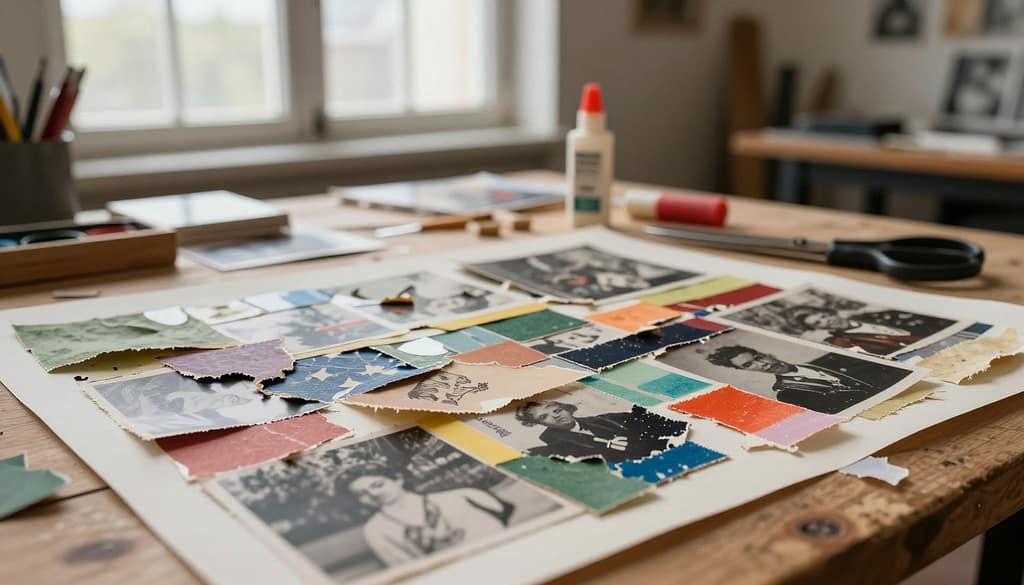
Hannah Höch was a pioneer in this field. She used scissors to create what she called a Klebebild or “glued picture.” This term shows the honest, tactile nature of the medium. Her work showed the evidence of hand-cutting, with dynamic, jagged shapes.
This method is a mindful contrast to digital perfection. It welcomes happy accidents and textures you can feel. The core techniques are simple and straightforward.
You can tear paper for soft, organic edges or cut for sharp, precise lines. Inlay involves nesting pieces within each other. Transfer techniques move images onto new surfaces. Your choice of adhesive, from glue sticks to matte medium, also shapes the final look and feel.
Mastering these traditional techniques builds a deep connection to your materials. It grounds your creative process in a rich, physical history.
Photomontage workflows: darkroom composites, sandwich negatives
The early photomontage method was all about visible seams. But some artists dreamed of something different. They wanted to make a seamless composite image that looked like it was captured in one moment.
To achieve this, they developed clever pre-digital workflows in the darkroom. They used double exposures and dodging and burning to merge elements on one print. This is called a darkroom composite.
Another technique was the sandwich negative. Here, they stacked two or more film negatives in the enlarger. Then, they exposed them together, creating a layered, dreamy image.
Artists like John Heartfield became experts in these methods. They used them to create powerful, illusionistic works. This traditional craft is the foundation for today’s digital compositing. It brings a tangible, magical quality that photography lovers find captivating.
Digital workflows: non‑destructive layers, masks, textures
The core ideas of blending disparate elements find a powerful new home on your computer. For today’s creative professional, a modern digital collage workflow is essential.
This method gives you incredible flexibility. You can combine screenshots, photos, and graphics without permanently altering your original files. Tools like Photoshop or Affinity Photo use non-destructive layers to make this possible.
The magic happens with layer masks. They let you hide and reveal parts of an image cleanly. This makes compositing seamless and completely reversible. To add depth, artists layer scanned textures over their work. This brings an organic, tactile feel to the digital canvas.
This approach is perfect for creating standout marketing visuals. You can build conceptual art for social media or unique brand imagery. It turns a collection of digital sources into a cohesive and compelling visual story.
Classroom projects for art and photo courses
True learning happens when we put theory into practice. For teachers, projects make art history come alive. They turn it into a place where students can create and learn.
Using techniques from artists like Max Ernst is a great idea. His methods are not just important in history. They are also easy to teach and can be done by many students.
We can plan activities for different levels, like high school or university. Imagine making a “Dada portrait” from magazine pieces. Or creating a “Surrealist Exquisite Corpse” collage together.
A “Digital Double-Take” montage can help students think about today’s media. These projects teach more than just skills. They help students see the world in a new way.
Students become like “visual anthropologists,” understanding the world around them. They learn to mix different images into something new and meaningful. The aim is to raise a new generation of creative thinkers.
Critique framework: narrative, semiotics, political context
Seeing a fragmented image is one thing. Understanding its deeper message is another. To move from simple appreciation to critical analysis, you need a structured approach.

This framework involves three powerful lenses. First, deconstruct the narrative the artist is building from disparate parts. Second, apply a semiotic analysis to read the signs and symbols. Third, always evaluate the political and social context of both the source materials and the final work.
As scholars note, political arrangements are not separate from aesthetic ones. Hannah Höch’s work critiques misogyny in popular culture. Max Ernst’s dream-like scenes challenge logical storytelling.
Learning to “read” a collage or photomontage this way is a valuable skill. It sharpens your critical thinking for any visual content you encounter.
Conservation, mounting, and display options
Creating art is just the start. Taking care of it and showing it off are just as key. Proper conservation helps your art last for years.
For physical art, the environment matters a lot. Use acid-free mats and boards. Keep it away from sunlight and moisture to avoid damage.
Digital art needs its own care plan. Save files in formats that don’t lose quality. Keep backups in different places to avoid losing your work.
Choosing the right mounting method makes a big difference. You can use simple hinges or dry mounting. Floating frames add a modern touch to any piece.
Good display makes a space pop. Think about the lighting, wall color, and how busy the area is. A well-displayed piece grabs attention in any setting.
This knowledge helps you protect and show off your art well. From making it to showing it off, every step is important.
Annotated Resources and Archives
Your journey into photomontage doesn’t have to stop here. There’s a lot of resources and archives to help you learn more.
Start with academic theses and museum catalogs. They have detailed info and analyses of famous works, like Hannah Höch’s. Documentaries on Dada and Surrealist movements give you a historical view. Websites from big art museums have online shows and articles.
Visit museums like the Berlinische Galerie or The Museum of Modern Art to see original works. Digital archives, like the University of Iowa’s Dada Archive or the Getty Research Institute, offer global access to images and documents.
Check out modern artists like John Baldessari or Martha Rosler to see how the tradition has grown. Online communities on Reddit or forums are great for sharing and getting feedback. Tools like Adobe Photoshop and GIMP are key for digital work.
This list is just the beginning of your exploration into this powerful visual art.