
Every great creation starts with the right materials. For artists, the world is their toolbox. Wood, fabric, and leaves become powerful tools and surfaces.
History shows innovators finding value in everyday items. Max Ernst’s collage work is a great example. He used floorboards and leaves to find new techniques.
Rubbing graphite on wood grain shows hidden patterns. Pressing paint between fabrics creates unique effects. These methods turn simple surfaces into complex textured grounds.
Today, this spirit of experimentation continues. Modern creators find inspiration in nature and common materials. Knowing these tools opens up new creative possibilities.
Definitions and historical emergence
A simple rubbing on a wooden floor turned into a powerful tool for the unconscious mind. This section explains the Surrealist techniques of frottage and grattage. It also looks at their fascinating origin story.
Frottage is making an image by rubbing a drawing medium over a textured surface. The French word means “rubbing.” It captures the texture of any object with a raised surface.
Grattage, or “scraping,” is a painting technique. Artists apply wet paint over a textured object and then scrape it away. This reveals the texture beneath in a unique way.
Max Ernst, a German artist, pioneered these techniques. He was in a hotel room in Pornic, France, on August 10, 1925. A rainy afternoon made him notice the floorboards.
The wood’s texture fascinated him. He placed paper over it and rubbed with a graphite pencil. This sparked his “visionary facilities.”
Ernst saw frottage as a way to bypass conscious control. It tapped into the subconscious. Mundane textures became doors to fantastical worlds.
This discovery was groundbreaking. Artists could now work with the physical world. A leaf’s veins, a coin’s engraving, or fabric could become their partners.
By 1927, Ernst had developed grattage. He moved from paper to canvas, using oils and scrapers. This allowed for richer, more complex compositions.
These techniques were key to Surrealism’s goals. They aimed to merge dreams and reality. Frottage and grattage made this possible.
They turned random textures into planned compositions. This mix of chance and control is their lasting impact. It opened a new way for artists to interact with their materials and minds.
Knowing this history is important. It shows frottage and grattage as more than crafts. They are tools for exploring the physical and visionary worlds.
Tools and surfaces: woods, coins, leaves, fabrics, textured grounds
Max Ernst started his frottage technique by exploring everyday surfaces. He saw the world as full of patterns waiting to be discovered. This new way of seeing opened up a whole new artistic world for him.
The materials for frottage and grattage are everywhere. They are the texture matrices that give you unique visual ideas. By rubbing them onto paper or canvas, you bring these hidden patterns to life.
Ernst’s art was incredibly varied. He used wood, leaves, bark, and straw for textures. He also tried thread, textiles, netting, and wire mesh. Even dried paint, broken glass, and cord were part of his creative process.
Any object with texture can be a texture matrix. The key is to mix different textures. Try combining rough bark with smooth glass or rigid wire mesh with soft fabric. This mix creates complex and interesting art bases.
Here’s a guide to help you find texture sources. This table lists materials by their origin and how to use them in your art.
| Category | Example Surfaces | Best Use For | Preparation Tip |
|---|---|---|---|
| Natural | Tree bark, leaves, ferns, stones, shells | Organic, flowing patterns; great for frottage backgrounds | Press leaves flat; ensure bark is clean and dry. |
| Manufactured | Coins, wire mesh, hardware cloth, perforated metal | Geometric, repetitive designs; strong graphic elements | Sand sharp edges; tape mesh to a board for stability. |
| Household & Fabric | Burlap, lace, corduroy, woven baskets, rubber mats | Adding fine detail and tactile warmth to compositions | Stretch fabrics taut to prevent shifting during rubbing. |
| Artistic & Found | Dried paint blobs, textured grounds (gesso+sand), cord | Creating unique, custom matrices for grattage scraping | Let paint or grounds cure fully on a separate tile. |
| Outdoor & Architectural | Manhole covers, brick walls, wooden fences, grating | Large-scale, site-specific texture gathering | Use large paper and secure with clips; mind the weather. |
Start by becoming a texture hunter. Look at the floor, walls, and your junk drawer. Each item can be a source of inspiration. By collecting a wide range of texture matrices, you open up new artistic possibilities.
Frottage technique: pressure, media choices, layering
Frottage is a technique that involves careful control over pressure, media, and layering. It’s more than just placing paper over an object. It’s a process where you blend artistic intent with textured reality. By mastering these elements, you can turn a simple rubbing into a complex, evocative piece.
The Art of Applied Pressure
Pressure is like the volume control in frottage. The force you apply affects the contrast and detail. A light touch reveals subtle textures, while a firm touch captures bold contrasts.
Experimenting with pressure is key. Varying it within a rubbing can create dynamic shadows and focus. This controlled touch transforms a simple texture copy into an intentional drawing.
Media Choices: From Graphite to Ink
Your choice of medium greatly influences the frottage’s character. Each tool offers unique marks and tonal ranges.
- Graphite Pencils: Provide precision and a wide grayscale. Max Ernst often used them for clean lines.
- Wax Crayons or Oil Pastels: Offer rich, opaque coverage and vibrant color. They’re great for capturing bold textures.
- Charcoal: Delivers deep, smoky blacks and is easily smudged for atmospheric effects.
- Ink (applied with a brush or roller): Creates fluid, dramatic impressions and can fill large areas quickly.
Choose a medium that fits your goal. For fine detail, use a sharp pencil. For bold impact, try a wax crayon.
Strategic Layering for Depth
Layering is key to frottage artistry. It involves creating multiple rubbings on the same sheet of paper. Ernst shifted the paper between rubbings to create complex images.
This process builds a dense, dreamlike field where textures collide. The layers create a tactile surface, similar to impasto. Ernst later reproduced these layered frottages as lithographs in “Histoire naturelle,” showing their pictorial power.
By controlling pressure, choosing media wisely, and planning layers, you unlock frottage’s full power. This methodical approach to rubbing lays a texture foundation that inspires grattage. To learn more, explore Max Ernst’s pioneering frottage and grattage.
Grattage technique: scraping wet paint, subtractive drawing
The grattage technique lets artists play with texture by scraping through wet paint. This method is similar to frottage but uses paint instead of rubbing. It reveals hidden patterns and creates complex surfaces.
Max Ernst was a pioneer of this technique. He believed in letting chance guide the initial composition. Then, the artist interprets the revealed forms, turning them into recognizable scenes.
Scraping Wet Paint
This stage starts with a prepared ground. Apply multiple layers of paint to your canvas. Use heavy body acrylic or oil paint for a textured layer called impasto. The paint should be wet and workable.
Before the paint dries, place your canvas over relief objects. These can be wood, mesh, cord, or fabric. The objects press into the wet paint, creating texture.
Now, take a firm palette knife or putty knife. Use it to scrape away the wet paint. Apply even pressure. As you scrape, the textures from the objects underneath are revealed.

This scraping action is not random. You control the direction and pressure. Horizontal scrapes suggest landscape strata. Circular motions evoke organic forms.
Subtractive Drawing
Think of your palette knife as a drawing tool that removes medium instead of adding it. This is subtractive drawing. Each scrape carves a line or shape out of the painted field.
After the initial reveal, study the abstract textures and lines. Do you see a bird’s wing in a scraped line? Use brushes to refine these suggestions. Add definition, adjust colors, and integrate the chance-born textures into a cohesive image.
Ernst famously transformed his grattage marks into eerie forests and mythical birds. Your own interpretation is key. The technique provides the raw, textured material. Your vision provides the final form.
| Tool | Primary Use in Grattage | Effect on Surface | Skill Level |
|---|---|---|---|
| Palette Knife | Broad, controlled scraping of wet paint | Creates clean, sharp lines and reveals broad texture areas | Beginner to Advanced |
| Putty Knife | Aggressive removal of thick impasto layers | Produces deep, gouged marks and high contrast | Intermediate |
| Cardboard Edge | Soft, granular scraping for subtle texture | Yields a feathered, distressed effect | Beginner |
| Old Credit Card | Detailed, precise line work in wet paint | Allows for fine, linear subtractive drawing | Intermediate |
Successful grattage relies on bold impasto and confident scraping. Do not fear removing paint. View each scrape as an act of discovery. The textures you find will become the foundation of a uniquely layered artwork.
Integrating chance with composition planning
Chance operations in art are not an endpoint, but a powerful starting point for composition. This was the revolutionary insight of Surrealists like Max Ernst. They used automated techniques to bypass conscious control and tap into the subconscious.
Ernst employed methods like decalcomania, pressing paint between two surfaces, and oscillation, dripping paint from a swinging can. These processes created unpredictable, organic patterns. He then engaged in what he called a “game of combinations.”
His famous work, “Napoleon in the Wilderness,” exemplifies this. The ghostly, forest-like background likely began as a chance-derived texture. Ernst then strategically painted the figure of Napoleon into the chaotic landscape, creating a haunting narrative.
The key for educators and artists is to frame these chance operations as a beginning, not a final product. The resulting marks and textures form a raw, suggestive foundation. Your next step is to analyze this foundation with a curious eye.
Examine your texture matrices. Look for shapes that suggest familiar forms: a face, an animal, a distant horizon. Does a cluster of lines resemble tree bark or flowing water? This act of seeking is the first move from accident to intention.
Once you identify suggestive elements within your texture matrices, begin strategic planning. Ask yourself compositional questions. Where should a focal point go to guide the viewer’s eye? Would a line of contrasting color strengthen a hidden form? Could a wash of transparent glaze unify disparate textures?
This methodology empowers you to harness serendipity productively. You are not just making a textured surface. You are collaborating with chance to build a coherent visual story. The initial automation provides surprise; your planned intervention provides meaning.
Safety, cleanup, and studio etiquette
Before you start with a scraper or thick impasto, setting up a safe and tidy workspace is key. These techniques can be messy, with dust and sharp tools. Think of safety as a way to free up your creativity, not a limit.
Learn about your materials first. Read the Safety Data Sheet (SDS) for each paint, medium, and solvent. This document tells you about the product’s dangers, how to handle it, and what to do in case of an emergency. It’s very important for oil-based work, as many products contain harmful chemicals.
Good air flow is your most important tool. Never work with oil paints or solvents without fresh air. Use an exhaust fan or work near a window with a fan. In shared studios, having a good air system is key for everyone’s health.
When scraping, tool safety is critical. Use tools made for scraping with handles that feel good in your hand. Always scrape away from you, keeping your other hand out of the way. Dull tools are more dangerous because they need too much force and can slip.
Cleaning up is important for keeping your tools and space in good shape. For tools covered in impasto paint, clean off extra paint with a rag or paper towel before washing. Use the right solvent (check the SDS) carefully. For water-based paint, warm soapy water works well. Never throw leftover solvents or paint down the drain; follow local rules for disposing of hazardous waste.
Handling the mess from scraping needs a plan. Use disposable or washable cloths to catch spills and debris. When painting up high, put a tray or paper at the bottom to catch drips. This makes cleaning up easier and stops paint chips from spreading.
In a shared studio, being considerate is as important as safety. Here are some rules to follow:
- Label Everything: Mark your solvents, mediums, and paints clearly with what they are and your name.
- Clean as You Go: Clean shared tables, sinks, and tools right away. Don’t leave brushes or knives to dry.
- Respect Ventilation: Don’t block fans or windows, and tell someone if equipment isn’t working right.
- Store Tools Safely: Keep sharp tools covered or in a special rack when not in use.
Following these guidelines lets you enjoy the creative freedom of texture techniques safely. A clean, respectful studio helps everyone focus and explore their creativity without risk.
Lesson Sequence with Differentiation (K–12 to University)
Making a simple rubbing is a great way for kids to start. But, it also has deep ideas for older students. Max Ernst’s methods are perfect for teaching at all levels.
Teachers can make lessons that grow with students. They start with hands-on learning and move to thinking deeply. This way, teachers share knowledge that fits each student’s level.
For Grades K–5: Sensory Exploration and Joyful Discovery
Young kids love touching and making things. The main goal is for them to enjoy the rubbing process. They should just focus on making rubbings.
Use big, soft tools and smooth paper. Try using tree bark, coins, leaves, and woven placemats for textures. Show them how to hold the tool and apply even pressure.
Demonstrate how to hold the tool on its side. Show students how to apply even pressure. The magic of a pattern appearing never fails to delight.
Differentiation is key at this level. For students developing fine motor skills, use larger tools and papers. Pre-tape items to the table for stability. For advanced young artists, introduce the idea of composing a collage from multiple rubbings.
For Grades 6–12: Introducing Intent and Art History Context
Middle and high school students can handle more complex ideas. This stage introduces chance operations and basic grattage. Link these activities directly to Surrealist art history.
Start with a structured rubbing exercise. Then, ask students to cut out their favorite textures. They should rearrange them blindly to create a spontaneous composition. This is a direct introduction to chance operations.
Next, layer grattage. Have students paint a thin, uniform layer over a textured surface. Once it’s tacky, they can scrape lines and shapes to reveal the texture beneath. Discuss how Ernst used this for dreamlike imagery.
Differentiation here addresses varying skill sets. Provide templates for compositional planning for some. Encourage others to work purely from intuition. Offer a range of scraping tools, from plastic cards to specialized art tools.
For University and Adult Learners: Theoretical Depth and Advanced Planning
At this level, the technique serves a deeper conceptual purpose. The focus shifts to Surrealist automatism, psychoanalytic theory, and advanced compositional strategy. Students analyze how chance operations bypass conscious control.
Seminars can explore texts by André Breton or Freudian concepts. Studio work involves sophisticated layering. Combine frottage, grattage, and overpainting with clear intentionality.
Learners might plan a series where chance dictates the initial texture. Then, they apply reasoned artistic decisions to develop the piece. This mirrors Ernst’s own process.
Differentiation caters to diverse learning objectives. Art history students might focus on research and analysis. Studio art majors can concentrate on developing a cohesive body of work. Workshops for adults often blend technique with personal expression.
| Educational Level | Primary Focus | Key Activities | Core Materials | Differentiation Strategy |
|---|---|---|---|---|
| K-5 | Sensory joy, texture discovery | Simple rubbings, texture identification | Large crayons, found textures, smooth paper | Adapt tools for motor skills; offer collage for extension |
| 6-12 | Chance, art history, basic grattage | Blind collage, scraping wet paint, art research | Graphite, acrylic paint, scraping tools, art history texts | Vary planning support; provide tool choice |
| University/Adult | Theory, automatism, advanced composition | Thematic series, layered techniques, seminar discussion | Mixed media, archival papers, theoretical readings | Tailor to academic vs. studio goals; emphasize personal voice |
This sequenced framework ensures that every student, from the youngest child to the graduate scholar, finds a point of engagement. The lesson plans move from the hand to the mind. They transform a simple rubbing into a gateway for critical thought and creative empowerment.
Analyzing masterpieces and student exemplars
Studying great works is key to mastering a technique. It connects learning to creating art. By looking at both old masterpieces and new student art, you see how ideas become real pictures.
Max Ernst, a surrealist leader, is a great example. His painting The Entire City shows off the grattage technique. Ernst used a texture matrix like wire mesh to scrape wet paint. This made the city look old and real.
In Napoleon in the Wilderness, Ernst used decalcomania to create textures. This method made a dreamy forest. The texture matrix here is the paint itself, creating unique forms. Ernst then shaped these into a landscape.
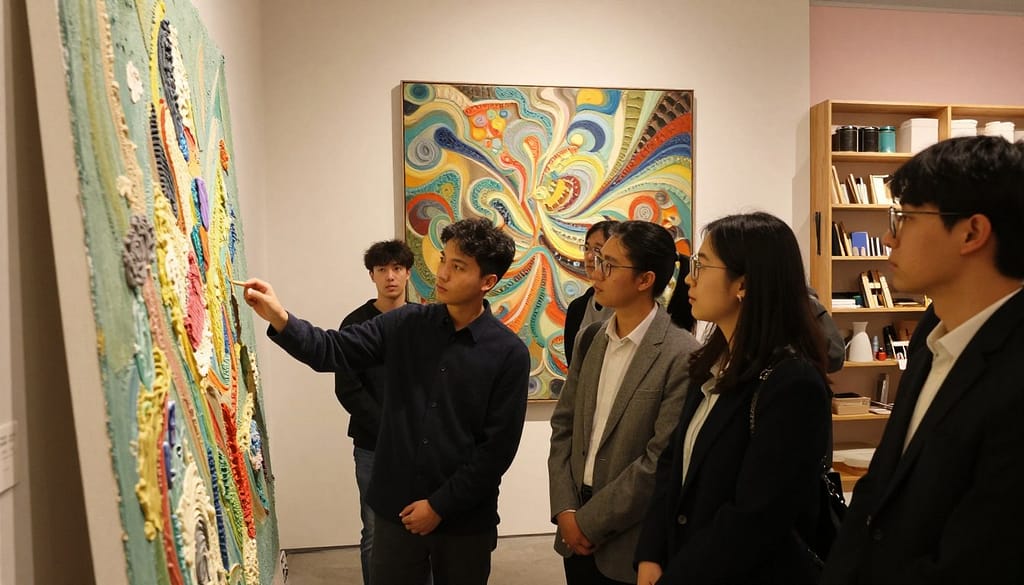
When studying these works, notice how the surface affects the mood. Is the impasto bold or soft? How does the texture guide your view?
Looking at student work is also important. It makes the learning process clear and shows what’s possible. When checking student art, keep these points in mind:
- Texture Integration: Is the texture a key part of the picture or just added on? Good work uses texture matrices as a base.
- Harnessing Chance: Look for where chance marks are used well in the image. This shows smart problem-solving and embracing creativity.
- Compositional Confidence: See how the student uses texture to guide the eye. As skill grows, texture becomes a main part of the art.
By analyzing both masterpieces and student work, you improve your artistic vision. You learn to see the thought behind each mark. This helps you use these techniques in your own art with more purpose.
Archival considerations for textured surfaces
Artworks with heavy impasto or detailed scraping face special conservation challenges. These textures add drama but also make the art more fragile. Standard preservation methods often fail to meet these needs.
Surfaces with thick paint or grattage are at risk. They can crack if the paint dries unevenly. Dust settles in the small crevices. Paint peaks are easy to chip if bumped.
Patience is key during drying. A thick impasto layer takes weeks or months to dry fully. Don’t rush to varnish or frame a piece that’s not fully dry. Keep it in a clean, stable place.
Varnishing textured work needs care. Use a flexible, non-yellowing varnish. Apply it gently with a soft brush or a spray varnish for even coverage.
Framing is the last line of defense for your artwork. A standard frame with glass can crush the texture and trap moisture. To protect it, use frames that create space.
| Framing Type | Best For | Key Consideration |
|---|---|---|
| Standard Frame with Spacers | Moderate impasto | Uses acrylic or wooden spacers to lift the glazing off the paint surface. |
| Float Frame | Canvas panels with textured edges | The artwork appears to “float” within the frame, leaving all sides visible and unprotected. |
| Shadow Box | Extreme texture and scraping depth | Provides a deep, enclosed box of space between glazing and artwork, giving the best protection. |
| Deep Cradle Panel | Works created on panel | The thick panel itself acts as its own frame; often finished and varnished on the sides for a frameless look. |
Safe handling is essential. Always lift a textured painting by the stretcher bar or substrate edges. Never press on the painted surface. Use clean, dry hands or cotton gloves.
- Store paintings vertically, facing each other with acid-free tissue paper in between.
- For transport, pad the front with a rigid board and foam.
- Use a soft, dry brush or canned air to remove dust from crevices gently.
- Never use cleaning fluids or water on an unvarnished textured surface.
By following these archival steps from the start, your textured creations will last. It turns a fragile surface into a stable, lasting piece. This planning is what makes a temporary piece into a lasting masterpiece.
Further reading and museum links
Your journey into frottage and grattage doesn’t have to stop here. There are many resources to help you understand these techniques better. They also shed light on their importance in art history.
Start by reading Max Ernst’s writings. His essays give you a direct look into the Surrealist world. Books on Surrealism offer important background information. Look for exhibition catalogues like “Max Ernst – Dream and Revolution” or the Fondation Beyeler retrospective for visual inspiration.
Many museums have high-quality images of Ernst’s work online. The Museum of Modern Art (MoMA) and the Centre Pompidou have large digital collections. By exploring their archives, you can see the detailed textures and surfaces of his texture matrices up close.
Today, many artists are also exploring these methods. Look for artists who use found objects and chance operations in their work. This shows how Ernst’s ideas are alive in today’s art.
Let these resources spark your creativity. Try out the techniques you’ve learned. Keep experimenting with textures and unexpected marks in your art.