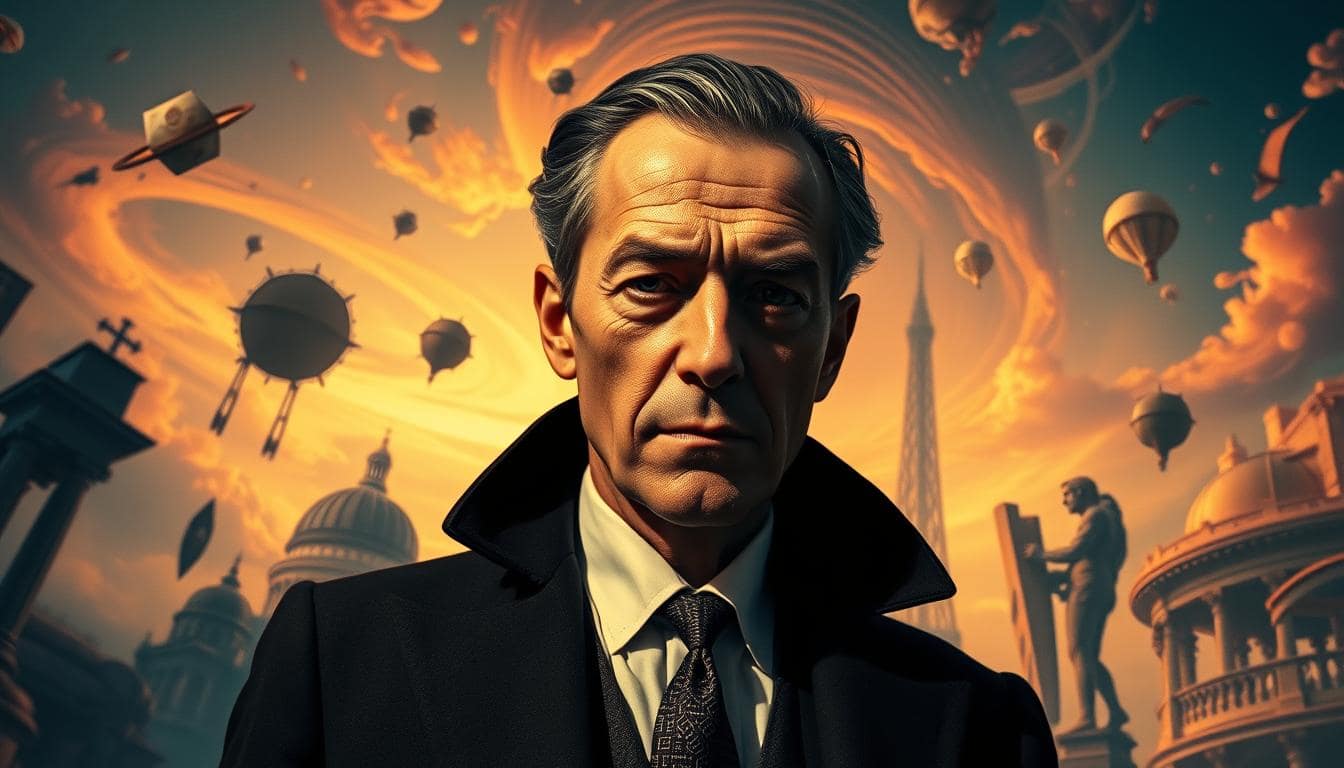
Imagine a medical student in 1916 Paris, cutting through logic’s rules. He became the most creative rebel in art history. He traded scalpels for “pure psychic automatism”, a phrase as wild as the movement he started. Breton didn’t just ignore reason; he eviscerated it with poet-surgeon precision.
Born in Tinchebray, Breton was once a medical student. He turned to cultural chaos with Jacques Vaché, his WWI friend. By 1924, Breton was writing manifestos, not prescriptions. He declared war on art market tricks while selling Picasso’s work. It was a mix of madness and champagne.
The Surrealist group’s story is like an absinthe-fueled poker game. Breton folded Dada’s nihilism, raised Freudian theory, and bluffed his way into history. But there were deep questions: Can madness be controlled? Why did women surrealists, like Leonora Carrington, often feel like muses, not makers?
Next, we explore how a former medic became the leader of artistic rebellion. He had expulsions, love spells, and enough theater of the absurd to make Kafka blush. Pass the lobster telephone.
Early Life and Influences
Imagine a boy growing up in Normandy’s misty valleys. Village gossip was as thick as cider. André Breton didn’t just live in Tinchebray—he absorbed it like a sponge in absinthe. His father, a policeman, was fiercely atheist, while his mother, a seamstress, was deeply religious. Their home was a battleground of logic and mysticism.
Breton’s Normandy childhood was more than just a setting. While others studied frogs, he explored local legends. Stories of haunted haylofts and shape-shifting wolves were his first experiments with the unknown. Little did he know, these tales were preparing him to revolutionize 20th-century art.
The Great War introduced Breton to a new kind of madness. In a neurological ward during WWI trauma, he met soldiers whose minds spoke in dadaist poetry. Treating these soldiers didn’t just spark his psychiatric interests. It gave him a glimpse into humanity’s unconscious world. Jacques Vaché, a patient-turned-prophet, showed him the dark side of art, inspiring him to challenge conventions.
| Early Influence | Source | Surrealist Impact |
|---|---|---|
| Parents’ ideological clash | Family dynamics | Foundation for surrealist duality |
| Normandy folklore | Regional mythology | Blueprint for exploring the irrational |
| Neurological ward exposure | WWI medical service | Clinical approach to the unconscious mind |
| Jacques Vaché’s anti-art philosophy | Military hospital encounters | Catalyst for breaking artistic conventions |
Breton’s war experience was more about madness and manifestos than bravery. The hospital, a place of eerie limbo, was his surrealist training ground. It was like Bob Ross teaching war survivors to paint, but with more opium.
This mix of Normandy childhood mysticism and WWI trauma psychiatry shaped surrealism. Breton wanted to create art that was not just weird but also powerful. The boy who questioned village ghosts grew into a man who declared: “Beauty must be convulsive or not at all.” That’s commitment.
Dada Roots & Shift to Surrealism
Dada was like a rebellious teen who smashed the art world. Surrealism, led by Breton, was like a professor studying the mess. They started Littérature journal in 1919 with Soupault and Aragon. It was their way of taking down Dada’s chaos with words.
The big change came with The Magnetic Fields experiments. Imagine three men in a room, sharing thoughts freely. Their automatic writing sessions led to:
- Raw, unfiltered stories
- Stories made together, without saying who wrote what
- A new way of thinking in Surrealism
This was like early AI, with humans as the machines. Breton’s group was writing Surrealism’s rules while Dada was causing trouble. It was a big shift, marked by manifestos, not bangs.
Here’s how it all changed:
| Dada | Surrealism | |
|---|---|---|
| Core Motto | “Destroy everything!” | “Explore everything.” |
| Leadership | Chaotic collectives | Breton as “Pope” |
| Legacy | Artistic shock therapy | Systematic mind-mapping |
The Littérature founders didn’t just leave Dada behind. They took it apart and made something new. It was a psychological toolkit, turning chaos into a method. It was like growing up, keeping the fire but finding a way to control it.
Breton’s Writings & Manifestos
If surrealism had a Bible, Breton would’ve been its Moses. He brought automatic writing to the masses. His manifestos were more than art theory; they were revolutionary playbooks for changing reality. Let’s explore these literary grenades.

The 1924 Manifesto of Surrealism introduced psychic automatism. It was like artistic telepathy. Breton wanted artists to tap into their subconscious freely: “Beloved imagination, what I most adore in you is your refusal to compromise.” This became surrealism’s first commandment, but critics saw it as romanticizing mental illness.
By 1930’s Second Manifesto, Breton became more exclusive. He kicked out Dalí (too commercial) and Bataille (not pure enough). This showed surrealism’s dark side – a movement celebrating chaos couldn’t handle dissent. Here’s how Breton’s vision changed:
| 1924 Manifesto | 1930 Manifesto | |
|---|---|---|
| Core Concept | Psychic automatism | Mad Love (amour fou) |
| Enemies | Rationalism | Former surrealists |
| Artistic Goal | Liberate imagination | Purify movement |
Enter Nadja (1928) – a mix of memoir and reality game. Breton’s detailed account of a mentally unstable muse is like a proto-ARG. Today’s alternate reality gamers would see his mix of fact and fiction. But his use of Nadja’s fragility is ethically questionable.
Breton’s impact? He made manifestos into art weapons. His ideas influence everything from punk rock to AI art. Just maybe, we should reconsider his 1930 excommunications.
Leadership, Group Formation, and Controversies
Imagine running an art movement like a religious cult. It had dogma, excommunications, and even slaps. That was Breton’s Paris group in a nutshell. By 1929, his Second Manifesto of Surrealism was more like a hit list than an artistic mission. It purged members who questioned his vision.
The backlash was huge. Even his closest allies started to doubt him. They saw him as an authoritarian leader.
Then, Salvador Dalí joined the group. He was the mustachioed wildcard who shook things up. His “paranoiac-critical method” was a way to be creative while hallucinating. This threatened Breton’s control.
The result was a huge split. Dalí was kicked out in 1934. Breton showed he’d do anything to keep his power.
The 1935 slap by Ehrenburg was a big deal. It showed Breton’s leadership was both passionate and petty. When Soviet writer Ilya Ehrenburg mocked surrealists, Breton threw a tantrum at an International Congress.
By 1938, Breton was in Mexico. It was surrealism’s most unlikely pilgrimage site. French intellectuals were there, playing dress-up. Frida Kahlo, from her wheelchair, served them tequila and reality checks.
Here’s the big question: When does inclusivity become control? Breton’s excommunications showed a harsh truth. Even art movements need leaders. The surrealism leader wanted to change art and demand loyalty.
Major Works & Impact
Who needs technical skill when you’ve got a typewriter and a talent for turning flops into fortunes? Breton’s surrealist legacy is built on his ability to manufacture masterpieces with words. Take Picasso’s Les Demoiselles d’Avignon – once seen as crude, later hailed as revolutionary.
Breton didn’t just appreciate the painting; he used it in manifestoes and salons. In 1924, collector Jacques Doucet paid 25,000 francs for it, calling it a “failed experiment” before.
But here’s the twist: Breton’s 1928 treatise Surrealism and Painting is a love letter to artists. Despite his lack of drawing skills, he championed “pure psychic automatism.” His own sketches were like a drunk Picasso trying to draw cave paintings.
Yet, this weakness became his strength. By theorizing beyond his abilities, he empowered true innovators.
Enter Joan Miró. While Breton’s words described biomorphic forms, Miró’s brush created them. Their 1925 collaboration created dreamscapes that made Freud blush. Miró later said: “Breton gave me permission to paint my nightmares as facts.”
| Aspect | Breton’s Influence | Traditional Art Critics |
|---|---|---|
| Promotion Tactics | Hype-driven market shifts | Gradual reputation building |
| Artistic Theory | Manifestoes as blueprints | Technical skill emphasis |
| Market Impact | 25,000% value increases | 5-10% annual growth |
| Legacy Type | Cultural revolution | Historical preservation |
The numbers show Breton’s impact. When he promoted Ernst in 1921, prices soared 300% in six months. His 1927 campaign for Tanguy turned him into surrealism’s “architect of delirium.” Galleries learned that Breton’s endorsement could make art valuable.
Yet, for all his art market influence, Breton’s greatest trick was making us forget his failures. He convinced us that art isn’t about lines, but about the unconscious. Now that’s surreal.
Relationships with Other Surrealists

Surrealism loved to challenge the status quo, but it had a big blind spot. The Paris group dynamics didn’t treat women fairly. They were seen as ideas, not as real people.
Gala Dalí was famous, but mostly as Salvador’s muse. Leonora Carrington faced big challenges, like escaping Nazi-occupied France. Yet, women like her were making surrealism new and exciting from the sidelines.
Jacqueline Lamba’s 1934 ‘Siren of the Seine’ performance was ahead of its time. She used seaweed to show the beauty of the unexpected. This was a bold statement against the norms of the time.
- Claude Cahun’s gender-fluid photography (1920s)
- Remedios Varo’s alchemical paintings (1940s)
- Unica Zürn’s anagrammatic poetry (1950s)
These women didn’t just add to surrealism; they changed it. Cahun challenged gender norms, and Varo mixed kitchen magic with cosmic ideas. But their work is often overlooked in history.
The real change in surrealism came from women. They used their struggles to create something new and powerful. Their stories show that art often hides its true meaning in the shadows.
Political Engagement
André Breton’s politics were as surreal as his Exquisite Corpse drawings. They were full of sharp turns and unexpected alliances. His journey through politics was a rollercoaster, with three main acts.
In 1927, Breton joined the French Communist Party. It was like a DJ jumping on the latest trend. But, his eight-year marriage to the party ended in a messy divorce. Party leaders saw his automatic writing as useless, while Breton refused to make art “politically correct.”
The big twist came in 1938. Breton met Leon Trotsky in Mexico. Together, they created the “Towards a Free Revolutionary Art” manifesto. This was a mix of Marxist theory and surrealist rebellion.
This manifesto was like the Bohemian Rhapsody of political art. It was operatic and impossible to categorize. But, Breton never fully answered a big question: Can you shock the bourgeoisie while being part of it? His journey left marks on both the avant-garde and politics.
| Period | Affiliation | Cultural Impact |
|---|---|---|
| 1927-1935 | French Communist Party | Clashed with party’s utilitarian art views |
| 1938-1940s | Trotskyist International | Pioneered anti-fascist surrealist networks |
Breton’s journey shows mixing Marxism and surrealism is volatile and exhilarating. His party-hopping might seem contradictory. But, it made surrealism art’s permanent opposition party.
Legacy in 20th Century Art
Is that a surreal meme on your feed, or just capitalism cosplaying as Breton’s revolution? The Paris group’s enduring influence has become cultural catnip—embraced by both museum curators and meme lords. You’ve seen his DNA in Jackson Pollock’s paint drips, chaotic splatters that scream, “Let the subconscious drive the brush!” Breton’s manifesto inspired Abstract Expressionism, giving artists permission to treat canvases like Rorschach tests.
Fast-forward to Banksy shredding his own artwork at auction. Is that punk rebellion or a $1.4 million performance piece? Either way, it’s pure surrealist legacy—subverting expectations while flipping off the establishment. The Paris group’s playbook lives on: shock the system, then vanish like a dream you can’t quite remember.
When the Pompidou Center reconstructed Breton’s studio wall in 1966, they weren’t just displaying artifacts—they enshrined a secular relic. Those dusty masks and postcards became holy objects for art pilgrims. Today, that same wall would probably be an Instagram backdrop between avocado toast photos.
Which brings us to the billion-dollar question: Are surreal memes the 21st century’s automatic writing, or just algorithms monetizing absurdity? Breton’s ghost might smirk at a dancing taco captioned “Exquisite Corpse,” but would he rage against the corporate machine co-opting his revolution? The answer’s murkier than a Dali melting clock—and twice as debated.
Conclusion
André Breton’s 1966 funeral procession in Paris was surrealism’s last big show. It was a clash of views, like Duchamp’s chess pieces in a macabre dance. The leader who wanted change saw his final act taken over by the culture he hated.
Today, Breton’s ideas seem eerily relevant. TikTok brings surreal dreams to the daily grind, while Dall-E spits out strange images on command. With AI art contests everywhere, was Breton just ahead of the game?
The story of André Breton is one of constant struggle. He kicked out many, yet his work inspired Warhol and Banksy. His writings now seem like a guide to finding meaning in a world that’s lost its way.
Believing in Breton’s vision today is a bold move. As AI turns creativity into code, his call for true imagination stands out. It’s not just a relic but a beacon for those who refuse to accept the status quo.