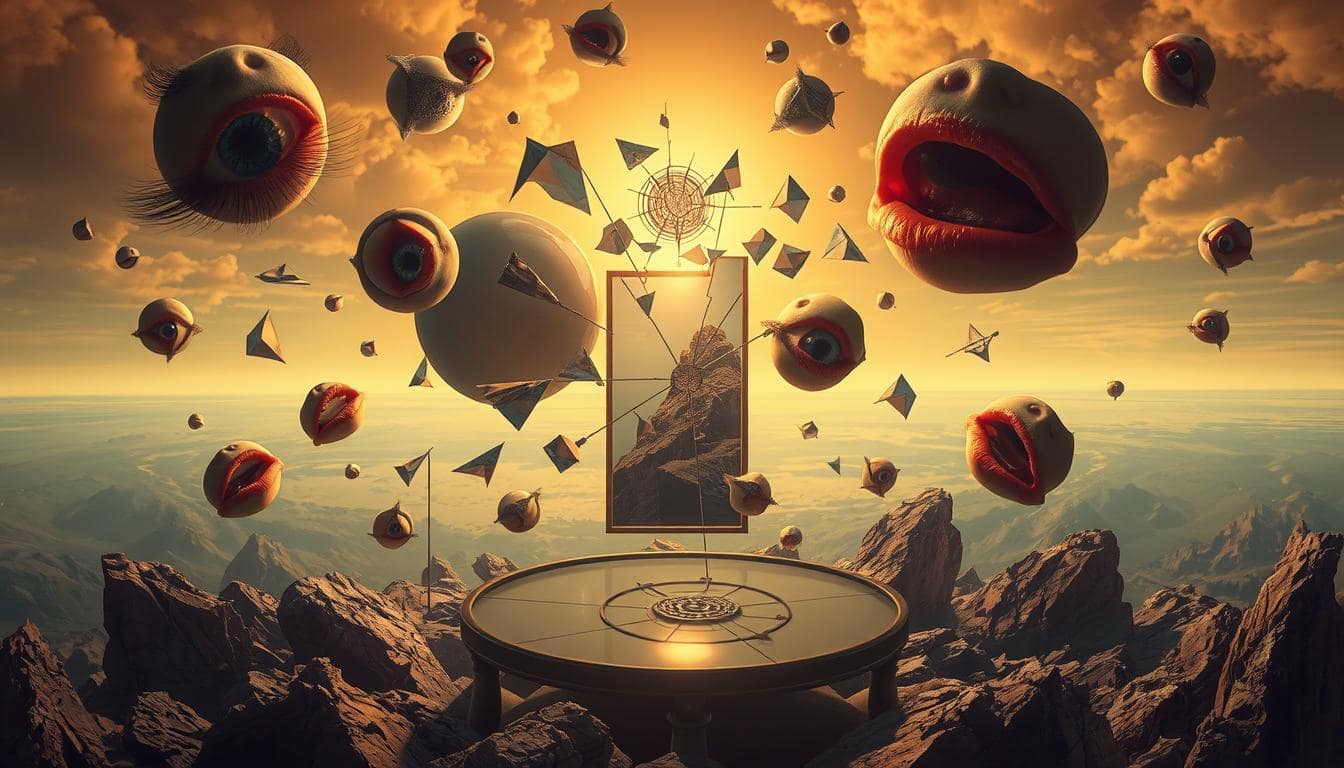
What do Freudian slips, dream journals, and melting clocks share? They’re visual puzzles that challenge our logic. Born from WWI’s chaos, this art movement explored the subconscious, inspired by Freud’s iceberg theory.
Breton’s manifestos were more than just statements. They were blueprints for rebellion, written in the language of dreams.
Imagine Dali sketching his famous melting clocks while Freud looked on. Or Magritte painting a pipe with the label “This is not a pipe.” These artists created psychological traps on canvas.
They turned art into a battle between reason and the absurd. Their works featured dripping clocks and floating hats.
Decoding surrealism isn’t about finding answers. It’s about asking better questions. Why does that lobster telephone feel so familiar? What’s with all the ants?
Freud would have had a lot to say about it. Through automatic writing and absurdity, these artists made art a therapy session for society. Every brushstroke was a whisper, urging us to “Talk about your mother.”
What is Symbolism in Surrealism?
Imagine Freud and Breton arguing over absinthe—what pours out isn’t just drunken theories, but surrealism’s blueprint for visual rebellion. The movement’s obsession with hidden meanings wasn’t about subtlety; it was about weaponizing the subconscious. Artists treated Freud’s Interpretation of Dreams like an IKEA manual for assembling uncanny imagery, where melting clocks weren’t defects but deliberate iconography.
Breton’s 1924 manifesto didn’t just launch a movement—it issued a challenge: “Abandon logic, embrace chaos.” This wasn’t art school pretension. Surrealists developed concrete methods to bypass conscious control:
- Automatism: Ernst’s frottage—rubbing pencil over textured surfaces—turned random patterns into ghostly forests
- Exquisite Corpse: That party game where collaborative drawings created hybrid monsters? Pure surrealist strategy
- Paranoiac-critical: Dalí’s method of seeing double (think: lobster telephones) owed more to Freudian analysis than artistic training
Halsman’s photographs of Dalí mid-leap didn’t just capture gravity defiance—they froze the moment when hidden meanings became visible. A floating chair wasn’t furniture; it was the weightlessness of desire. A cracked egg? Not breakfast, but birth imagery ripped from Freud’s case studies.
| Technique | Pioneer | Hidden Meaning Generator |
|---|---|---|
| Exquisite Corpse | Breton & Friends | Collective unconscious made literal |
| Frottage | Max Ernst | Textures as memory triggers |
| Paranoiac-Critical | Salvador Dalí | Deliberate misinterpretation as truth |
Here’s the twist: surrealist iconography wasn’t about personal symbolism. These artists created a visual Esperanto—a shared language of ants (anxiety), drawers (secrets), and clocks (time’s fluidity). You didn’t need Freud on speed dial to feel unease staring at Magritte’s apple-faced businessman.
Modern viewers often miss the joke. That melting clock? It’s not just about relativity—it’s Breton trolling Descartes: “I melt, therefor I am.” The movement’s genius lay in making hidden meanings feel inevitable, like finding faces in clouds… if clouds critiqued bourgeois norms.
Common Surrealist Symbols and Their Meanings
What do melting clocks, bowler hats, and thorn necklaces have in common? They’re the visual hieroglyphs of surrealism – symbols so charged with hidden meanings they make Rorschach tests look like children’s doodles. Let’s dissect these illogical scenes with the precision of Freud analyzing a dream.
Salvador Dalí’s ants aren’t just picnic crashers – they’re decomposition made glamorous. Crawling across watches in The Persistence of Memory, these insects symbolize time’s corrosive nature. But here’s the twist: Dalí claimed they were inspired by rotting figs. Objective chance surrealism at its finest – finding profound meaning in life’s random snacks.
Magritte’s apples demand their own TED Talk. That floating fruit in The Son of Man? It’s not about healthy eating. The obscured face behind the apple represents the tension between visible reality and concealed truth – a 1920s precursor to modern corporate logos hiding their actual agendas.
| Symbol | Artist | Surface Meaning | Subtext | Technique Used |
|---|---|---|---|---|
| Melting Clocks | Dalí | Time distortion | Relativity of reality | Illogical Juxtaposition |
| Floating Apples | Magritte | Visual paradox | Hidden identities | Objective Chance |
| Thorn Necklace | Kahlo | Physical pain | Colonial oppression | Autobiographical Coding |
| Iron with Spikes | Man Ray | Domestic object | Sexual revolution | Ready-made Absurdity |
| Celestial Bodies | Miró | Cosmic patterns | Subconscious language | Automatic Drawing |
Frida Kahlo turned self-portraits into political manifestos. Her monkeys and deer aren’t cute zoo escapees – they’re Aztec spirit guides critiquing European colonialism. That thorn necklace drawing blood? A hidden meaning cocktail mixing Catholic martyrdom with feminist resistance.
Man Ray’s Gift (the spiked iron) wasn’t just bad housekeeping. This domestic weaponization became the ultimate Dadaist mic drop – proving surrealism could turn illogical scenes into cultural grenades. Miró’s constellations? The original encrypted messages, mapping the subconscious like astrological cheat codes.
These symbols work like dream logic – nonsensical until you crack their personal and collective codes. They challenge us to see beyond literal interpretation surrealism demands, asking not “What is this?” but “What does this do to my understanding of reality?”
Interpreting Surrealist Artwork: Practice and Strategy
Decoding Surrealist art is like playing chess against Dali’s mustache – the rules seem absurd until you realize absurdity is the rulebook. Let’s cut through the lobster-telephone static with three battle-tested tactics used by Surrealist movement insiders:
- Freudian slip ‘n slide: That melting clock? More than a bad wax museum day. It’s mortality anxiety doing the cha-cha with Einstein’s relativity. Eggs aren’t breakfast – they’re cosmic ovaries waiting to hatch new realities.
- Juxtaposition jujitsu: Ernst’s collage novels treat logic like a piñata. A fish wearing a business suit isn’t random – it’s capitalism swimming in circles. Spot these mismatches like a Where’s Waldo? of subconscious rebellion.
- Dream analysis demolition: Buñuel and Dalí’s Un Chien Andalou didn’t just slice eyeballs – they dissected bourgeois morality. Treat bizarre sequences like IKEA instructions for the soul: confusing, but weirdly profound when assembled.
Here’s the kicker: Surrealist symbols work best when you stop making sense. That train bursting from a fireplace? It’s not about locomotives – it’s your repressed childhood memories conducting a jailbreak. The real strategy? Approach each piece like a Rorschach test smoked a joint and started confessing its secrets.
Pro tip: If your interpretation feels as comfortable as a porcupine hug, you’re winning. The “why not?” factor is Surrealism’s secret handshake. Clock melting in the desert? Why not. Ants crawling from a palm? Sure, let’s unpack that childhood trauma. This isn’t art criticism – it’s psychological parkour.
Classroom Applications: Teaching Symbol Decoding
Forget dusty textbooks—your classroom’s about to become a surrealist playground. Here, iconography isn’t just decoded, but discovered through spilled tea and collaborative chaos. Let’s turn those rigid lesson plans into Rorschach tests where every inkblot sparks a debate about subconscious expression.

1. Exquisite Corpse 2.0: Upgrade the classic parlor game with tech twists. Have students text-message surreal phrases to neighbors, then illustrate the Frankensteinian results. You’ll get more Freudian slips than a psychoanalysis convention.
2. Teacup Forensics: Project Meret Oppenheim’s fur-lined cup and ask: “Is this a commentary on domesticity or the ultimate hipster coffee accessory?” Bonus points for students who argue both using visual literacy frameworks.
| Activity | Surrealist Focus | Critical Thinking Angle |
|---|---|---|
| Biomorphic Clay Sculpting | Yves Tanguy’s forms | Interpreting organic vs. mechanical symbolism |
| Lobster Phone Roleplay | Dalí’s communication critique | Analyzing absurdist consumer culture takes |
| Surreal Meme Creation | Modern iconography fusion | Comparing 1930s/2020s symbolic languages |
Here’s the kicker: When students dissect Dalí’s crustacean telephone, they’re not just analyzing surrealist symbols. They’re unpacking 20th-century communication anxieties that make TikTok drama look tame. Try this debate prompt: “If Dalí made AirPods, would they be shaped like melting cochleas?”
Grading Rubric or Reality Show?
Ditch traditional assessments for:
- Surrealist Shark Tank: Pitch symbolic art installations to “investors”
- Automatic Writing Olympics: Speed-interpretation challenges with egg timers
- Rorschach Roast Battles: Defend your inkblot analysis like a comedy club regular
Pro tip: Stock your classroom with thrift store finds—a fur-covered alarm clock or fish-shaped lamp does more for understanding iconography than any slideshow. After all, surrealism wasn’t meant to be studied—it was meant to be lived, preferably with a side of existential confusion.
Case Studies of Symbolism in Major Works
Let’s play art detective with X-ray vision. Surrealist masterpieces aren’t just weird for weirdness’ sake. They’re complex symbolic systems waiting for decoding images like Renaissance-era QR codes. Today, we’ll explore three iconic works that’ll make you rethink reality.
Case 1: Dalí’s Melting Clocks (The Persistence of Memory)
Forget Spanish stereotypes about tardiness. Dalí’s limp clocks visualize relativity theory’s impact. Time melts when you’re having existential crises. The ants crawling on the pocket watch? Nature’s ultimate garbage disposal crew, chewing through human constructs.
Case 2: Magritte’s Eyeball Sky (The False Mirror)
This ocular landscape isn’t just a trippy contact lens ad. The iris-as-clouds motif flips Descartes’ “I think, I am” into “I see, I’m confused.” Magritte asks: Are we observing reality or just staring at our own mental weather reports? Spoiler—it’s both.
Case 3: Ernst’s Avian Hybrid (Woman/Old Man/Flower)
That bird-headed figure isn’t a rejected Dr. Moreau experiment. Ernst’s feathered Frankenstein stitches together his wartime trauma and childhood parrot’s death—a literal hidden meaning taking flight. The flower growing from its neck? Nature’s middle finger to mechanical warfare.
Bonus Cold Case: Kahlo’s Broken Column
While not in our original lineup, Frida’s spine-as-crumbling-monument deserves an honorable mention. Her self-portrait predates modern pain scale charts by decades, using shattered architecture as a metaphor for chronic suffering. Take that, WebMD symptom checkers.
What do these hidden meanings teach us? Surrealist symbolism operates like a dream journal written in disappearing ink. The more you decode, the stranger—and more human—it becomes. Ready to grab your magnifying glass?
Critical Approaches to Symbolism
Imagine Freudian analysts and feminist scholars meeting in a Surrealist bar. It’s like the most exciting art history debate ever. They’re discussing surrealist iconography and why your art professor might have had an opinion.

Freudian diehards believe in dream analysis. But today, critics ask deeper questions. For example, why do 90% of female figures in Dalí’s work look like virgins or spiders? Feminist scholars say this shows the male gaze in surrealist symbol interpretation.
Postmodernists go even further. They see Magritte’s floating apples as early memes. These symbols lose their original meaning. This idea fits well in our TikTok world, where surreal iconography is remixed into memes and AI art.
| Approach | Focus | Key Argument | Modern Parallel |
|---|---|---|---|
| Freudian | Subconscious drives | Melting clocks = time perception anxiety | Dream journal apps |
| Feminist | Gender power dynamics | Objectified female forms reveal misogyny | #MeToo reinterpretations |
| Postmodern | Cultural reproduction | Symbols gain new meanings through repetition | Viral meme culture |
| Eco-critical | Environmental anxiety | Surreal landscapes predict climate collapse | Greta Thunberg protest art |
The table shows different views on surrealist interpretation. It’s not about finding the “right” answers. It’s about asking better questions. When artists mix plastic waste into their work, they’re carrying on Breton’s legacy in our modern world.
Next time you see a lobster phone, think about it. Is it a Freudian joke, a feminist statement, or a warning about DoorDash? The truth is, all these answers could be right. And that’s what the surrealists wanted.
Influence Beyond Surrealism
Surrealism didn’t die; it just evolved. Now, it’s seen in viral memes and Yayoi Kusama’s infinity rooms. This movement’s focus on hidden meanings thrives in our digital world. Let’s explore how surrealist symbols became a key part of internet culture and corporate marketing.
Banksy’s shredded ‘Girl With Balloon’ shocked the art world. It became a commentary on art itself. The act of self-destruction post-auction was a 21st-century twist on Surrealism’s themes.
David Lynch’s coffee ads show surrealist symbols can sell anything. His dreamlike style, seen in Twin Peaks, is now in YouTube ads. Why does a talking log lady selling coffee feel so right?
| Symbol | Surrealist Origin | Modern Adaptation |
|---|---|---|
| Melting Clocks | Dalí’s Persistence of Memory | Elon Musk’s “Twitter time dilation” during acquisitions |
| Floating Eyes | Man Ray’s photographic experiments | Instagram AR filters manipulating perception |
| Infinite Repetition | Kusama’s 1960s mirror rooms | TikTok’s endless scroll mimicking obsessive patterns |
Conspiracy theories now use Surrealism’s style. QAnon’s logic is similar to Dalí’s, but with memes. It’s a mix of art and politics.
Kusama’s dots, once a bold statement, now decorate Target items. But there’s a catch. When we take selfies in her rooms, we’re part of Surrealism’s joke. The real art is in our urge to capture the uncaptureable.
Conclusion
Surrealist symbols have lived on long after their 1920s start. Dalí’s melting clocks now show up in Instagram filters. Magritte’s bowler hats appear in TikTok AR effects.
Our daily online browsing is like Breton’s automatic writing. It’s all about finding meaning in images from our subconscious.
Today’s icons carry surrealism’s mark, like a cool jacket. That weird Gucci ad? It’s inspired by Buñuel. Netflix’s strange title cards are a nod to Tanguy’s art.
Interpreting surrealism isn’t just about art history. It’s a way to survive in our confusing world.
Real power comes from using these symbols wisely. When a Zoom background looks like Dalí’s work, think about what it reveals. Could your LinkedIn profile use some Ernst’s texture?
Your phone is basically running Freud’s ideas by default. You have the power to decode these symbols.
Surrealism’s impact is seen where order meets chaos. Whether it’s Pollock’s art or K-pop MVs, remember: Every piece you create keeps surrealism’s prank alive. The unconscious is always with us, now in group chats.