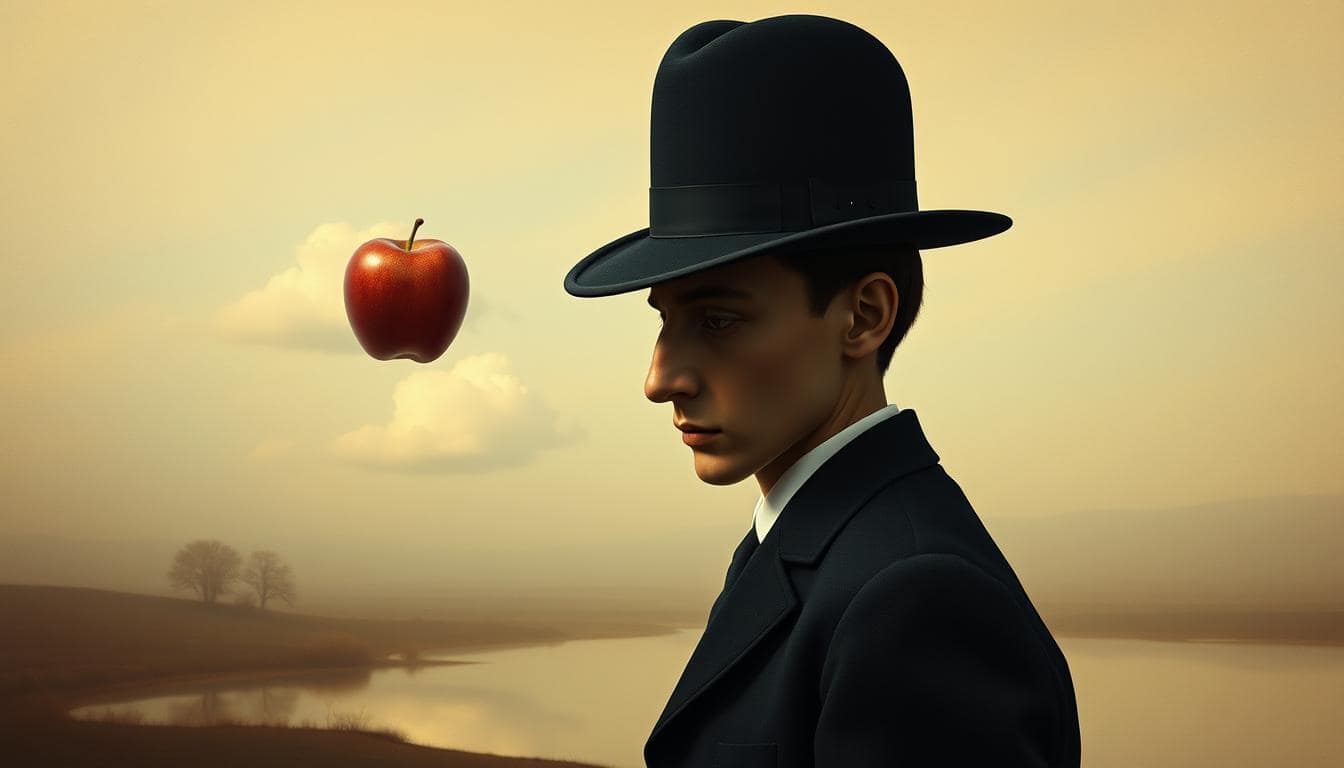
Imagine Marcel Duchamp sipping absinthe at a Brussels café, playing chess with Freud. That’s René Magritte—the stylish enigma who made everyday objects into deep questions. While Salvador Dalí played with time, Magritte used the ordinary to ask a big question: What if reality’s just a cleverly staged prank?
Born in 1898 in Belgium, Magritte’s life was like one of his paintings—seemingly simple. His mother’s tragic death at 13 changed him. He worked as a wallpaper designer, wearing a bowler hat to hide his true self. Yet, he was a mind that would shock André Breton, the leader of Surrealism.
Magritte’s talent was in turning the visual language of capitalism against itself. His 1929 painting, The Treachery of Images (“This is not a pipe”), became a joke about doubt. Critics laughed at first. Now, his works sell for $59.4 million at Christie’s, showing even business folks need to question reality.
So, why do we keep coming back to Magritte? Maybe because his tricks from the 20th century feel like operating instructions for modern life. The man in the bowler hat didn’t just paint dreams—he showed us how to question reality.
Early Belgian Influences
What does a 14-year-old do after finding his mother’s body in a river? For Magritte, it was a wake-up call to question reality. The 1912 death of Régina Magritte, found in the Sambre River, was a turning point. It showed him the difference between what we see and what’s real.
The Academie des Beaux-Arts tried to refine his skills with classical art. But Magritte had other plans. He painted cherubs and landscapes, all the while observing society’s quirks. Brussels, with its strict rules and old streets, was his playground.
Magritte learned from three key sources:
- Metaphysical whiplash: Giorgio de Chirico’s empty spaces taught him to use architecture to unsettle
- Trauma as toolkit: The river scene was his guide to uncovering hidden truths
- Pragmatic surrealism: Unlike Dalí, Magritte focused on the everyday, like apples with teeth
Paul Delvaux’s dreamy train stations were a big influence on Magritte. But while Delvaux hinted at mysteries, Magritte was upfront with his humor. Brussels, to him, was a place where nothing was as it seemed.
Magritte’s talent was in tapping into Belgium’s hidden energy. Growing up with such a traumatic event, he could have become many things. But he chose to paint, challenging our views of reality.
Magritte’s Paris Years & Surrealist Entry
Imagine a Brussels insurance salesman arriving in 1927 Paris, wearing his signature bowler hat. This was more than just a move; it was Magritte’s Gatsby moment. He traded Belgian rain for Surrealist champagne. Instead of jazz-age parties, he found André Breton’s intellectual salons.
Breton’s Court & the Outsider Artist
The Surrealist group history is like a philosophical fight club. Breton was its temperamental referee. Magritte’s early work The Lost Jockey got a shrug from Breton. It was seen as too “illustrational.”
But their clash was more than about looks. It was a battle of alpha minds. Breton was all about Freud, while Magritte focused on visual language.
Let’s look at their creative styles:
| Magritte | Dalí | Breton’s Verdict |
|---|---|---|
| Businessman’s attire | Flamenco dancer mustache | “Fashionably absurd” |
| Hyper-realistic apples | Melting clocks | “Too literal vs. properly dreamlike” |
| Word-paintings | Lobster telephones | “Philosophical vs. commercially viable” |
Magritte was inspired by Miró’s blob-like creatures. He doubled down on realism. While others explored subconscious art, Magritte painted precise images of bureaucrats. It was a visual Wittgenstein logic.
Their split was about defining reality. Breton wanted dreams; Magritte wanted waking nightmares. The Paris years were a 3-act play. Magritte arrived, impressed the crowd, then left to create his own rules. The curtain fell, and corporate surrealism was born.
Defining Visual Language & Techniques
Magritte was a secret weapon in advertising, using his graphic design skills to sneak in surrealism. Unlike Salvador Dalí, who added clocks to his art, Magritte used clear designs to hide deep questions. He made subversive clarity his game, blending commercial art with existential mysteries.
The Illusion of Reality
In the 1930s, Magritte designed billboards for Belgian fabric mills. These jobs were training for his visual tricks. He could grab your attention in seconds and then challenge reality.
Take “The Treachery of Images” for example. The pipe looks like a logo, but the French text says it’s not. It’s like a viral tweet revealing a deepfake.
Magritte’s art was not just for galleries. It was like clickbait. He’d say, “If you dream of a pipe, it’s not a pipe either.” Today’s marketers can learn from his ability to share big ideas in simple images.
Trompe-l’œil with a Twist
Magritte’s trompe-l’œil was different from traditional ones. He tricked the mind, not just the eye. He hid surprises in his art, like a train coming out of a fireplace.
- A train erupts from a fireplace (The Unexpected Answer, 1933)
- Street lamps pierce both day and night skies (The Empire of Light series)
- An apple floats before a man’s face, both hiding and revealing (The Son of Man, 1964)
Unlike Kay Sage, who created eerie voids, Magritte’s art seemed normal. His tricks worked because they used familiar images in unexpected ways. It was like turning a Times Square billboard into a Zen koan.
Key Themes: Clouds, Curtain, Bowler Hat

If René Magritte’s bowler hat could talk, it would share dry jokes about suburban life. It would also smoke a pipe. This iconic accessory, seen in over 50 paintings, was more than just a hat. It was a statement against the 20th-century middle class, shown in the everyday setting of a department store.
The Bourgeois Surreal
Magritte made the bowler hat a symbol of middle-class life. He painted it on men floating in the sky, looking like corporate workers on break. His “Sunlit Surrealism” period during WWII brought a new light to his work. Imagine Edward Hopper directing a Salvador Dalí script for Life Magazine.
Here, Freud’s Uncanny theory meets Belgian surrealism. Familiar objects become strange through precise details, like a dentist polishing your nightmares.
Headless Men and Apple Faces
The artist’s floating apples and faceless businessmen created a new way of seeing. His green fruit and anonymous suits (1946’s The Son of Man prototype) mixed temptation with advertising. It’s like Snow White’s poison apple, but for corporate branding.
Compare this to Meret Oppenheim’s fur-lined teacups. While she made domesticity wild, Magritte made office wear eerie.
Through these illusions, Magritte didn’t just paint dreams. He captured the anxiety of modern life. His bowler-hatted everyman is both self-portrait and cultural mirror. He reflects society’s search for meaning in a world of mass production. The true surrealism? These 1930s visual puzzles now fit perfectly on our smartphone screens.
Major Works Decoded
Magritte’s paintings are more than art; they’re puzzles in fancy clothes. Let’s look at two famous works that changed culture. They show why a $29M sale in 2023 proves Magritte was smarter than critics and crypto fans.
The Treachery of Images (1929)
That pipe isn’t a real pipe. Magritte’s 1929 masterpiece, “Ceci n’est pas une pipe”, was a viral joke. It’s like a 20th-century meme, questioning what’s real.
Dalí might have dripped clocks, but Magritte used irony 90 years before Twitter. Recent Magritte analysis shows his work was against NFTs. It spread widely, unlike NFTs’ limited copies. The original sold for $1.1M in 1998; now it’s worth $29M, showing reality is up for grabs.
The Son of Man (1964)
Art history’s greatest self-portrait is overshadowed by a floating apple. Magritte said he painted the hidden in plain sight. His self-portrait, with a bowler hat, became as iconic as Warhol’s soup cans.
| Artist | Iconic Motif | 2023 Auction Peak | Cultural Permanence |
|---|---|---|---|
| Dalí | Melting Clocks | $21.4M | Meme fodder |
| Magritte | Bowler Hats | $29M | Philosophical shorthand |
MoMA’s 1965 show made Magritte famous. He then painted more apples. Today, tech moguls could learn from Magritte: true fame is being talked about, not seen. Even Meta’s VR avatars owe a debt to Magritte’s apple.
Philosophical Writings
Imagine Descartes with a pipe and a bowler hat instead of a robe. Magritte’s writings are like fun puzzles for the mind. They mix humor with deep questions, making us see the world in a new light.
While Breton shouted for change, Magritte quietly asked us to look closer at everyday things. His idea of a “hidden reality” is about finding the strange in our daily lives.

Words Against Images
Magritte used words as a powerful tool. His famous phrase, “Ceci n’est pas une pipe”, challenges our trust in what we see. It’s like a warning from before the internet era.
His paintings with captions, like “This is cheese,” under a shoe, seem even more relevant today. With Instagram and AI, we’re constantly questioning what’s real.
Here’s a list of thinkers who made us think twice about what we see:
| Thinker | Medium | Core Question | Cultural Legacy |
|---|---|---|---|
| René Magritte | Paint/Text | “Is representation treason?” | Meme culture, Instagram reality |
| André Breton | Manifestos | “Can dreams overthrow empires?” | 1960s counterculture |
| Ludwig Wittgenstein | Texts | “What can be said clearly?” | Analytic philosophy |
Magritte’s work is memorable because it’s both fun and deep. His simple, everyday scenes invite us to ponder big questions. Unlike Wittgenstein, who analyzed language, Magritte used humor to challenge our views.
Today, his ideas are everywhere. From TikTok to corporate training, Magritte’s legacy lives on. His ability to make us question reality is timeless.
Influence on Later Art/Media
Magritte’s bowler-hatted figure didn’t just haunt galleries. It invaded our collective subconscious, like a viral meme before the internet. His surrealist legacy became the ultimate cultural skeleton key, unlocking everything from rock album aesthetics to Silicon Valley’s logos. If Warhol turned soup cans into art, Magritte turned art into a language for questioning reality itself.
From Album Covers to AI Art
The bowler hat’s pop culture migration is like a spy thriller. After its 1965 MoMA debut, it appeared on Pink Floyd’s Animals cover as a floating pig accessory. It also inspired debates about Apple’s “bitten fruit = Eden reference” conspiracy theories. Even Banksy’s shredded Girl With Balloon owes Magritte royalties—both turn art into philosophical pranks that outlive their physical forms.
But the surrealist legacy isn’t just for men. Dorothea Tanning’s domestic nightmares and Remedios Varo’s occult laboratories expanded Magritte’s paradoxes through feminist lenses. Their work asks: What if the uncanny wasn’t just about men in suits, but about women rewriting reality’s rulebook?
Now, AI is the ultimate Magritte disciple. Tools like DALL-E generate endless “this is not a pipe” variations. From hyperrealistic teapots with dragon wings to CEO portraits where the eyes are tiny stock market tickers. It’s as if Magritte coded his DNA into the algorithm: “Make them question everything, and charge them subscription fees for the privilege.”
David Lynch’s coffee ads feel like Magritte storyboards. Even TikTok’s “is this cake?” trend follows his playbook. It’s about mundane objects masquerading as something else, served with a side of existential dread. The man in the bowler hat might’ve hated commercial art, but his ghost sure knows how to trend.
Conclusion
René Magritte’s life was like a surrealist dream come true. He turned simple ideas into big questions. His art’s value skyrocketed in 2023, showing how much we value his work.
Magritte’s art is everywhere today. Think of that generic CEO photo with an apple over his face. Or the Microsoft Teams background that looks like his 1928 sky. He showed us that reality is just a clever trick.
Magritte’s biggest trick was making money want to question itself. Today, AI art and marketing teams use his ideas. So, when your Zoom call freezes, ask yourself: Is it a glitch, or Magritte’s magic at work?