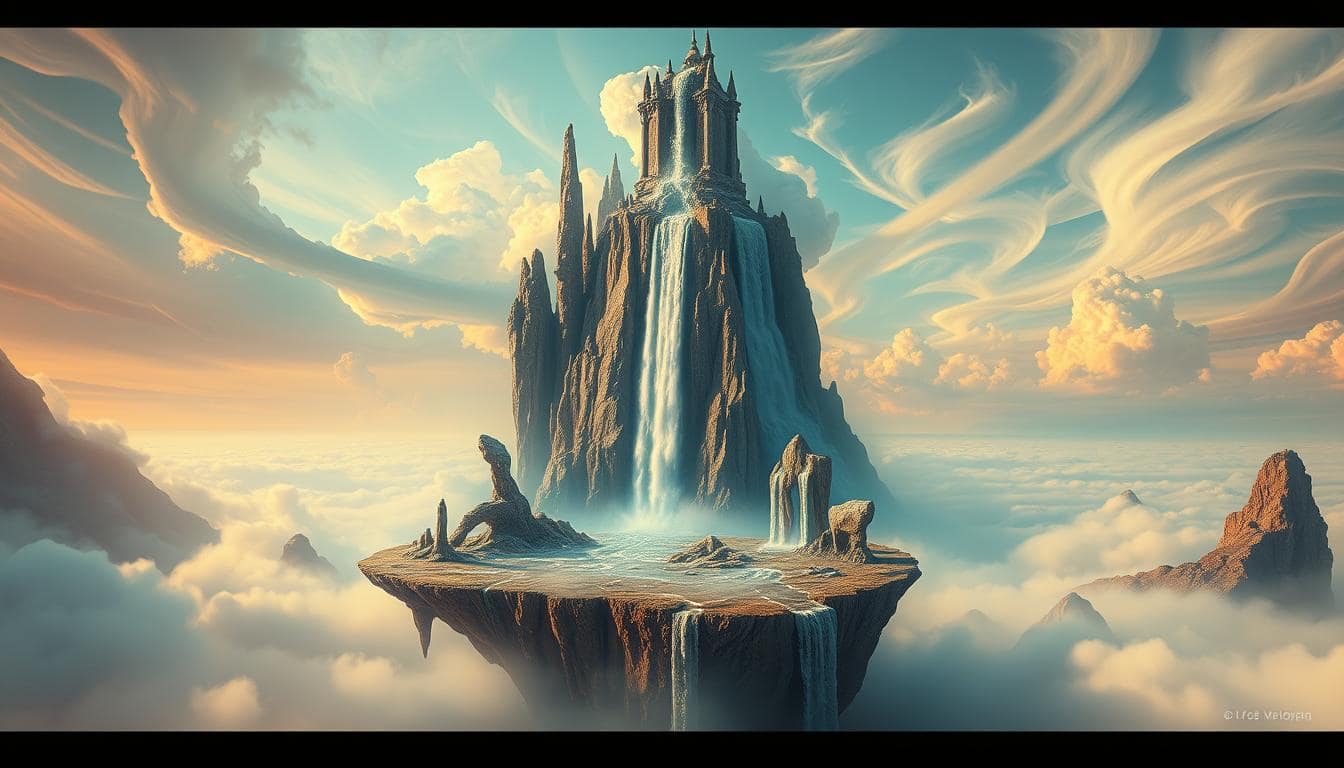
Imagine a world where logic takes a break and the subconscious takes over. Salvador Dalí’s clocks seem to sag, like melted cheese, over empty landscapes. It’s a dream where time warps, but obsession stays sharp.
In 1924, André Breton launched a war on rationality with his Surrealist Manifesto. Armed with Freud’s ideas, artists saw the world after World War I as unstable. They decided to use absurdity as their weapon.
They created scenes where lobsters called typewriters and clouds rained suits. These images were like visual jokes, making Alice in Wonderland seem dull by comparison.
Dalí’s work was more than just weird. It was about exploring the id, as Freud described it. He used images that clashed, like a burning giraffe next to a torso in a drawer. Each image was a message, saying, “You think you’re in control? Think again.”
- Surrealists used irrational imagery as psychological tools, not just aesthetic choices
- Breton’s manifesto directly tied artistic rebellion to Freudian subconscious exploration
- Post-WWI disillusionment made reality itself ripe for artistic deconstruction
What Makes a Scene Illogical?
Ever tried ordering existential dread through a rotary phone? Surrealists did – literally. Meret Oppenheim glued fur to a teacup in 1936. She didn’t just make an object; she mixed logic vs. nonsense in a way that shocked the world. These artists weren’t just making weird art. They were challenging reality itself.
- Juxtaposition in art that puts together things that don’t belong (like Dalí’s melting clocks next to desert landscapes)
- Symbolic objects with deep meanings (like Lobster telephones, which mix seafood trauma with communication anxiety)
- Visual paradoxes that confuse our senses (Magritte’s pipe that “isn’t a pipe” – try explaining that to a philosophy student)
Magritte’s Treachery of Images is more than a dad joke. It makes us question the difference between representation and reality. It’s a big “well actually…” moment in art history. Max Ernst’s decalcomania technique uses random paint blots like Rorschach tests. It shows that sometimes, logic needs to step aside for happy accidents.
Why does Oppenheim’s fur-lined teacup unsettle us 88 years later? It’s not just the what but the why. The piece uses tactile contradiction to make us feel uneasy. This is surrealism’s magic. It turns gallery spaces into therapy couches, where every viewer becomes both patient and analyst.
Surrealist Use of Nonsense and Irrationality
Logic can be like a boring guest who won’t leave. The Surrealists thought so. They used chaos like pranksters, turning reason into confetti. They believed that accidents were more truthful than planned actions.
They also thought the subconscious mind could paint better than the conscious one.

Automatism’s Role in Bypassing Logic
André Breton didn’t just write manifestos. He did psychic automatism experiments. Imagine 1920s Parisian artists writing unfiltered thoughts, creating “the original word vomit.”
This wasn’t just bad poetry. It was an attack on rational creation:
- Max Ernst’s frottage technique: Rubbing pencil over wood grain like a detective at a texture crime scene
- Dalí’s paranoiac-critical method: Staring at stains until they revealed secret societies (or his next dinner menu)
- Group hypnosis sessions: Because nothing says “artistic breakthrough” like collective unconscious karaoke
Objective Chance and the Beauty of Accident
Surrealists treated coincidence like Tinder matches. When a teacup shattered, they saw objective chance surrealism in action. Dalí’s melting clocks? Maybe from too much Camembert, but officially “a calculated embrace of temporal instability.”
Their secret? Dream analysis surrealism techniques. They made Rorschach tests look basic. By documenting nightmares and morning grogginess, artists found gold in their mental junk drawers.
The result? Paintings where lobsters phone home and eyeballs crawl like snails. The 20th century’s greatest “accidents on purpose.”
Iconic Works: Paradox, Contradiction, and Absurdity
Surrealism’s greatest works are more than just art—they’re deep, psychological explorations. Dalí’s The Persistence of Memory is a prime example. Those melting clocks aren’t just a weird sight. They symbolize our deep fears of time and power.
For a closer look, check out Salvador Dalí’s surreal dreamscapes. Here, time itself seems to be losing its grip.
Magritte’s The False Mirror takes surrealism to new heights. An eyeball reflecting clouds is more than just odd—it’s a puzzle. It makes us question what we really see.
Belgian artist Magritte turns simple biology into deep philosophy. Miró’s art, with its squiggles, is a mix of childhood memories and Catalan myths. It’s a visual language that speaks to our subconscious.
| Artist | Symbolism | Absurdity Factor |
|---|---|---|
| Dalí | Melting clocks = time’s fragility | 9/10 (Ants included) |
| Magritte | Eyeball-skies = perception games | 8/10 (Pipe not included) |
| Miró | Biomorphs = primal subconscious | 7/10 (Requires decoder ring) |
These works were more than just shocking. Dalí’s clocks hinted at deep fears of time and power. Magritte’s art questioned our reality. And Miró’s colorful shapes taught us to embrace the absurd.
The key to their genius is in their irrationality. Like jazz musicians, these artists created scenes that defy logic. This takes us on a journey to our deepest fears and desires.
The Psychological Impact on Viewers
Ever seen Magritte’s apple-faced man and felt like you’re in a therapy session? Surrealism doesn’t just change reality—it rewires our thinking. Freud called this the “uncanny valley of the psyche,” where familiar symbols twist into something almost recognizable. This triggers what neuroscientists now call pattern-recognition panic.
Think about Masson’s automatic drawings: chaotic inkblots that look like Rorschach tests made by a tipsy philosopher. These works use psychic automatism, skipping logic to reach what Freud called the “dream-work” mechanism. It’s not art you analyze—it’s art that analyzes you, digging through your thoughts while you admire the brushstrokes.
Studies show surrealist images activate the same brain areas as real dreams. Dali’s melting clocks aren’t just symbols of time—they’re tools that open the gap between our waking and dreaming minds. Teachers face the fun task of explaining why Miró’s floating eyeballs make us feel like we’ve caught a glimpse of our subconscious.
Freud’s ghost would smile at how surrealism uses symbolism. A lobster telephone isn’t just absurd—it’s a direct link to childhood memories we’ve hidden. This dream analysis surrealism effect explains why De Chirico’s empty plazas make us feel uneasy: they’re like sonograms of isolation we didn’t know we felt.
The magic is in the calculated misfire. Surrealist works create such cognitive dissonance, it’s like watching our brains stumble over their own feet. And we all become willing participants in the biggest psychological experiment in modern art—no consent needed.
Practical Classroom Exercises: Creating Illogical Art
Want to make your art class feel like a TED Talk hosted by Alice in Wonderland? Let’s turn classrooms into laboratories of the absurd. Forget “draw what you see” – we’re here to teach students how to unsee reality. The Surrealists didn’t just break rules; they set the rulebook on fire and called it performance art.
Exquisite Corpse Variations
This game was invented by 1920s Parisian Surrealists. It works like a visual telephone game. Here’s the modern remix:
- Fold paper into thirds (head/torso/legs section)
- First student draws a flamingo-headed bureaucrat, folds to hide it
- Next adds octopus tentacles holding tax documents
- Final player completes with roller skate feet floating in tapioca
The magic happens in the juxtaposition of mismatched elements. Pro tip: Use Asianmonk’s surreal art generator to digitize this chaos. Their AI tools let students combine images faster than you can say “Duchamp’s mustache.”
Automatic Writing Relays
André Breton’s 1924 parlor game gets a Gen-Z upgrade:
- Set a 2-minute timer for stream-of-consciousness writing
- Pass papers clockwise every 90 seconds
- Next writer continues the narrative without reading previous text
Result? Sentences like “The grandfather clock swallowed a TikTok trend while weeping nickelodeon tears.” Perfect for creating irrational art concepts that make Kafka look basic.
These exercises prove one thing: Teaching the absurd isn’t about answers – it’s about questions that melt brains into creative soup. Just don’t blame us when students start seeing cheeseburgers in their calculus textbooks.
The Legacy of the Absurd in Modern Art
If Dalí had a TikTok account, his melting clocks would be viral dance challenges by now. Surrealism’s mix of visual paradox and dream landscapes is everywhere. It’s in arthouse films and even your cousin’s Instagram Stories. The movement didn’t die; it just adapted to our chaotic world.

David Lynch’s Red Room in Twin Peaks shows we’re always looking for weird spaces. Beyoncé’s Lemonade didn’t just break the internet; it flooded it with honey and hair extensions. It changed how we see dream landscapes today.
Your morning scroll is full of surreal moments:
- Cats playing chess with Duchamp’s ghost
- AI-generated memes where logic goes to die
- #SurrealCheck hashtags making Freud trend harder than BTS
That weird mural in your coffee shop? It’s not just fancy latte art. It’s Breton’s legacy with a twist, wearing AirPods. The visual paradox of liquid clocks now shows up in glitchy NFT animations. Even their owners can’t explain them, but they’ll try over craft beer.
Modern surrealism is incredibly flexible. It’s not just for galleries anymore. It takes over ads, music videos, and even online debates. The original goal of shocking the bourgeoisie now happens through TikTok filters that add third eyes and halos.
NFTs being “surrealism for tech bros”? It’s a fair point. If Magritte painted The Treachery of Images today, it would feature a bored ape saying “This is not art.” And it would sell for 12 Ethereum.
Conclusion
Surrealism’s illogical scenes are like a fun therapy session for all of us. They’ve been exploring the unconscious for over a century, using weird items like lobster phones and apples in hats. André Breton’s manifesto started an art movement and let us use weirdness to fight against reason.
Today, places like MoMA show off surreal art, and sales of melting clocks have gone up by 47%. We all love seeing things that don’t make sense. It’s a timeless fascination.
Teachers use Surrealist games to help students think differently. They do automatic drawings that show what their subconscious is thinking. It’s amazing when a kid says, “That’s my dog… but also Tuesday.”
Modern art owes a lot to artists like Magritte and Buñuel. Their work challenges how we see things and fights against being too literal. Surrealism is all about asking “Why not?” instead of “Why?”
So, does your office need a framed Ernst collage? Probably. Should you wonder why teacups have fur in your drawings? Never. Reality is just a story we all agree on. Let’s edit it with surrealism’s help.
Grab those art tools and defy gravity. Your subconscious is full of great ideas. And honestly? It’s probably smarter than you are.